

- HR software earns back its cost when it cuts payroll errors, compliance penalties, slow hiring, and the manual hours HR teams spend on repetitive admin work.
- The real ROI rarely shows up as one number. It shows lower compliance risk, faster hiring, better retention, and cleaner reporting outcomes that are easier to feel on a P&L than to spot on a spreadsheet.
Most growing businesses in India reach a point where HR runs on a patchwork of spreadsheets, WhatsApp approvals, and a payroll file someone reconciles by hand every month. It works until it doesn’t work. A missed PF deadline, a wrong TDS calculation, or an offer letter that goes out three weeks late can cost far more than the price of a subscription.
The ROI of HR software is not just about saving HR’s time. It touches payroll accuracy, statutory compliance, hiring speed, employee retention, and how confident leadership can plan around workforce cost. For IT and service businesses in India, where headcount is the biggest line item on the balance sheet, getting this calculation right matters more than for most industries.
This guide breaks down what HR software ROI actually means, where it typically shows up, how to calculate it with a simple formula, and what to look for before you sign a contract.
HR Software ROI in India: At a Glance
Before the details, here is a quick, honest comparison of how core HR costs typically behave with a manual process versus a connected HR platform.
| Cost Area | Manual / Spreadsheet Approach | With HR Software |
| Payroll processing | Hours of manual calculation and reconciliation every cycle, with higher risk of error | Automated calculations, fewer manual touchpoints, faster close |
| Compliance | Deadlines tracked manually across PF, ESI, TDS, and professional tax | Centralized tracking and reminders reduce the chance of a missed filing |
| Recruitment | Resumes and candidate status spread across email, sheets, and messaging apps | Structured pipeline with visibility into where each candidate stands |
| Attendance & leave | Manual leave registers and approvals over email or chat | Self service requests, approvals, and realtime balances |
| Reporting | Data pulled and reconciled from multiple files before a review | Live dashboards for headcount, cost, and utilization |
| Employee records | Documents and history scattered across drives and folders | A single employee record accessible to the right people |
Quick takeaway: HR software rarely reduces cost in one dramatic line item. It reduces the accumulation of small, recurring costs a few hours here, a compliance risk there that is easy to underestimate individually but add significantly over a year.
What is HR Software ROI?
HR software ROI is the measurable value a business gains from an HR platform relative to what it costs to buy, implement, and run. It is usually expressed as a ratio or percentage, comparing the money and time saved (or the risk avoided) against the total cost of the software over a given period.
Unlike ROI on a marketing campaign or a piece of machinery, HR software ROI blends hard savings (fewer payroll errors, lower compliance penalties) with soft but real gains (faster hiring, better retention, less HR burnout). Both matter, and a fair ROI assessment should account for each.
How ROI is typically measured for HR software
- Time saved: hours of HR, finance, and managers no longer spend on manual data entry, approvals, and reconciliation.
- Cost avoided: fewer payroll errors, late filing penalties, and duplicate tool subscriptions.
- Revenue protected: faster hiring and better resource visibility that keep billable teams staffed and delivered.
- Risk reduced: fewer compliance gaps and better audit readiness across statutory records.
A simple illustration
Consider an IT services company with 120 employees that currently run payroll and attendance manually. If two HR executives each spend roughly six hours a week on payroll reconciliation, leave tracking, and compliance follow-ups, that is close to 600 hours a year of HR capacity tied up in repetitive work time that could otherwise go into hiring, engagement, or performance management. This is illustrative, not a benchmark; the actual number depends on team size, process maturity, and how many systems are already in use.
Why the ROI of HR Software Matters for Indian Businesses
India’s HR and payroll environment is compliance heavy and detail sensitive. That is exactly what makes manual HR expensive in ways that are easy to overlook until something goes wrong.
The hidden cost of manual HR processes
Spreadsheets do not scale gracefully. As headcount grows, so does the time needed to update salary structures, reconcile attendance, chase approvals, and prepare monthly payroll. This is rarely visible as a single cost, because it is absorbed as “just part of the job” by HR, finance, and even people managers who spend time on administrative follow-ups instead of their core responsibilities.
The cost of compliance errors
India’s payroll compliance requirements span PF, ESI, professional tax, and TDS, each with its own deadlines and calculation rules. A guide to statutory compliance in payroll shows how many moving parts a single payroll cycle involves. A missed filing or a miscalculated deduction can lead to interest, penalties, and time consuming corrections, none of which show up as a line item until an audit or a labor authority notice arrives.
The cost of slow, unstructured hiring
When candidate information lives across inboxes and spreadsheets, hiring slows down and good candidates drop out of the process. An applicant tracking system and a structured approach to recruitment management both address this directly. For IT and service businesses, a delayed hire often means a delayed project start or a team stretched thin on delivery.
The cost of losing employees
Replacing an employee is expensive recruitment cost, onboarding time, ramp up period, and lost institutional knowledge all add up. Weak visibility into engagement and performance management makes it harder to spot disengagement early, which increases the chance that a preventable exit becomes a surprise resignation.
Where HR Software Typically Delivers ROI
ROI does not come from one feature. It accumulates across several connected areas of HR and business operations.
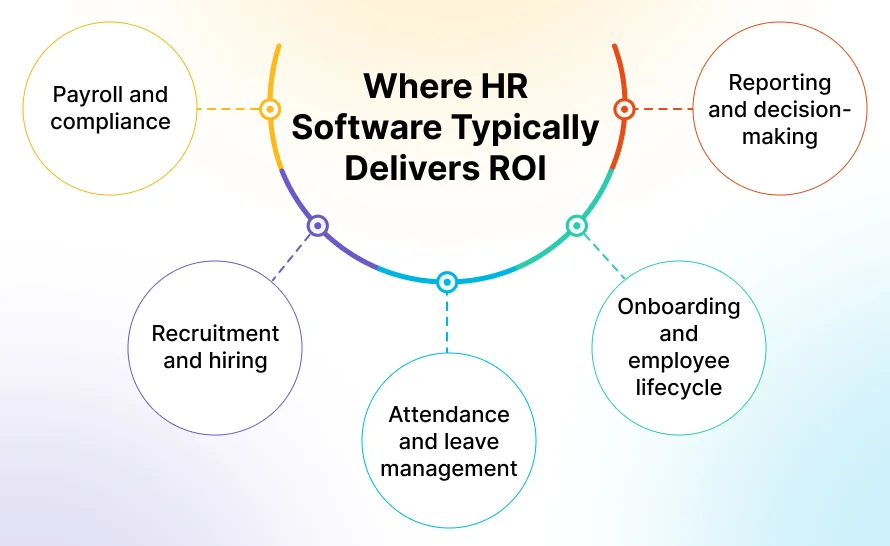
Payroll and compliance
Automated payroll management reduces manual calculation errors and speeds up monthly processing. Built in tracking for statutory deductions and rules, such as overtime calculation also lowering the risk of disputes and compliance gaps.
Recruitment and hiring
A structured pipeline shortens time to hire, reduces the coordination overhead between recruiters and hiring managers, and gives leadership visibility into hiring bottlenecks before they delay a project.
Attendance and leave management
Self service requests and automated approvals cut down on the manual follow up that leave management otherwise demands, while keeping leave balances accurate for payroll.
Onboarding and employee lifecycle
A structured onboarding process gets new hires productive faster and reduces early attrition caused by a disorganized first few weeks. Tracking the full employee journey also makes offboarding cleaner and better documented.
Reporting and decision making
When headcount, cost, attendance, and performance data live in one system, leadership can make faster, better-informed decisions about hiring plans, budget, and resourcing, instead of waiting for someone to compile numbers from five different files.
How to Calculate the ROI of HR Software
A simple, workable formula for HR software ROI is:
ROI (%) = [(Value Gained − Cost of Software) ÷ Cost of Software] × 100
“Value gained” should include both hard savings and reasonably estimated soft gains:
- Hours saved × the average cost of that time (HR, finance, or manager hours).
- Reduced errors and penalties avoided on payroll and compliance.
- Faster hiring translated into reduced vacancy time on billable or critical roles.
- Lower attrition where better engagement and process visibility contribute to retention.
A sample ROI calculation (illustrative)
The figures below are illustrative only, to show the method not a benchmark or promised outcome for any business.
| Item | Estimated Annual Value |
| HR hours saved on payroll and attendance admin | ~500 hours redirected to hiring and engagement |
| Payroll errors and latefiling risk reduced | Fewer corrections and reduced penalty exposure |
| Faster hiring on 1015 roles a year | Reduced vacancy days on billable positions |
| Annual cost of HR software | Recurring subscription and implementation cost |
| Resulting ROI | Positive when time and risk savings exceed the software cost |
Even without exact rupee figures, this exercise is useful: it forces a business to name what it is currently spending on manual HR work, which is often the first time that cost becomes visible at all.
Signs Your Business Is Losing Money to Manual HR
Not every business needs to make this decision urgently. But a few patterns are reliable signals that manual HR has started costing more than software would.
- Payroll takes days, not hours: if closing a payroll cycle regularly stretches across several days of back-and-forth, the process has outgrown spreadsheets.
- Compliance deadlines are tracked from memory: PF, ESI, TDS, and professional tax deadlines living in someone’s head, or a personal calendar is a risk, not a system.
- Hiring managers chase HR for candidate updates: this usually means candidate data is not visible enough for managers to check status themselves.
- Leave balances are frequently disputed: manual leave registers are a common source of payroll disputes and rework.
- Leadership asks for headcount or cost reports HR cannot produce quickly: if a simple “how many people do we have on Project X” question takes a day to answer, reporting is a bottleneck.
Factors That Influence HR Software ROI in India
HR software ROI in India depends on factors such as company size, workforce complexity, industry compliance requirements, feature fit, implementation, and employee adoption. Understanding these factors helps businesses choose the right HR technology and maximize measurable returns.
Company size and workforce complexity
A 20person company and a 500person company get ROI from different places. Smaller teams often see the biggest gains in time saved on payroll and compliance; larger organizations see more value in reporting, workforce planning, and reducing coordination overhead across departments.
Industry and compliance exposure
IT and service businesses that manage interns, contractors, and fulltime employees side by side face more classification and compliance complexity than a single category workforce. The more compliance surface area a business has, the more ROI it typically gets from automated tracking and reminders.
Feature fit versus feature bloat
Paying modules a team never uses reduces ROI just as much as being under equipped. The right platform matches the business’s actual workflows recruitment, payroll, attendance, performance rather than bundling in unrelated functionality that adds cost without adding value.
Implementation and adoption
Software that HR loves, but employees avoid delivering a fraction of its potential ROI. Ease of use, mobile access, and a manageable rollout plan directly affect how much of the projected time savings materializes.
What to Look for in HR Software to Maximize ROI
The right choice depends on how complex the business’s HR needs already are, and how connected HR needs to be with the rest of operations.
Choose a compliance first platform when
- The business manages PF, ESI, professional tax, and TDS across a growing headcount.
- Interns, apprentices, contractors, and full-time employees are managed together.
- Past payroll errors or missed deadlines have already created cost or risk.
Choose an all-in-one platform when
- HR data needs to connect with recruitment, projects, and finance, not sit in isolation.
- Leadership wants a single source of truth for headcount, cost, and utilization.
- The business is tired of reconciling data across multiple disconnected tools.
Choose a lighter, point solution when
- The team is very small and only needs one function, such as a basic payroll.
- There is no near-term plan to scale headcount or add recruitment and project workflows.

Common Mistakes That Reduce HR Software ROI
- Buying features instead of workflows: a long feature list means little if it doesn’t match how the team works.
- Skipping change management: low adoption by employees and managers quietly erodes the time savings the software was meant to deliver.
- Treating HR software as HR only: the biggest ROI often comes from connecting HR data with finance, projects, and sales, not keeping it siloed.
- Ignoring data migration quality: incomplete or messy historical data undermines reporting accuracy from day one.
- Not tracking outcomes: without a baseline for time spent, errors made, or hiring speed before implementation, it becomes hard to prove ROI after.
Pros and Cons of Investing in HR Software
| Advantages | Limitations |
| Reduces manual hours spent on payroll, attendance, and admin | Requires upfront implementation time and change management |
| Lowers the risk of compliance errors and missed deadlines | Value depends heavily on adoption across HR, managers, and employees |
| Improves hiring speed and candidate experience | Choosing the wrong feature set can add cost without matching value |
| Gives leadership realtime visibility into workforce cost | Migrating historical data can take time to do accurately |
HR Software ROI: The Cost Perspective
For founders and finance leaders, the comparison is not simply “software cost versus zero cost.” Manual HR is not free; it is a recurring, largely invisible cost paid in staff hours, error correction, and slower hiring.
HR software is typically a predictable, budgeted recurring cost. Manual HR is a variable cost that tends to grow faster than headcount, because coordination overhead increases nonlinearly as more people, approvals, and exceptions enter the process.
For an early stage or fast-growing IT company, the practical question is less “can we afford HR software” and more “how much longer can we afford to run HR manually as the team keeps growing.” A team of 15 can usually absorb manual HR without much strain. A team of 150, split across projects, clients, and possibly locations, generally cannot, without either adding HR headcount or adding software.
How HR Teams Can Maximize ROI From HR Software
- Map current HR workflows before choosing a platform, so the tool fits the process rather than forcing a new one.
- Set a baseline for time spent, error rates, and hiring speed before going live, to measure improvement afterward.
- Roll out in phases of payroll and attendance first; recruitment and performance next rather than everything at once.
- Train managers and employees, not just the HR team, since adoption outside HR drives most of the time savings.
- Review reports regularly instead of generating audits or leadership requests.
- Revisit the feature set periodically to avoid paying for modules that go unused.
How CollabCRM Helps Maximize the ROI of HR Software
CollabCRM is a business operating system built for IT and service companies, connecting people management, recruitment, payroll, projects, invoicing, and reporting on one platform, rather than spreading HR data across separate, disconnected tools.
That connection is where a large part of the ROI shows up. When a lead turns into a deal, the deal into a project, the project into a delivery team, and delivery into an invoice, HR data who is available, who is billable, and what a project is costing in people stays linked to the rest of the business instead of living in a separate silo.
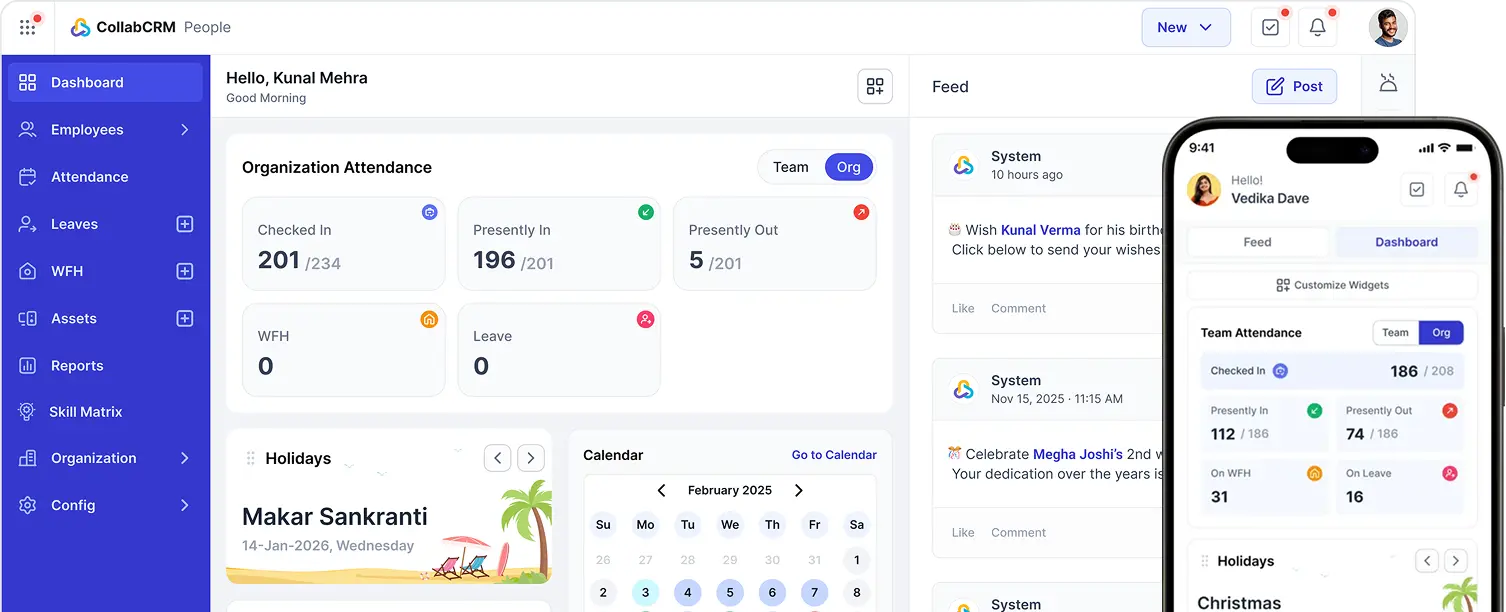
For HR specifically, CollabCRM supports the full employee lifecycle, from recruitment and onboarding through attendance, leave, performance tracking, and payroll, with reporting that gives leadership visibility into headcount and cost without manual reconciliation. It is built for HR teams at IT companies that need HR to work alongside project delivery and revenue, not apart from it.
CollabCRM does not promise a fixed ROI figure for every business, because the actual return depends on team size, current processes, and how consistently the platform is adopted. What it does provide is the structure of connected data, automated workflows, and clear reporting that makes a strong ROI achievable.
Final Thoughts
The ROI of HR software in India is not a single number you can look up. It is the result of comparing what manual HR quietly costs a business today in hours, errors, delays, and missed compliance deadlines against what a connected platform costs to run.
For most growing IT and service businesses, that comparison tips in favor of HR software well before headcount reaches a level where manual processes become unmanageable. The businesses that get the most value are the ones that pick up a platform matched with their actual workflows, roll it out deliberately, and track the time, cost, and risk it removes.
If HR still runs spreadsheets and manual follow-ups today, the most useful next step is not choosing software immediately. It is measuring what manual HR currently costs in hours and at risk, so any ROI comparison that follows is grounded in your own numbers, not a generic estimate.
Frequently Asked Questions
The ROI of HR software is the value a business gains in time saved, errors avoided, faster hiring, and better retention compared to what the software costs to buy and run. It is usually calculated as (value gained − cost) ÷ cost × 100.
It depends on how much time and risk manual HR currently creates. Small businesses with straightforward payroll and a handful of employees may see modest gains, while those managing statutory compliance, hiring, and attendance manually especially IT and service businesses juggling interns, contractors, and fulltime staff often see faster payback because the cost of getting classification or deadlines wrong is higher.
Estimate the value gained hours saved, errors and penalties avoided, faster hiring, and improved retention and subtract the annual cost of the software. Divide that figure by the software cost and multiply by 100 to get a percentage.
Pricing varies widely by vendor, feature set, and number of employees, and typically follows a per employee, per month model. Because pricing changes frequently, it is best to request current pricing directly from a vendor rather than rely on published averages.
Many businesses start seeing time savings on payroll and attendance within the first one to two payroll cycles after adoption. Gains from better hiring speed and retention typically take longer to show up, since they depend on hiring and attrition patterns over several months.
It can, by centralizing statutory deadlines, automating calculations, and keeping documentation organized for audits. It does not eliminate the need for correct policy decisions. HR and finance teams still need to configure the system accurately for their specific obligations.
The most common hidden costs are HR and manager hours spent on manual admin, payroll and compliance errors, slower hiring that delays project starts, and preventable attrition caused by weak visibility into employee engagement.
Many HR platforms scale pricing by employee count, which makes them accessible to smaller teams. The more relevant question is often whether a business can continue to afford the hidden cost of manual HR as headcount grows.
Automated payroll and compliance tracking, structured recruitment, self-service attendance and leave, and connected reporting tend to deliver the most measurable ROI, because they replace the most time-consuming manual tasks.
For businesses that need HR data connected to recruitment, projects, and finance, an all-in-one platform usually reduces the coordination cost and data reconciliation that come with running several disconnected tools. A single point tool can still make sense for a very small team with one narrow need.





 Priority Onboarding