
Every growing IT and service company eventually hits the same wall: the business is scaling faster than its people can keep up. New tools arrive every quarter, client expectations shift, and the skills that got a team through last year’s projects are not always enough for this year’s.
Human resource development, or HRD, is the function that closes that gap. It is not a single training session or an annual appraisal form. It is the ongoing, planned process of building employee capability, so that individuals grow, and the organization grows with them.
This guide explains the meaning of human resource development, why it matters for IT and service businesses, the objectives and components that make up HRD, the step-by-step process organizations follow, and the specific techniques HR teams use to develop people at every level.
TL; DR: Key Takeaways
- Human resource development (HRD) is the continuous process of enhancing employees’ knowledge, skills, and capabilities through training, performance management, career planning, and organization development.
- HRD is broader than HRM. HRM (human resource management) covers the administrative and transactional side of managing employees; HRD focuses specifically on their growth and development.
- The HRD process typically follows five stages: needs assessment, objective setting, program design, implementation, and evaluation.
- HRD techniques fall into two broad categories: on-the-job methods (coaching, job rotation, mentoring) and off-the-job methods (workshops, e-learning, simulations).
- Well-run HRD programs improve retention, productivity, internal mobility, and succession of readiness, especially in skills-driven industries like IT.
- India’s technology sector is shifting from volume hiring to skill-based hiring, which makes structured human resource development a business necessity, not a nice-to-have.
- A connected HR system helps HR teams track skills, performance, and development activity in one place instead of scattered spreadsheets.
What is Human Resource Development (HRD)?
Human resource development is the systematic process of helping employees acquire the knowledge, skills, and attitudes they need to perform their current role well and prepare for future responsibilities.
It typically involves HR professionals, department heads, and often external trainers or subject-matter experts working together. The core idea behind HRD is straightforward: employees are not static assets to be deployed and managed. They are a resource that grows in value when the organization invests in developing it.
HRD covers activities such as:
- Identifying skill and competency gaps
- Designing and delivering training programs
- Managing performance and providing feedback
- Planning careers and internal growth paths
- Preparing employees for future leadership roles
- Improving the overall culture and quality of work life
For an IT or service company, this might include training a QA engineer on automation frameworks, preparing a senior developer for a technical lead role, or building a structured onboarding-to-mastery path for new hires in a specific technology stack.
The term is closely associated with organizational behavior researcher Leonard Nadler, who is widely credited with coining “human resource development” in the 1960s, describing it as a set of organized learning experiences within a specific time period designed to produce behavioral change.
Why Do IT and Service Companies Need Human Resource Development?
Skill relevance in technology has a short shelf life. A framework, cloud platform, or AI toolchain that is standard practice today can be outdated within a couple of years. Companies that treat employee development as optional tend to fall behind on delivery capability and lose people who feel their growth has plateaued.
A few market signals make the case clearly:
- Hiring is shifting from volume to skills. NASSCOM’s Technology Sector Strategic Review 2026 notes that hiring in India’s technology industry is expected to shift from volume toward the right skill mix as AI-driven productivity gains increase, which means existing teams need continuous upskilling rather than just backfilling headcount.
- AI readiness is a live gap. Industry commentary citing India’s Ministry of Electronics and Information Technology has pointed out that only a small share of the country’s IT workforce is currently AI-skilled, even though AI-linked job demand is climbing fast, which is pushing companies to run structured, project-based upskilling rather than one-off workshops.
- Employability is rising, but unevenly. The India Skills Report 2026 found that national employability reached 56.35% in 2026, up from 54.81% the previous year, with technology, BFSI, and a handful of other sectors leading hiring demand. Companies that build internal development pipelines are less dependent on an uneven external talent pool.
- The cost of not developing people shows up as attrition. When employees don’t see a growth path, they look elsewhere. This is especially expensive in IT, where replacing a mid-level engineer involves recruitment cost, ramp-up time, and project risk.
Beyond the market context, HRD also connects the dots across the employee lifecycle. A company that hires well but never develops its people ends up right back where it started: hiring again. Strong employee lifecycle management treats development as the middle link between onboarding and long-term retention, not an afterthought.
Human Resource Development vs. Human Resource Management vs. Training
These three terms are often used loosely, but they mean different things.
| Term | Focus | Scope | Example |
| Human Resource Management (HRM) | Administering and managing the workforce | Broad recruitment, payroll, compliance, employee relations, HRD | Processing payroll, managing leave, handling grievances |
| Human Resource Development (HRD) | Growing employee capability | A sub-function within HRM | Running a leadership development program, career planning |
| Training | Building a specific skill for a specific task | Narrow one activity within HRD | A two-day workshop on a new testing tool |
In short: training is one activity inside HRD, and HRD is one function inside the wider HRM umbrella. A company can run training sessions without having a real HRD strategy, but it cannot have effective HRD without an underlying HRM foundation that handles the administrative basics such as accurate employee records, attendance and leave data, and payroll accuracy.
Benefits of Human Resource Development
A structured HRD approach benefits both the organization and individual employees.
- Improved productivity: Employees who understand current tools, processes, and best practices work faster and make fewer errors.
- Higher retention: Visible growth paths are one of the strongest levers against voluntary attrition, particularly among mid-level technical talent.
- Better succession readiness: Organizations with active development pipelines are less exposed when a key employee resigns or is promoted.
- Stronger internal mobility: Employees can move across teams or roles instead of the company always hiring externally, which reduces recruitment cost and speeds up delivery.
- Improved quality of work life: Development shows employees the company is investing in them, which improves morale and engagement.
- Faster adoption of new technology: Companies with a habit of structured learning adapt faster when a new tool, framework, or client requirement appears.
- More consistent performance evaluation: When development is tied to clear competencies, performance conversations become more objective and less subjective.
Objectives and Key Components of Human Resource Development
A complete HRD framework usually rests on a few core components. Here are the most relevant to IT and service businesses.
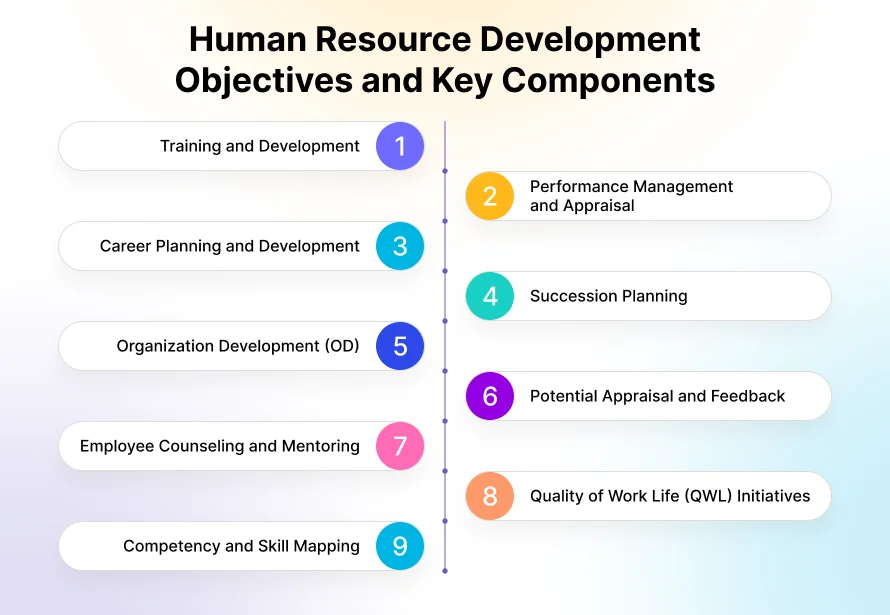
1. Training and Development
The most visible component of HRD. This covers technical skill-building (a new programming language, a cloud certification path), as well as soft-skill training such as communication, client handling, and collaboration.
2. Performance Management and Appraisal
HRD is closely linked to how performance is measured and discussed. A structured performance management process gives employees clear expectations, regular feedback, and a documented basis for development of conversations rather than a single rushed review once a year.
3. Career Planning and Development
This involves mapping potential career paths within the organization, so employees can see what growing from, say, a junior developer to a technical architect actually requires, and what support the company will provide along the way.
4. Succession Planning
Identifying and preparing employees who could step into key roles if a leader leaves or is promoted. This reduces business disruption and signals to high performers that leadership positions are attainable internally.
5. Organization Development (OD)
A broader, longer-term component focused on improving how teams collaborate, how decisions get made, and how the organization adapts to change. OD interventions might include team-building exercises, process redesign, or culture-change initiatives.
6. Potential Appraisal and Feedback
Distinct from performance appraisal (which looks at how someone did in their current role), potential appraisal looks forward, assessing whether an employee has the capability to take on more responsibility.
7. Employee Counseling and Mentoring
Structured mentoring relationships and access to career counseling help employees navigate challenges, plan their growth, and stay engaged, particularly during role transitions.
8. Quality of Work Life (QWL) Initiatives
Programs aimed at improving job satisfaction, work-life balance, and overall employee experience, since development efforts rarely stick to a stressful or disengaged work environment.
9. Competency and Skill Mapping
Before any of the above components can work well, an organization needs a clear picture of what skills exist today and what skills are missing. A visible skill matrix that tracking proficiency levels across teams makes it much easier to plan targeted development instead of generic training for everyone.

The Human Resource Development Process: Step by Step
HRD is not a one-time event. It follows a repeatable process, usually structured in five stages.
| Stage | What Happens |
| Needs Assessment | Identify current skill gaps through performance data, manager input, skill audits, and business goals |
| Setting Objectives | Translate identified gaps into specific, measurable development goals |
| Program Design | Choose the right techniques, content, and delivery format for the target audience |
| Implementation | Roll out the training or development activity, whether on-the-job or off-the-job |
| Evaluation and Follow-up | Measure whether the development activity changed behavior or performance, and adjust for the next cycle |
Step 1: Conduct a Training Needs Assessment (TNA)
This is where HRD starts. HR teams gather information from multiple sources: performance appraisal data, manager feedback, project delivery issues, employee self-assessments, and skill matrix gaps. The goal is to identify what capability the organization actually needs, rather than guessing.
Step 2: Define Clear Development Objectives
Vague goals like “improving technical skills” rarely lead to measurable outcomes. Objectives should specify who needs to learn what, by when, and how success will be measured. For example: “80% of the QA team should be certified on the new automation framework within one quarter.”
Step 3: Design the Development Program
This step involves choosing the right mix of techniques (covered in detail in the next section), setting the curriculum or content, deciding who delivers it internally or externally, and setting a realistic timeline that does not clash with delivery commitments.
Step 4: Implement the Program
Rolling out training, mentoring, job rotations, or workshops. Communication matters here: employees need to understand why the development activity exists and how it connects to their growth; not just treat it as a mandatory box to check.
Step 5: Evaluate and Follow Up
Training that is never evaluated tends to be repeated without improvement. A widely used framework for evaluating training effectiveness is the four-level model developed by Donald Kirkpatrick, which looks at participant reaction, learning gained, behavior change on the job, and business results. Even a simplified version of this, checking whether skills show up in day-to-day work, closes the loop and informs the next needs assessment cycle.
Human Resource Development Techniques
HRD techniques are generally grouped into two categories: on-the-job methods that happen while an employee performs their regular work, and off-the-job methods that happen away from daily tasks.
| Category | Technique | Best Suited For |
| On-the-job | Coaching | Ongoing skill-building with direct manager involvement |
| On-the-job | Job rotation | Building cross-functional understanding, reducing skill silos |
| On-the-job | Mentoring | Career guidance and knowledge transfer from senior employees |
| On-the-job | Understudy assignments | Preparing a successor for a specific role |
| On-the-job | Special project assignments | Stretch experience without a full role change |
| Off-the-job | Classroom or instructor-led training | Structured, standardized knowledge delivery |
| Off-the-job | E-learning and self-paced courses | Flexible, scalable skill-building, especially for technical topics |
| Off-the-job | Workshops and seminars | Focused, time-boxed skill or awareness building |
| Off-the-job | Case studies and simulations | Building judgment and decision-making skills |
| Off-the-job | Role-playing | Practicing interpersonal or client-facing scenarios in a safe setting |
| Off-the-job | Certifications | Validating technical expertise against an external standard |
On-the-Job Techniques
These techniques are cost-effective because they happen during real work, and the transfer of learning to the job is immediate since there is no separate “classroom to workplace” gap. The trade-off is that they depend heavily on the quality of the coach, mentor, or manager involved.
Off-the-Job Techniques
These techniques allow for more standardized, structured learning, and are often necessary for topics that require dedicated focus, such as a new certification or a complex framework. The trade-off is cost, time away from work, and a potential gap between what is learned and how it is applied afterward.
Most mature HRD programs use a blend of both. A typical example: a developer might complete an off-the-job certification course on a cloud platform, then apply that knowledge through an on-the-job special project, with a senior engineer mentoring them through the first real implementation.
Human Resource Development in Practice
Several large Indian technology companies have made structured HRD a visible part of their business strategy. Reports on India’s AI skilling push have noted that companies including TCS and Wipro have run large-scale internal training programs to build AI capability among their existing employees, and that Infosys has developed a dedicated digital learning initiative to support both internal upskilling and academic curriculum design.
These examples share a common thread relevant to smaller and mid-sized IT companies too: development works best when it is planned, tied to actual skill gaps, and tracked over time, rather than treated as a one-time compliance activity.
A Simple HRD Framework for Growing Companies
If you are building your first structured HRD approach, the following framework can serve as a practical starting point.
- Skill Inventory: Maintain a current, accurate record of what skills exist across the team and at what proficiency level.
- Development Objectives: Link every planned training or development activity to a specific business or role requirement.
- Delivery Mix: Choose a mix of on-the-job and off-the-job techniques appropriate to the skill and the employee’s level.
- Manager Involvement: Ensure managers are active participants in coaching and feedback, not just approvers of a training budget.
- Career Pathing: Give employees visibility into what growth looks like beyond their current role.
- Evaluation Cadence: Review whether development activity is translating into on-the-job performance, at least once per quarter.
- Documentation: Keep development records connected to performance and skill data, so decisions are based on evidence, not memory.
This is a starting structure, not a rigid template. Every organization should adapt it to its size, industry, and the pace at which its technical requirements change.
The CollabCRM Advantage
A well-designed HRD strategy is only useful if it is actually followed. Too often, skill matrices live in one spreadsheet; performance reviews live in another, and training records live in someone’s inbox. That disconnects makes it hard to see whether development efforts are working.
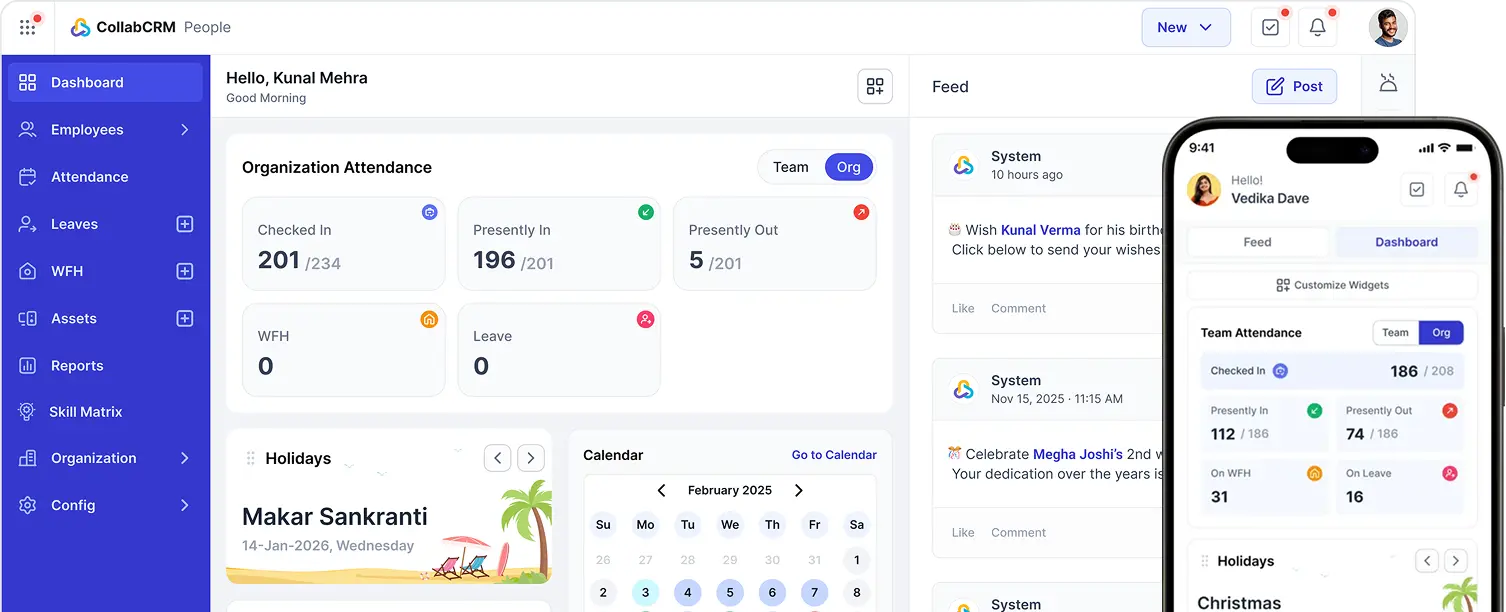
This is where CollabCRM’s People Management module helps. It brings core HR data into one place for growing IT and service teams:
- Skill Matrix: Track employee skills with experience levels such as beginner, intermediate, and expert, so gaps are visible instead of buried in sheets.
- Employee Lifecycle Visibility: Manage the full journey from onboarding to offboarding, so development activity connects to the bigger picture of who is growing and who is at risk of leaving.
- Performance and Reporting: Centralized reports on attendance, skills, and workforce trends give HR and managers a shared, real-time view instead of fragmented data.
- Recruitment Integration: Because CollabCRM’s Recruitment module is connected to People Management, skill needs identified while hiring naturally feed into ongoing development planning.
CollabCRM does not replace the strategic work of designing an HRD program, but it removes the administrative friction of tracking it, which is often where good intentions quietly fall apart.
Conclusion
Human resource development is not a checkbox activity that HR runs once a year. It is a continuous, structured process of identifying skill gaps, setting clear objectives, choosing the right mix of on-the-job and off-the-job techniques, and evaluating whether development changes performance on the ground.
For IT and service companies operating in a market where skill requirements shift quickly, this discipline is directly tied to retention, delivery quality, and how easily the business can adapt to new client and technology demands. Companies that treat their HR operations as a connected system rather than a set of disconnected spreadsheets are in a far better position to make HRD a genuine, repeatable practice rather than a once-a-year event.
FAQs about Human Resource Development
HRD stands for human resource development. It is the continuous, planned process organizations use to build employees’ knowledge, skills, and capabilities through training, performance management, career planning, and related development activities.
In simple terms, human resource development means helping employees grow so they can perform better in their current role and take on more responsibility over time. It covers activities like training, mentoring, career planning, and performance feedback.
HRM (human resource management) is the broader function that covers all aspects of managing a workforce, including recruitment, payroll, compliance, and employee relations. HRD is a specific sub-function within HRM that focuses on developing employee capability through training and growth-related activities.
The main objectives of HRD include improving employee skills and knowledge, preparing employees for future roles, supporting career growth, building succession readiness, and improving overall organizational performance through a more capable workforce.
The HRD process generally follows five stages: conducting a training needs assessment, setting clear development objectives, designing the training or development program, implementing it, and evaluating its effectiveness before starting the next cycle.
Common HRD techniques include on-the-job methods such as coaching, mentoring, and job rotation, along with off-the-job methods such as classroom training, e-learning, workshops, simulations, and certifications.
HRD is important for IT companies because technical skills become outdated quickly. Structured development helps teams stay current with new tools and frameworks, reduces dependence on external hiring, and improves retention among technical employees who want visible growth paths.
Human resource development is generally a shared responsibility between the HR or L&D team, who design and coordinate programs, and people’s managers, who provide day-to-day coaching, feedback, and on-the-job development opportunities.
Yes. HR software can centralize skill data, performance records, and workforce reporting, making it easier to identify development needs and track whether training efforts are translating into improved performance, instead of relying on scattered spreadsheets and manual tracking.




 Priority Onboarding