
Performance management is the ongoing process of setting expectations, tracking progress, giving feedback, developing skills, and recognizing employee contributions.
It helps employees understand what success looks like and helps organizations connect everyday work to larger business priorities.
A connected work management system can make those goals, responsibilities, and progress updates easier to organize across teams.
At its best, performance management is not a once-a-year form. It is a practical, continuous conversation between employees, managers, and HR. It creates clarity, encourages growth, and makes performance decisions more consistent.
TL;DR Key Takeaways
- Performance management is a continuous process, not only an annual performance review.
- It connects individual goals with team and business goals.
- A strong process includes goal setting, regular check-ins, feedback, coaching, development, evaluation, and recognition.
- Performance management and performance appraisal are related, but they are not the same thing. An appraisal is one part of the larger process.
- The most effective systems balance measurable results with fair evaluation of behaviors, collaboration, skills, and growth.
- Managers need training, simple tools, and enough time to have meaningful performance conversations.
- A performance management system such as CollabCRM can centralize goals, feedback, reviews, recognition, and reporting to make the process easier to manage.
What is Performance Management?
Performance management is a structured, ongoing approach to improving employee performance and aligning it with organizational goals. It involves managers and employees working together to define responsibilities, set goals, monitor progress, discuss challenges, build skills, and evaluate outcomes.
In simple terms, it answers five important questions:
- What is expected from the employee?
- How will success be measured?
- What progress has been made?
- What support or development does the employee need?
- How should strong performance be recognized?
A modern performance management process focuses on the future as much as the past. It does not only identify whether someone met a target. It also helps them understand how to improve, what skills to build, and how their work contributes to the business.
The Chartered Institute of Personnel and Development, or CIPD, describes performance management as a broad process that includes objective setting, feedback, development, and performance review activities. It has shifted over time from a narrow annual-rating exercise toward more regular, development-focused conversations.
Why is Performance Management Important?
Performance management matters because employees cannot consistently deliver strong results if they do not know what is expected from them. Clear goals, useful feedback, and regular conversations help people prioritize work and adjust before small issues become larger problems.
Gallup reported that only 47% of employees strongly agreed that they knew what was expected of them at work in 2024. That figure illustrates a major workplace challenge: many employees lack clear direction about success in their roles.
A well-designed performance management process can help organizations create that clarity. It gives employees a line of sight between their work and the outcomes that matter to the company.
Performance Management Supports Business Alignment
When goals cascade from organizational strategy to departments, teams, and individuals, employees can see how their work contributes to larger priorities.
For example, a company may have a business goal to improve customer retention. That goal can flow into team and employee goals:
- The customer success team may focus on improving renewal rates.
- The support team may aim to reduce response time and resolve issues faster.
- Product teams may work on improving features that customers frequently request.
- Individual employees may set measurable goals tied to customer experience, quality, or retention.
This alignment reduces disconnected work. It also helps managers explain why a task, project, or metric matters.
Performance Management Helps Identify Issues Early
Annual reviews often look backward. If an employee is struggling in January but receives feedback only in December, the organization loses months of opportunity to help.
Regular check-ins make it easier to identify:
- Unclear priorities
- Unreasonable workloads
- Resource gaps
- Skill gaps
- Low engagement
- Performance barriers
- Coaching needs
- Opportunities for recognition
Early action is usually more effective and more respectful than waiting until a formal review period.
Performance Management Builds Better Manager Relationships
Employees need managers who can clarify expectations, remove roadblocks, recognize effort, and give specific feedback. Performance management gives managers a structure for those conversations.
However, feedback quality matters more than frequency alone. CIPD’s evidence review notes that feedback can improve performance, but poorly delivered feedback can also harm it. Useful feedback should be specific, credible, relevant to the role, constructive, and as unbiased as possible.[scribd]
Performance Management Goals
Performance management goals describe what an organization wants to achieve through its performance process. These goals should go beyond assigning ratings or deciding compensation.
Common performance management goals include:
- Align employee priorities with business strategy
- Clarify role expectations and success measures
- Improve individual and team productivity
- Encourage accountability without creating a culture of fear
- Build skills needed for current and future roles
- Identify development, coaching, and training needs
- Support fair promotion, compensation, and succession decisions
- Recognize meaningful contributions
- Improve employee engagement and retention
- Build a culture of continuous learning and improvement
The strongest goals balance business needs with employee growth. A process that focuses only on ratings may feel administrative. A process that focuses only on development without accountability may lack direction. Effective performance management combines both.
Performance Management Process
The performance management process is the repeatable cycle an organization uses to set goals, track performance, provide feedback, develop employees, and assess results.
While each company can adapt the process to its culture and workforce, most effective systems include the same core activities.
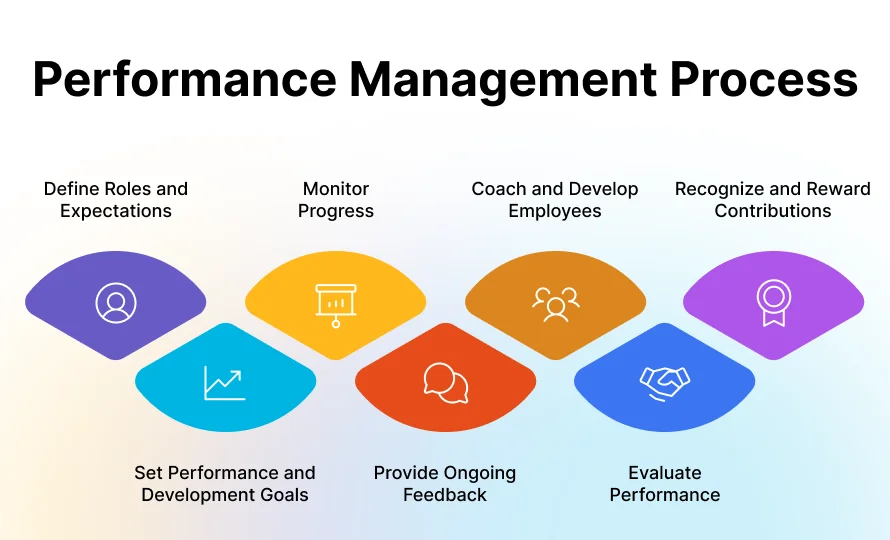
1. Define Roles and Expectations
Employees need a clear understanding of their responsibilities before they can be evaluated fairly. Start with an up-to-date job description that explains the role’s purpose, core responsibilities, expected behaviors, and success measures.
Avoid vague expectations such as “be proactive” or “improve communication” without context. Make expectations specific.
For example:
- Vague: Improve customer service.
- Clear: Maintain a customer satisfaction score of at least 90%, respond to customer requests within one business day, and document recurring customer issues for the product team.
2. Set Performance and Development Goals
Managers and employees should create goals together. Collaborative goal setting improves ownership because employees understand why the goal matters and how success will be measured.
For growing teams, goal management software can help keep individual, team, and company goals visible, aligned, and easier to review over time.
Goals usually fall into two categories:
- Performance goals focus on business outcomes, deliverables, quality, revenue, efficiency, customer experience, or project completion.
- Development goals focus on new skills, knowledge, behaviors, certifications, leadership capability, or career readiness.
A useful framework is SMART goals:
- Specific
- Measurable
- Achievable
- Relevant
- Time-bound
For example, a marketing manager’s performance goal may be to increase qualified inbound leads by 15% during the next quarter. Their development goal may be to complete an analytics course and apply the learning to campaign reporting by the end of the quarter.
3. Monitor Progress
Monitoring does not mean micromanaging. It means keeping goals visible and reviewing progress often enough to make useful adjustments.
Managers can monitor performance through:
- One-on-one meetings
- Project milestones
- Goal dashboards
- Customer feedback
- Quality indicators
- Key performance indicators, or KPIs
- Peer input
- Work samples
- Self-reflections
The goal is to use evidence, not assumptions. Employees should also be able to update progress and raise concerns before deadlines are missed.
4. Provide Ongoing Feedback
Feedback should be timely, specific, and focused on observable actions or outcomes. It should help employees understand what to continue, change, or improve.
A helpful feedback structure is:
- Describe the situation
- Explain the observed behavior or result
- Share the impact
- Discuss the next step
For example:
“During the client presentation on Tuesday, you clearly explained the project risks and answered the stakeholder questions with useful detail. That helped the client feel confident about the plan. For the next presentation, let’s add a one-page summary at the beginning so senior leaders can understand the key decision faster.”
This approach is more useful than saying, “Great job,” or “You need to communicate better.”
5. Coach and Develop Employees
Performance management should create opportunities for growth, not just identify gaps. When an employee needs support, managers can use coaching, mentoring, training, stretch assignments, peer learning, or job rotations.
Development actions should be practical and connected to the employee’s goals.
For example, if a new manager needs stronger delegation skills, a development plan could include:
- Attending a manager training workshop
- Observing a senior manager’s team meeting
- Delegating one project workstream with clear success criteria
- Reviewing progress during monthly coaching sessions
6. Evaluate Performance
Formal evaluations still have a role. They provide a structured opportunity to review performance over a defined period, document achievements, discuss challenges, and make decisions related to advancement, compensation, or rewards.
The evaluation should rely on evidence collected throughout the review period. It should not depend only on what happened most recently or what the manager remembers.
A fair evaluation considers:
- Achievement of agreed goals
- Quality of work
- Collaboration and behaviors
- Customer or stakeholder impact
- Skill growth
- Reliability and accountability
- Context, resources, and changing priorities
7. Recognize and Reward Contributions
Recognition reinforces the behaviors and results of an organization’s value. It can be formal, such as a bonus or promotion, or informal, such as public acknowledgment during a team meeting.
Recognition should be timely and specific. Instead of saying, “Thanks for your hard work,” explains what the employee did and why it mattered.
For example:
“Thank you for identifying the reporting error before the client meeting. Your attention to detail prevented incorrect information from reaching the customer and protected the team’s credibility.”
Stages of Performance Management
The stages of performance management are commonly grouped into four connected phases: planning, monitoring, developing, and reviewing or rewarding.
| Stage | What happens | Main outcome |
| Planning | Employees and managers define responsibilities, goals, measures, and expectations | Clear direction |
| Monitoring | Progress is checked through regular conversations, data, and work updates | Early course correction |
| Developing | Employees receive coaching, training, mentoring, and stretch opportunities | Better skills and capability |
| Reviewing and rewarding | Performance is assessed, documented, recognized, and used for decisions | Fair accountability and recognition |
These stages are cyclical. Once a review period ends, the next round of planning begins.
1. Planning Stage
Planning is where the performance process becomes clear and practical. Managers and employees agree on goals, deadlines, standards, and resources.
This stage should answer:
- What are the employee’s most important priorities?
- What outcomes will define success?
- Which metrics are appropriate for the role?
- What behaviors matter in the role?
- What support does the employee need?
- What development opportunities should be included?
2. Monitoring Stage
Monitoring is about keeping performance visible. Managers should schedule regular check-ins, but the exact frequency can vary by role, business cycle, and employee needs.
A sales representative may need weekly conversations during a critical quarter. A senior specialist working on a long-term project may need a monthly check-in. The important point is consistency and relevance.
3. Developing Stage
Development turns performance information into action. Employees may need new knowledge, coaching, tools, or experience to meet expectations.
Development should not be treated as a response only to poor performance. High-performing employees also need growth opportunities, new challenges, and career pathways.
4. Reviewing and Rewarding Stage
This stage summarizes performance over the review period. It may include self-evaluation, manager evaluation, peer feedback, ratings, calibration, and a discussion about future goals.
Recognition should reflect the organization’s values and reward criteria. When rewards are unclear or inconsistent, employees may lose trust in the system.
Performance Management vs. Performance Appraisal
Performance management vs. performance appraisal is a common point of confusion. They are connected, but they serve different purposes.
Performance management is the full, ongoing process of setting goals, coaching, monitoring progress, developing employees, providing feedback, and evaluating results. A performance appraisal is a formal review meeting or document that evaluates past performance during a specific period.
| Area | Performance management | Performance appraisal |
| Scope | Broad, continuous process | One activity within the process |
| Frequency | Ongoing throughout the year | Often quarterly, semiannual, or annual |
| Main focus | Performance, development, alignment, and future growth | Assessment of past performance |
| Style | Collaborative and forward-looking | Formal and evaluative |
| Outcome | Ongoing improvement, clarity, and development | Ratings, documentation, recognition, and decisions |
| Ownership | Shared by employees, managers, HR, and leaders | Usually led by the manager with employee input |
A company can conduct an annual appraisal without having strong performance management. But a strong performance management system will usually include some form of appraisal or formal review.
CIPD notes that performance reviews can support employee development and inform pay or other employment decisions. The quality of the manager conversation and the fairness of the process are essential to their value.
Performance Management Methods
Performance management methods are the approaches organizations use to assess and improve employee performance. Most companies use a mix of methods rather than relying on a single framework.
1. Goal Setting and SMART Goals
Goal setting is the foundation of performance management. It gives employees direction and creates a measurable basis for discussions.
SMART goals are useful when work outcomes can be clearly defined. However, not every role can be measured only by numbers. A balanced approach may include project outcomes, quality standards, collaboration, customer outcomes, and development measures.
2. Management by Objectives
Management by Objectives, or MBO, is a method in which managers and employees jointly set objectives. Performance is assessed based on the extent to which the agreed objectives are achieved.
MBO works best when goals are realistic, measurable, and aligned with broader business objectives. It can be less effective when goals become rigid or when business priorities change quickly.
3. Objectives and Key Results
Objectives and Key Results, or OKRs, combine ambitious objectives with measurable key results. An objective explains what the team wants to achieve. Key results define how success will be measured.
Example:
Objective: Improve the onboarding experience for new customers.
Key results:
- Reduce average onboarding time from 21 days to 14 days.
- Increase onboarding satisfaction score from 82% to 90%.
- Reduce first-month support tickets by 20%.
OKRs are useful for creating focus and transparency across teams. They work best when organizations review progress regularly and do not treat every missed key result as a failure.
4. 360-Degree Feedback
360-degree feedback gathers input from people who work with the employee, such as managers, peers, direct reports, cross-functional partners, and sometimes customers.
This method can provide a more complete picture of behaviors such as communication, leadership, collaboration, and influence. It is especially helpful for managers and leaders.
However, 360-degree feedback should not be used carelessly. Participants need clear instructions, confidentiality protections, and a shared understanding of how feedback will be used.
5. Continuous Performance Management
Continuous performance management replaces long gaps between feedback conversations with regular check-ins. It does not mean constant surveillance. It means that managers and employees discuss priorities, progress, challenges, and development throughout the year.
This method is well suited to fast-changing environments, hybrid teams, and roles where goals need to adapt quickly.
6. Behaviorally Anchored Rating Scales
Behaviorally Anchored Rating Scales, or BARS, assess performance using defined behavioral examples. Instead of rating “communication” in a vague way, the organization describes what different performance levels look like.
For example, for collaboration:
- Exceeds expectations: Proactively shares knowledge, resolves cross-team issues, and supports others’ success.
- Meets expectations: Works constructively with colleagues and completes shared responsibilities.
- Needs improvement: Withholds information, misses collaborative commitments, or creates avoidable friction.
BARS can improve clarity and consistency, but they require careful design and manager training.
7. Ranking and Forced Distribution
Ranking compares employees against one another. Forced distribution places employees into fixed rating categories, such as top 10%, middle 70%, and bottom 20%.
These methods can create unhealthy competition and may be unfair when team performance depends on collaboration or when employees work in different contexts. Many organizations now prefer goal-based, evidence-based, and development-focused methods.
Benefits of Performance Management
The benefits of performance management extend to employees, managers, HR teams, and the organization as a whole. However, the benefits depend on how the process is designed and used.
A process that is unclear, inconsistent, biased, or overly bureaucratic may reduce trust. A process that is simple, fair, and focused on growth can improve performance conversations across the organization.
Benefits for Employees
- Clear expectations and priorities
- Better understanding of how their work matters
- More useful feedback and coaching
- Greater visibility into strengths and development needs
- Access to training and career development opportunities
- Recognition for meaningful contributions
- More transparent conversations about promotion and growth
Benefits for Managers
- A repeatable structure for one-on-ones and reviews
- Better visibility into team goals and risks
- Earlier identification of performance barriers
- Stronger evidence for performance decisions
- Better employee development planning
- More consistent communication across the team
Benefits for Organizations
- Stronger alignment between strategy and employee goals
- Better workforce planning and succession decisions
- Improved visibility into skill gaps
- More consistent performance standards
- Stronger culture of accountability, feedback, and recognition
- More reliable data for talent decisions
A well-designed performance management process can improve visibility into employee goals, skill gaps, workload concerns, and development needs. It can also help leaders address the factors that affect workplace productivity before unclear priorities, resource constraints, or burnout begin to affect performance.
Performance Management Examples
Performance management examples help show how the process works in real situations. The following examples are illustrative and can be adapted for different teams.
Example 1: Sales Representative
Business priority: Increase revenue from mid-market customers.
Employee goal: Close $300,000 in new annual recurring revenue during Q3 while maintaining a sales cycle of 60 days or less.
Development goal: Improve discovery-call skills by completing sales coaching sessions and applying the new framework in five recorded calls.
Check-in cadence: Weekly pipeline reviews and monthly development conversations.
Measures: New revenue, conversion rate, sales cycle length, customer feedback, and quality of CRM data.
Example 2: Customer Support Specialist
Business priority: Improve customer experience.
Employee goal: Maintain a customer satisfaction score of 92% or higher and resolve 80% of tickets within the agreed service-level target.
Development goal: Build product knowledge by completing advanced product training and shadowing the implementation team twice per month.
Feedback approach: The manager reviews a sample of support interactions every two weeks and provides specific coaching.
Example 3: People Manager
Business priority: Strengthen employee engagement and internal mobility.
Employee goal: Hold monthly one-on-ones with every direct report, complete quarterly development plans, and improve the team’s internal engagement score by five points over six months.
Development goal: Complete manager coaching training and practice structured feedback conversations.
Measures: One-on-one completion rate, team engagement data, retention, development-plan progress, and qualitative employee feedback.
Best Practices in Performance Management
Best practices in performance management help organizations build a process that employees and managers will actually use.
Set Clear, Relevant Goals
Every goal should connect to a real business, team, or customer need. Avoid long lists of low-priority goals. Employees should know which outcomes matter most.
Review goals when priorities change. Keeping outdated goals can make the process feel disconnected from real work.
Make Feedback Specific and Actionable
Useful feedback focuses on observable behaviors, work quality, and outcomes. It should clarify what happened, why it mattered, and what to do next.
Managers can use the same principles behind how to create an action plan to turn feedback into clear responsibilities, deadlines, support requirements, and measurable next steps.
Avoid personality-based statements such as “You are not a strong communicator.” Instead, describe the behavior: “The project update did not include risks, owners, or next steps. Add those three elements to future updates so stakeholders can make decisions faster.”
Train Managers
Managers are central to the performance experience. They need training in goal setting, active listening, coaching, feedback, bias awareness, documentation, and difficult conversations.
Without manager support, even the best performance management software will not solve the underlying problem.
Use Fair and Consistent Criteria
Employees should understand how performance will be assessed. Use role-relevant criteria, documented evidence, and calibration conversations among managers when appropriate.
Calibration helps leaders compare evaluations across similar roles and spot inconsistent standards or possible bias.
Separate Development From Compensation When Needed
Pay and promotion discussions can be important, but they may make employees less open during development conversations. Consider holding separate conversations for:
- Career growth and skill development
- Formal ratings and compensation decisions
- Goal progress and performance support
This helps employees discuss learning needs more honestly.
Balance Results and Behaviors
Results matter, but so does how people achieve them. A high-performing employee who damages team trust, ignores compliance requirements, or creates unnecessary conflict may not be contributing sustainably.
Evaluate both:
- What the employee achieved
- How the employee achieved it
Protect Employee Data
Performance data can include sensitive information. Organizations should define who can access it, how long it is retained, and how it is protected.
Be transparent about data use, especially when using AI-enabled tools, analytics, automated reminders, or performance insights.
Keep the Process Simple
A performance process should add value, not paperwork. Use plain language, practical templates, simple workflows, and a manageable number of goals.
If managers spend more time completing forms than coaching employees, redesign the process.
Common Performance Management Challenges
Organizations often struggle with performance management because the process becomes too formal, too infrequent, or too complicated.
Common challenges include:
- Goals that are unclear or disconnected from strategy
- Feedback that arrives too late
- Managers who lack coaching skills
- Overreliance on annual reviews
- Inconsistent standards across teams
- Recency bias, where only recent events influence ratings
- Favoritism or unconscious bias
- Lack of employee ownership
- Too many forms and administrative tasks
- Metrics that measure activity instead of meaningful results
- Lack of follow-through after a review conversation
The solution is not necessarily more technology or more forms. It is a clearer process, stronger manager capability, fairer evaluation criteria, and regular human conversation.
How to Build a Better Performance Management Process
A better performance management process starts with practical design choices. It should support the way people actually work.
1. Audit the Current Process
Ask employees, managers, and HR what is working and what is not. Review completion rates, feedback quality, goal clarity, rating distributions, employee sentiment, and manager confidence.
Questions to ask include:
- Do employees understand what success looks like?
- Are goals meaningful and current?
- Do managers give feedback regularly?
- Are reviews fair across teams?
- Does the process support career development?
- Is the system easy to use?
2. Define Your Performance Philosophy
Before choosing a tool or template, decide what the organization believes about performance.
For example:
- Do you prioritize continuous feedback?
- Do you use ratings?
- How often will reviews happen?
- How will performance connect to compensation?
- What behaviors matter alongside results?
- How will development be included?
A clear philosophy makes implementation more consistent.
3. Build Simple Workflows
Create a manageable rhythm for goal setting, check-ins, feedback, development planning, and formal reviews.
For many organizations, a practical schedule may include:
- Annual or semiannual goal setting
- Monthly one-on-ones
- Quarterly goal reviews
- Ongoing recognition and feedback
- Midyear development discussion
- Year-end performance review
The cadence should fit the business. Fast-moving teams may need more frequent goal updates.
4. Measure Process Health
Do not measure only employee ratings. Also measure whether the process itself is working.
Track indicators such as:
- Goal-setting completion rate
- One-on-one completion rate
- Review completion rate
- Development-plan participation
- Internal mobility
- Promotion patterns
- Employee clarity of expectations
- Manager confidence in feedback conversations
- Employee perceptions of fairness
5. Improve Continuously
Performance management should evolve as the business changes. Review the process at least once a year and use feedback from managers and employees to improve it.
How CollabCRM Supports Performance Management
A performance management system should make employee performance conversations more organized, visible, and actionable. It should not turn people management into a spreadsheet exercise.
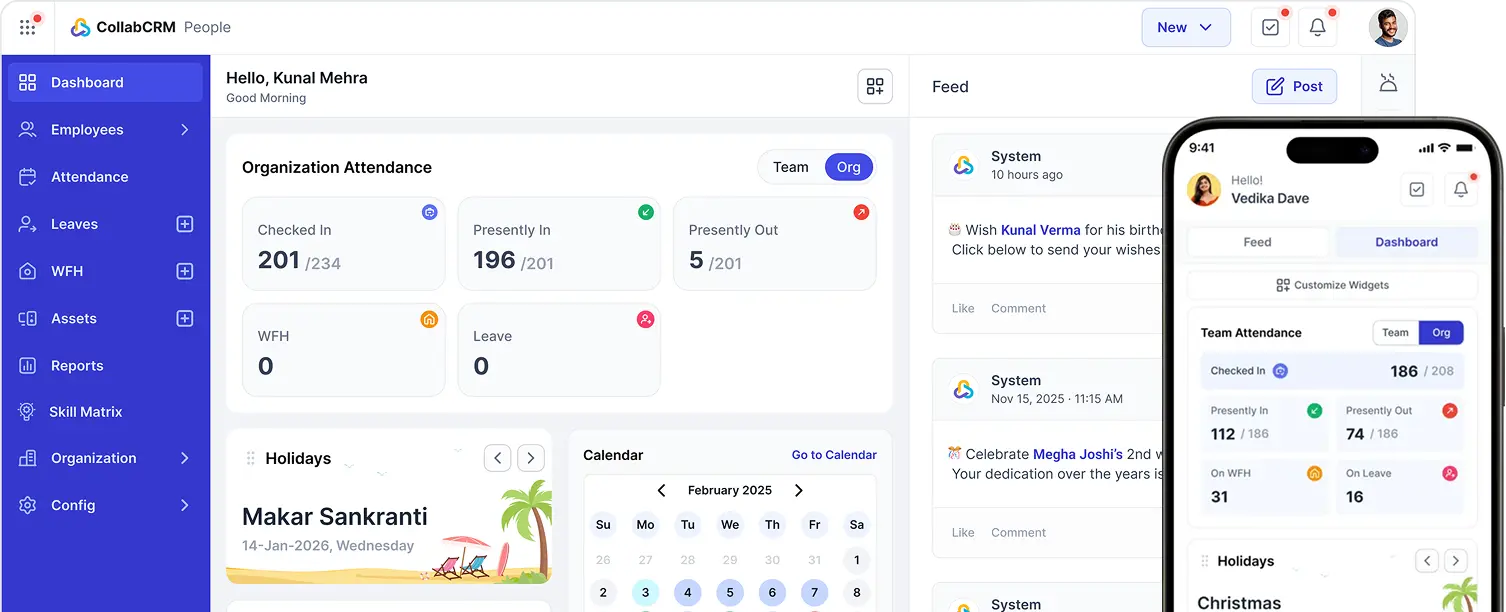
CollabCRM supports a more connected performance management process by giving teams one place to manage goals, track progress, document feedback, run reviews, support development, and recognize contributions.
With the right configuration, CollabCRM helps organizations:
- Set individual, team, and organizational goals in one centralized system
- Align employee goals with department and company priorities
- Track progress through dashboards, milestones, and measurable outcomes
- Schedule and document regular check-ins
- Capture manager feedback and employee self-reflections
- Create structured performance review workflows
- Build individual development plans
- Maintain consistent records for recognition, coaching, and performance discussions
- Give HR teams clearer visibility into review completion and goal progress
- Reduce manual follow-up work through reminders and automated workflows
Using CollabCRM workflows also helps teams standardize reminders, review steps, approvals, and follow-up actions across the performance management cycle.
The real value is not only in storing performance data. It is in making performance management easier to practice consistently. When employees and managers can see goals, feedback, next steps, and development priorities in one place, conversations become more focused and less dependent on memory.
For organizations that want to move beyond annual appraisals, CollabCRM can serve as a practical performance management system that supports clarity, accountability, continuous improvement, and employee growth.
Final Takeaway
Performance management is not about watching employees more closely or filling out more forms. It is about helping people understand what matters, do better work, grow their skills, and receive fair recognition for their contribution.
The strongest performance management process is continuous, simple, fair, and human. It gives employees clarity. It gives managers a structure for coaching. It gives HR better visibility into growth, capability, and performance patterns.
When supported by a centralized platform like CollabCRM, performance management becomes easier to manage across teams. Goals stay visible, feedback is documented, development plans are actionable, and reviews become part of an ongoing conversation instead of a stressful annual event.
Frequently Asked Questions
Performance management is the ongoing process of setting employee goals, tracking progress, giving feedback, improving skills, and reviewing results. It helps employees understand expectations and helps organizations achieve business goals.
The four common stages are planning, monitoring, developing, and reviewing or rewarding. These stages repeat throughout the employee’s performance cycle.
Performance management is the continuous process of managing goals, feedback, development, and performance. A performance appraisal is a formal review of past performance that happens at a specific time, such as quarterly or annually.
Performance management is important because it creates role clarity, aligns employee work with business goals, supports development, improves feedback quality, and helps organizations make fairer talent decisions.
Common performance management methods include SMART goal setting, Management by Objectives, OKRs, continuous feedback, 360-degree feedback, performance appraisals, coaching, and behaviorally anchored rating scales.
A customer support employee may set a goal to maintain a 92% customer satisfaction score, receive biweekly coaching based on ticket reviews, complete product training, and discuss progress in monthly one-on-ones with their manager.
Formal performance reviews often happen annually, semiannually, or quarterly. However, performance conversations and feedback should happen more regularly, such as weekly, biweekly, or monthly depending on the role and business needs.
A performance management template should include employee details, goals, success measures, progress updates, achievements, feedback, development priorities, support needed, next steps, and follow-up dates.
Employees benefit from clearer expectations, useful feedback, development opportunities, recognition, better communication with managers, and greater visibility into career growth opportunities.
Yes. A CRM or collaborative work platform can support performance management when it includes goal tracking, workflows, feedback records, dashboards, review templates, employee development plans, and reporting. CollabCRM can help centralize these activities so managers, employees, and HR teams can manage performance more consistently.




 Priority Onboarding