

A project manager looks at two developers on the same team. One is buried in three overlapping projects, barely keeping up. The other has spare hours every week but no one seems to notice.
Without the right data, this kind of imbalance stays invisible until deadlines slip, or someone burns out.
This is where resource utilization comes in. It is the metric that shows exactly how much of your team’s available time is being spent on productive work, and how much is sitting idle. Paired with smart project resource allocation, it gives managers the visibility they need to staff projects realistically and avoid overloading anyone.
In this guide, we will break down what resource utilization means, why it matters across industries, and how to calculate it using simple, practical formulas. You will also learn what a healthy utilization rate looks like, common reasons utilization go off track and how project management tools make tracking and improving utilization easier for IT teams.
Key Takeaways:
- Resource utilization shows how effectively your team’s time is being used across projects
- It is calculated as billable hours divided by total available hours, expressed as a percentage
- Overutilization leads to burnout; underutilization signals poor planning or staffing gaps
- Forecasted utilization helps you plan capacity before committing to new work
- Team-level utilization can hide individual overload, so always check personal rates too
- Tracking utilization regularly, not just at project close, helps catch problems early
- Tools like CollabCRM make occupancy tracking and project resource allocation easier for IT teams
What Is Resource Utilization?
Resource utilization is a key performance indicator that reflects well your business is using its people and physical resources. It helps to identify:
- whether your resources are underused or overused
- calculate the percentage of time on productive tasks
- ensuring optimal efficiency while preventing team burnout
Resource Utilization in IT Industries
Resource utilization in IT companies often refers to technological assets such as servers, ensuring systems run smoothly without interruptions. Proper monitoring prevents downtime, overload, or wasted capacity, helping businesses maintain consistent performance.
In IT industries it helps to:
- Track server load and uptime
- Prevent downtime and bottlenecks
- Optimises infrastructure costs
- Prevent employee burnout
- Match the right technical expertise to correct tasks
Why Does Resource Utilization Matter?
Resource utilization is more than a tracking number. It shows how well your business uses the time and people available, with effects that reach far beyond a single project. Here are some of the importance of resource utilization:
- Shows how efficiently your business uses available time and people, regardless of industry
- Acts as a key metric for measuring overall productivity and operational performance
- Influences financial outcomes, since billable hours delivered directly affect profitability
- Supports stronger strategic resource and workforce planning across projects and teams
- Helps balance workloads, ensuring no one is overburdened or underutilised
- Improves employee satisfaction by maintaining manageable, fair workloads
- Strengthens retention, since balanced workloads reduce burnout and turnover risk
How to Calculate Resource Utilization
The resource utilization formula looks like this:
1. Basic Resource Utilization Formula
Resource Utilization= (Billable Hours Worked ÷ Total Hours Available) × 100
Example:
A developer works 40 hours in a week and logs 32 billable hours.
Utilization = (32 ÷ 40) × 100 = 80%.
2. Forecasted Resource Utilization Formula
Forecasted Utilization = (Scheduled Hours ÷ Total Available Hours) × 100
Example:
A QA engineer has 40 available hours next week and is scheduled for 36 hours.
Forecasted utilization = (36 ÷ 40) × 100 = 90%.
3. Team-Level Utilization
To get a team-wide view, add up each member’s individual utilization rate and divide by the total number of team members.
This highlights overall capacity gaps or overload, though it can mask individual outliers, so check personal rates too.
Example:
A UX design team has four members with utilization rates of 90%, 85%, 70%, and 75%.
Team-level utilization = (90 + 85 + 70 + 75) ÷ 4 = 80%.
The team average looks healthy but note that a designer with 90% utilization may be close to overload while one with 70% utilization has spare capacity.
What to Include and Exclude When Calculating Resource Utilization
Here are a few things that you should include or exclude while calculating resource utilization:
- Include all approved working hours within the period
- Exclude public holidays, approved leave, and sick days if tracked separately
- Include billable project work, even if completed outside standard hours with approval
- Exclude unpaid breaks and time not logged against any task
- Exclude training or onboarding hours unless your business treats them as billable
- Keep definitions consistent across every reporting period for accurate comparisons
Common Reasons for Poor Utilization Rates
Resource utilization numbers rarely go wrong on their own. They usually point to a deeper issue in how work is planned, assigned, or tracked.
Understanding why rates drift too high or too low is the first step toward fixing them, and it starts with better smart workload management.
1. Overutilization of Resources: Why It Happens
Overutilization often comes from poor capacity planning. Project managers commit team members to new work without checking what they already have on their plate.
This is common in IT companies managing multiple projects at the same time, where the same developer gets pulled into two or three sprints simultaneously.
For instance, a backend developer is allocated 45 hours of work in a 40-hour week across two ongoing projects. Utilization shows 112%, an early warning that workload management has failed somewhere upstream.
At the same time, scope creep adds to the problem. A project that grows beyond its original plan eats into time that was never accounted for. Without a process to flag overload early, team members keep absorbing extra work until burnout or missed deadlines surface the issue.
2. Underutilization of Resource: Why It Happens
Underutilization usually points to uneven distribution of work. Some team members are overloaded while others wait for tasks, often because project managers lack visibility into who is free.
On the other hand, skills mismatch plays a role too. Someone might be available, but their expertise does not fit the open task.
Excessive internal meetings also eat into billable time without anyone noticing the pattern. And in some cases, the issue is not the workload itself but incomplete time tracking, where billable work happens but never gets logged.
For example, a QA tester logs only 24 billable hours out of 40 available, not because there is no work, but because three hours of meetings each day quietly consume time that should be billable.
How to Improve Resource Utilization
Improving resource utilization is less about working harder and more about working with better visibility. The following five tips help IT teams build habits that keep utilization in a healthy, sustainable range.

Tip 1: Get Visibility into Who Is Doing What
Recourse utilization starts with mapping current allocations and tracked time across every active project. This shows who is stretched thin and who has room for more work.
Without this visibility, project managers end up making staffing decisions based on guesswork rather than facts.
For instance, a project manager reviews a shared resourcing dashboard and notices one developer is booked across three projects while another sits at 50% capacity. Reassigning a task between them balances the load immediately.
You can use tools that have a resource occupancy tracker to spot overload instantly and reassign work before deadlines slip. They can help you to:
- Visualise team capacity at a glance
- Flag overbooked resources early
- Rebalance workloads before deadlines slip
Tip 2: Plan Capacity Before You Commit
Before agreeing to a new project or sprint, check whether your team has the hours to deliver it. Factor in holidays, existing commitments, and realistic working hours rather than assuming everyone is fully free. Most overutilization problems trace back to this step being skipped.
For instance, before accepting a tight client deadline, a delivery lead checks the team’s forecasted utilization and finds two developers are already at 95%. The lead negotiates a short extension instead of overcommitting the team.
Tip 3: Track Time Consistently
Correct utilization numbers depend on accurate time entries. Encourage daily logging instead of reconstructing timesheets from memory at the end of the week.
Make tracking easy by keeping it close to the actual work, ideally at the task level. Using project management software that lets people log time directly on tasks removes the extra step of switching tools and defining clearly what counts as billable helps everyone apply the same standard.
For example, a development team switches from weekly timesheet entry to logging time directly on tasks within their project management software. Reporting accuracy improves, and previously invisible non-billable hours finally show up in the data.
Tip 4: Audit Non-Billable Time
Review how much time goes toward meetings, admin work, and internal tasks. Some non-billable time is necessary, but a lot of it can be reduced.
Ask whether meetings could be shorter, less frequent, or replaced with async updates. Cutting unnecessary non-billable time raises utilization without adding pressure on the team.
A QA team discovers that daily standups and status meetings consume six hours a week per person. Shortening standups and moving status updates to async messages frees up nearly a full day of billable time monthly.
Tip 5: Review Utilization Regularly, Not Just at Project Close
Waiting until a project ends to check utilization means problems get caught too late to fix. Weekly or biweekly reviews help spot overload or idle time early, while monthly reviews are useful for spotting longer-term trends.
Tying these reviews into existing project status meetings makes utilization tracking a habit rather than an extra task.
For example, a team that reviews utilization every two weeks catches an emerging overload pattern in week three of a project, well before it affects the final delivery timeline.
Resource Utilization in IT Teams: Specific Considerations
IT project teams have utilization patterns that look different from agencies or consulting firms. A few factors make this especially true.
- Developers often switch between multiple projects or clients in the same week, not just one assignment at a time
- QA and DevOps roles tend to follow spike and idle patterns tied to release cycles, busy before a launch and quieter right after
- Scrum teams assign work in sprint blocks, so tracking utilization within a sprint needs sprint-level data, not just weekly totals
- Multi-project management is a common challenge in IT. A single developer can easily be spread across three projects in each week
- This makes team-level utilization tracking especially important. Looking at individual numbers alone can miss overload that only shows up when you combine work across projects
- Sprint planning is a natural checkpoint for forecasted utilization. Before assigning story points, check each team member’s available hours for that sprint to avoid overcommitting the team from the start
How can CollabCRM Help with Better Resource Utilization
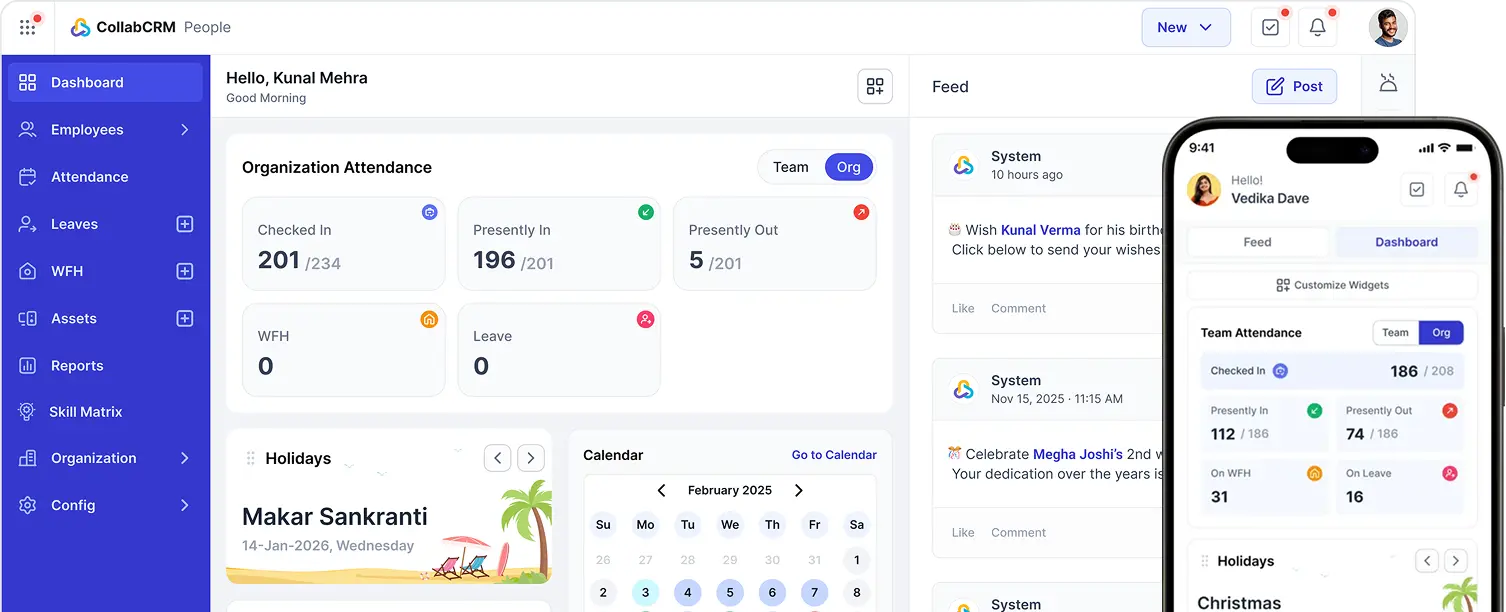
CollabCRM brings resource utilization tracking together in one place, helping managers see how effectively people are being used across projects and where overutilization or underutilization is creeping in.
Occupancy Tracking shows workload levels for every employee, so managers can spot available capacity before assigning new work. Resource Allocation lets you assign people based on skills, roles, and availability, keeping workloads balanced across multiple projects.
Timesheets and Work Logs capture actual hours spent on tasks, making it easy to compare planned effort against what really happened. Billable vs Spent Hours tracking highlights resource efficiency and flags projects running over budget.
In addition, Skill Matrix Management matches employees to the right projects and surfaces skill gaps early, while Availability and Leave Visibility factors in time off and work-from-home schedules so plans stay realistic.
Also, the Reporting and Utilization insights pull all of this into clear reports that catch bottlenecks before they cause problems.
Together, these features of best operations management tool give teams a centralised view of who is working on what, how much capacity remains, and how efficiently resources are being used across every project.

FAQs
Resource allocation is the process of assigning people to tasks and projects. Resource utilization is a metric that shows how those assignments translated into actual time worked. Allocation happens during planning; utilization is measured after or during execution.
Most teams benefit from weekly tracking at the individual level and monthly review at the team or department level. Quarterly reviews are useful for strategic planning and hiring decisions.
The goal of resource utilization is to balance workloads so that team members are neither overburdened nor idle. It helps maximise productivity, improve project profitability, and support better staffing decisions, all while keeping employees engaged and preventing burnout across projects.






 Priority Onboarding