
In a fast-paced business environment, the margin for error is shrinking, and execution makes or breaks a company’s bottom line. Leaders are constantly pressured to deliver more with less, yet teams everywhere still struggle to align their daily tasks with overarching corporate strategies.
To fix these costly bottlenecks, successful teams rely on proven data rather than guesswork. Understanding the latest project management statistics helps you benchmark your current operations against top-performing companies worldwide.
Whether you manage regional teams in North America or cross-border operations across Europe and the Asia-Pacific, these insights reveal what separates successful initiatives from costly failures.
You will learn exactly why initiatives collapse, how high-performing Project Management Offices (PMOs) protect their budgets, and how emerging technologies like AI are reshaping team productivity.
Key Takeaways:
- Project management is no longer just about delivering tasks on time and within budget, it now defines how organizations execute strategy and drive business value.
- AI and automation are reshaping how project teams plan, allocate resources, and track progress across every industry.
- Hybrid and agile methodologies have overtaken traditional waterfall approaches as the preferred way to manage modern projects.
- Remote and hybrid work has permanently changed how project teams collaborate, communicate, and deliver results.
- The demand for skilled project managers is growing faster than the talent supply, making proficiency a critical competitive advantage.
- Organizations that invest in the right project management tools and practices consistently outperform those that do not.
- The future of project management belongs to teams that combine strong business acumen with technology fluency and adaptability.
Key Project Management Statistics
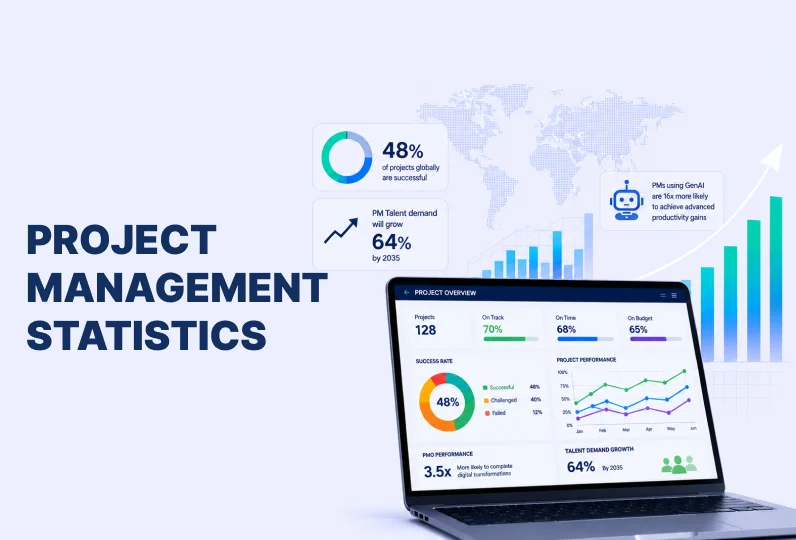
- Only 48% of projects globally are considered successful, while 12% are classified as outright failures.
- Organizations with high-performing PMOs are 3.5 times more likely to have completed digital transformations than others.
- Global demand for project management talent will grow 64% by 2035, creating a shortfall of nearly 30 million professionals.
- Only 34% of organizations consistently complete projects on time and within budget.
- Project managers who use GenAI extensively are 16 times more likely to achieve advanced productivity gains than those just starting out.
- 95% of life sciences capital projects fail to meet their authorized cost and schedule targets.
- High-performing PMOs that use technology to enable value creation outperform others by more than double across every key project metric.
- Nearly 9 in 10 project managers report a positive return on their AI tools investment, with more than a third planning to increase AI spending through 2025.
The Global State of Project Success and Failure Rates
Many businesses struggle with managing their projects and therefore struggle in meeting objectives as easily as they would have imagined.
1. Only 48% of projects globally are considered successful
PMI research reveals that 48% of projects qualified as successful, 40% fall into a gray area with mixed views, and 12% are outright failures. PMI used this data to calculate a Global Net Project Success Score of 36.
2. Projects with clear goals are nearly twice as likely to succeed
Projects with clear goals, performance management systems, and tracked metrics over the project’s life were nearly twice as likely to succeed. Other key factors include a sound business case, positive team morale, adequate funding, and effective resource management.
3. Project professionals with high business acumen see 83% of projects meet business goals
According to PMI’s Pulse of the Profession 2025, project professionals with high business acumen have 83% of their projects meet business objectives, compared to 78% among others.
4. Just 36% of organizations fully deliver the benefits their projects were designed to achieve
Only 36% of organizations mostly or always deliver the full benefits of their projects. In the same report, just 34% mostly or always complete projects on time, and another 34% mostly or always complete projects on budget.
5. Average project performance rate stands at 73.8%
The average project performance rate is 73.8%, according to PMI’s 2024 data. Employees who understand how success is measured are 2x more likely to feel motivated to achieve results.
6. Only 34% organizations complete projects on time
Only 34% of organizations mostly or always complete projects on budget, according to Wellingtone’s State of Project Management report. The same research found an identical 34% consistently deliver projects on time, pointing to a widespread gap in delivery discipline.
Project Management Software Market Size
The project management software market is growing fast. Organizations across every industry are investing in tools that improve visibility, reduce delays, and streamline delivery.
Here is a look at how large the market has become and where it is headed.
1. The global project management software market was valued at USD 9.76 billion in 2025
The project management software systems market was valued at USD 9.76 billion in 2025 and is estimated to grow from USD 11.27 billion in 2026 to reach USD 23.09 billion by 2031, at a CAGR of 15.42% during the forecast period.
North America commanded a 36.12% market share in 2025, while Asia-Pacific registered the strongest growth at a 16.06% CAGR through 2031.
2. The market will grow from USD 9.14 billion in 2025 to USD 16.87 billion by 2030
The project management software market will grow from $9.14 billion in 2025 to $10.51 billion in 2026 at a CAGR of 14.9%. It is expected to reach $16.87 billion by 2030 at a CAGR of 12.6%, driven by increasing demand for predictive project analytics, AI-based resource optimization, and the expansion of remote and hybrid work models.
3. The online project management software market stood at USD 9.20 billion in 2025
The global online project management software market accounted for USD 9.20 billion in 2025 and is predicted to increase from USD 10.40 billion in 2026 to approximately USD 31.90 billion by 2035, expanding at a CAGR of 13.24%. North America dominated with a 40% share in 2025, while Asia-Pacific is expected to grow at the fastest CAGR of 18.5% during the forecast period.
4. The market is projected to grow from USD 10.33 billion in 2025 to USD 40.12 billion by 2033
The global project management software market was valued at USD 8.72 billion in 2024 and is projected to grow from USD 10.33 billion in 2025 to reach USD 40.12 billion by 2033, growing at a CAGR of 18.48% during the forecast period.
Key growth trends include increasing cloud-based adoption, remote work acceleration, and deeper integration of AI and machine learning into project management tools.
5. The agile project management software segment alone will reach USD 14.71 billion by 2032
The global agile project management software market is projected to grow at a CAGR of 13.9% between 2025 and 2032. It is estimated to reach USD 5,915.2 million in 2025 and USD 14,711 million by 2032.
Cloud-based solutions account for a 58% market share in 2025, with North America holding the largest regional share at 46.9%.
6. Only 1 in 3 businesses successfully adopts new software without disruption or regret
Capterra’s 2026 Software Buying Trends Report, based on a survey of 3,385 software decision-makers across 11 countries, found that only 34% of buyers are successful software adopters who achieve both a smooth buying and implementation process. The remaining 66% experience unexpected disruption, regret, or both after a purchase.
The Rise of AI and Automation in Modern PM Workflows
Artificial intelligence is no longer a future consideration for project managers. It is already changing how teams plan work, allocate resources, and track progress.
Here is what the latest data says about AI adoption in project management today.
1. Project managers who use GenAI extensively are 16 times more likely to achieve advanced productivity gains than those just starting out
PMI research finds that project professionals who use GenAI extensively, are 16 times more likely than explorers to achieve advanced productivity gains, with 48% of trailblazers reporting such gains compared to just 3% of explorers.
2. AI trailblazers report 91% improvement in quality management versus 40% among non-adopters
PMI’s GenAI adoption research found that high adopters see improvements across core project functions, including project scope (87% of high adopters versus 34% of early-stage users), scheduling (85% vs. 46%), cost management (85% vs. 42%), and quality management (91% vs. 40%). High adopters also report stronger collaboration (83% vs. 32%) and creativity (84% vs. 44%).
3. 9 in 10 project managers report a positive return on their AI tools investment
According to Capterra’s survey of 2,500 global project managers, 90% of project managers report a positive ROI from their AI tools over the past year, with 36% planning to increase AI investment by 2025.
4. GenAI embedded in existing enterprise workflows jumped from 24% to 35% in a single quarter
KPMG’s Q1 2025 AI Pulse Survey of 130 U.S.-based C-suite leaders at organizations with over $1 billion in annual revenue found that GenAI embedded into existing workflows rose from 24% to 35% in one quarter. Daily use of AI productivity tools also climbed from 22% to 58% in the same period.
5. Gartner predicts 80% of project management tasks will be run by AI by 2030
Gartner predicts that by 2030, 80% of project management tasks will be handled autonomously by AI, including data collection, tracking, and reporting. The forecast does not signal the end of the project manager role, but a shift toward eliminating repetitive work so professionals can focus on higher-value decisions.
Methodologies: Hybrid, Agile, and Waterfall Frameworks
How teams choose to deliver projects has shifted significantly over the last decade. Agile, hybrid, and waterfall frameworks each serve a different purpose, and organizations are increasingly mixing approaches to match the demands of modern project work.
1. Hybrid project management adoption has risen 57% since 2020
The use of hybrid project management approaches has increased from 20% in 2020 to 31% in 2023, a rise of 57%. Over the same period, predictive (waterfall) approaches declined by 24%, while agile use rose 6%.
2. 76% of organizations expect agile adoption to increase over the next five years
76% of respondents to a PMI survey expect an increase in their organization’s usage of agile approaches over the next five years, and 73% expect the same for hybrid approaches. Meanwhile, 34% expect a decline in the use of predictive approaches over the same period.
3. Project teams perform equally well regardless of whether they use agile, hybrid, or predictive methods
PMI research shows that organizations see comparable rates of project performance regardless of whether they use predictive, hybrid, or agile approaches, provided teams are properly trained and supported. An 8.3%-point increase in project performance was observed among organizations that offer at least three enabling resources versus those that offer none.
4. 74% of organizations now use hybrid, blended, or custom agile models
Digital.ai’s 18th annual State of Agile Report found that 74% of organizations now use hybrid, blended, or homegrown agile models, up from roughly 10% a decade ago. Investment in agile also held steady, with 41% of organizations increasing agile spending over the past two years.
5. 76% of agile practitioners report pressure to prove the ROI of agile investments
The 2025 State of Agile Report found that 76% of respondents cite increased scrutiny on the business impact and ROI of agile, while only 49% have governance guardrails in place as AI adoption accelerates faster than oversight structures.
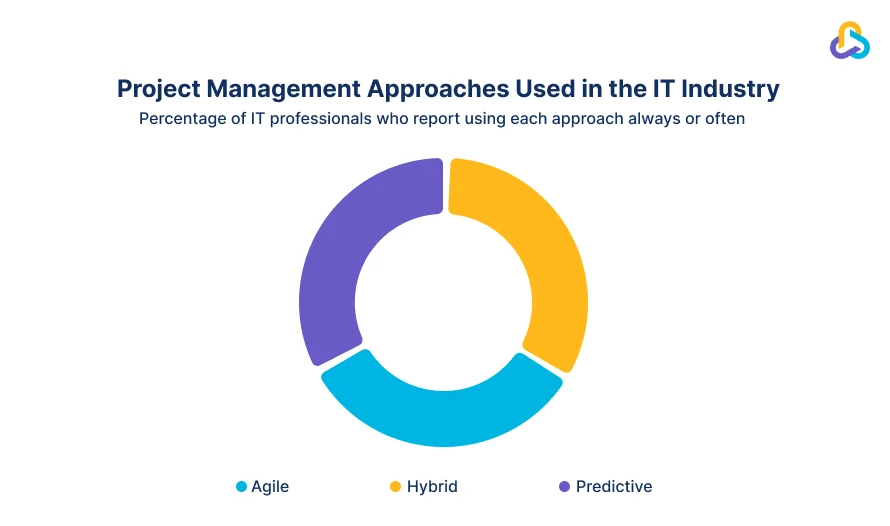
6. 53% of IT professionals report using agile always or often, while 55% use a hybrid approach
According to PMI’s Pulse of the Profession 2024, 53% of respondents in the IT industry report using agile always or often. 55% use a hybrid approach often, while 52% report using a predictive approach often. In the financial services sector, 58% use agile always or often.
7. 61% of agile practitioners report deploying agile practices for over five years
A Forrester survey found that 61% of agile practitioners report deploying agile practices for over five years, reflecting a strong and enduring shift away from older methodologies such as waterfall, which continues to see a decline in adoption.
Remote and Hybrid Project Management Trends
Remote and hybrid work has fundamentally changed how project teams operate. From communication to resource planning, distributed teams now require a different approach to project delivery.
Here is what the data reveals about how organizations are adapting.
1. “Work from anywhere” arrangements are the number one factor changing how project team’s work
According to PMI’s Pulse of the Profession 2024, remote and hybrid work arrangements have been the number one factor contributing to changes in how project teams work and deliver projects, as reported by 61% of senior leaders.
Remote work among project professionals dropped from 89% in 2021 to 61% in 2023, reflecting the stabilisation of hybrid norms.
2. Project teams perform equally well regardless of whether they work onsite, hybrid, or fully remote
PMI’s research confirms that project teams perform equally well using predictive, hybrid, and agile approaches across all work locations be it onsite, hybrid, or remote. The key differentiator is equipping employees with the right skills and empowering teams with flexibility.
3. Fully remote workers report the highest engagement at 31%, but the lowest overall wellbeing
Gallup’s State of the Global Workplace research finds that fully remote workers are the most likely to be engaged at work at 31%, compared to hybrid workers at 23% and on-site remote-capable workers at 23%. However, fully remote workers also report lower overall life wellbeing and higher rates of stress, loneliness, and emotional strain.
4. Despite return-to-office mandates, 51% of remote-capable employees still work hybrid
Gallup data from Q2 2025 shows that despite high-profile return-to-office mandates from large employers, the share of remote-capable employees working hybrid declined only slightly, from 55% in 2024 to 51% in 2025.
5. Hybrid employees now spend 46% of their workweek, roughly 2.3 days, in the office
The same Gallup’s analysis finds that hybrid workers now spend 46% of their workweek in the office, equivalent to approximately 2.3 days per week. The percentage of employees who say their hybrid schedule is entirely their own choice declined from 37% in 2024 to 34% in 2025, as employers seek more influence over scheduling.
6. Hybrid and remote workers log 8.5 productive hours daily, outperforming full-time office workers
ProHance’s H1 2025 Global Productivity Benchmarking Report, covering 246,500 users across 68 enterprises worldwide, found that both hybrid and work-from-home employees logged 8.5 productive hours per day. Full-time office workers logged 42 minutes fewer productive hours per day by comparison.
7. Job market optimism fell sharply among fully on-site workers but stayed flat among hybrid workers
Gallup’s State of the Global Workplace 2026 report found that in 2025, job market optimism dropped by 5 points for fully remote workers and by 14 points for remote-capable but fully on-site workers, while optimism remained flat among hybrid workers. The drop among on-site workers may reflect declining remote job opportunities due to employer policy changes or automation of knowledge work.
8. Global employee engagement fell to 20% in 2025, its lowest level since 2020, costing an estimated $10 trillion in lost productivity
Global employee engagement fell to 20%, its lowest level since 2020. The decline is estimated to have cost the world economy $10 trillion in lost productivity, with distributed and hybrid team management identified as a key pressure point for managers.
Project Management Skills and the Talent Shortage
Skilled project managers are in short supply and high demand. As projects grow more complex and organizations push for faster delivery, the gap between available talent and what businesses need continues to widen.
1. Only 18% of project professionals demonstrate high business acumen
PMI’s Pulse of the Profession 2025 found that only 18% of project professionals demonstrate both high skill proficiency and strong strategic application. Another 66% fall into the moderate category, with proficiency in 4 to 6 skills, while 16% have low business acumen with expertise in 3 or fewer skills.
2. PMP-certified professionals earn 17% higher median salaries than non-certified peers globally
PMI’s 14th edition Earning Power: Project Management Salary Survey, fielded across 21 countries with 14,628 project professionals, found that PMP-certified respondents earn 17% higher median salaries than non-certified professionals. In the United States specifically, certified professionals reported a median salary of $135,000, compared to $109,157 for those without certification, a nearly 24% difference.
3. Global demand for project management talent will grow 64% from 2025 to 2035
PMI’s Global Project Management Talent Gap report found that the world could face a shortfall of up to 29.8 million qualified project professionals by 2035. Global demand for project talent is projected to grow by 64% from 2025 to 2035, driven by capital investment and industry transformation.
There are currently nearly 40 million project professionals in the global workforce, already outnumbering the world’s software developers at approximately 25 million.
4. High business acumen project professionals use nearly 3 additional performance measures compared to low acumen peers
PMI’s Pulse of the Profession 2025 found that project professionals with high business acumen utilize nearly three additional factors to measure project performance compared to those with low business acumen.
High acumen professionals achieve higher rates of business goals met, better schedule adherence at 63% versus 59%, and stronger budget adherence at 73% versus 68%.
5. An estimated 4.4 million project professionals will leave the global workforce by 2035 due to retirement and attrition
PMI’s Global Project Management Talent Gap report estimates that approximately 4.4 million project professionals will exit the workforce by 2035 due to attrition and retirement.
South Asia is projected to face the steepest demand growth of between 68% and 91%, while China may need to more than double its project talent base from 11.1 million to 23.3 million professionals.
Project Management Success
Delivering a successful project takes more than a good plan. It requires clear goals, the right tools, strong leadership, and consistent execution.
Here is what the latest research reveals about what separates successful projects from those that fall short.
1. Only half of projects succeed globally, but the M.O.R.E. approach more than triples success rates
PMI’s Step-Up report, based on a survey of over 5,800 project professionals, found that only half of projects succeed globally. However, project professionals who consistently practice all elements of the M.O.R.E. approach see success scores increase substantially, with the approach reported to more than triple success rates compared to those who do not apply it.
2. 93% of senior executives say they must reinvent their business model at least every five years
A CEO survey conducted found that 93% of senior executives say they must rethink or reinvent their business model or operating approach at least every five years, with nearly two-thirds doing so every two years or more frequently.
The findings directly link this reinvention pressure to the need for stronger project success practices.
3. 80% of high-performing PMOs use technology to enable value creation, versus only 32% of others
PMI’s Built to Thrive report found that 80% of organizations with high-performing PMOs use technology to enable value creation, compared to only 32% of other organizations.
High-performing PMOs are also twice as likely to use AI, and 62% of respondents from top PMOs rate their company’s agility as high, versus just 25% among those with low-performing PMOs.
4. Projects with a clear vision score +41 on PMI’s Net Project Success Score, versus -18 without one
PMI’s 2025 project success research found that having a clear vision of success gives a project a Net Project Success Score of +41, compared to -18 when there is no clear vision. Projects that ultimately succeeded were frequently those that had been at risk of failure, with adaptability and communication identified as the key recovery factors.
5. Projects delivering social impact are 2.6 times more likely to be deemed successful
PMI’s Maximizing Project Success research found that projects delivering value in the form of social impact are 2.6 times more likely to be deemed successful.
6. Projects with clear goals and tracked metrics are likely to succeed
According to Wellingtone’s State of Project Management 2024 report, only 34% of organizations consistently complete projects on time and within budget, and just 36% fully realise the benefits their projects were designed to achieve.
This points to the gap between project execution and measurable outcomes when clear performance frameworks are absent.
Project Management Statistics by Industry
Project management challenges and success rates vary significantly across industries. From construction and life sciences to IT and financial services, each sector faces its own delivery pressures.
Here is what the data shows about project performance across key industries.
1. 95% of Life science capital projects exceed their authorized budget and schedule
McKinsey research found that 95% of life sciences capital projects fail to meet their authorized cost and schedule targets, with the sector experiencing a larger proportion of delays and budget overruns than almost any other industry.
Life sciences firms have announced more than $150 billion in new capital projects before 2030, making delivery performance a critical business risk.
2. Only 61% of construction firms use cloud-based project management tools, with 35% planning to increase investment in PM software in 2025
The Associated General Contractors of America (AGC) and Sage’s 2025 Construction Hiring and Business Outlook survey found that 61% of construction firms now use cloud-based project management tools, while 35% plan to increase investment in project management software in 2025.
Cybersecurity was cited as the top IT challenge by 41% of respondents, followed by finding time to implement and train on new technology.
3. Consulting PMOs in IT industry rate as the highest performing at 74%, while retail and automotive rank lowest
PMI’s Built to Thrive report found that consulting firms have the highest proportion of high-performing PMOs at 74%, followed by energy at 61% and IT at 56%. Retail (38%), automotive (40%), and pharmaceutical (42%) sectors ranked lowest for strong PMO performance.
4. Financial services leads agile adoption, with only 45% of firms still relying on predictive project management methods
Financial services are moving away from traditional project management. Only 45% of firms in the sector still rely on predictive methods, reflecting a clear industry shift toward agile and hybrid approaches that better match fast-moving customer and market demands.
Project Management Future Statistics
Project management is evolving faster than ever. AI, shifting workforce dynamics, and rising business complexity are reshaping how organizations plan and deliver work.
Here is what the data signals about where project management is headed in the years ahead.
1. 40% of enterprise applications will feature AI agents by end of 2026, up from less than 5% in 2025
Gartner predicts that 40% of enterprise applications will be integrated with task-specific AI agents by the end of 2026, up from less than 5% in 2025. In its best-case scenario, Gartner projects that agentic AI could drive approximately 30% of enterprise application software revenue by 2035, surpassing $450 billion.
2. By 2027, half of companies using Generative AI will have launched agentic AI capable of performing complex project work with limited human oversight
Deloitte’s TMT Predictions 2025 forecasts that by 2027, half of companies currently using generative AI will have launched agentic AI applications capable of performing complex work with limited oversight, fundamentally shifting how projects are planned, managed, and delivered across organizations.
3. 68% of organizations aim to reach the highest level of AI maturity by end of 2026, yet only 24% are there today
KPMG’s Global Tech Report 2026, based on a survey of technology executives worldwide, found that 68% of organizations aim to reach the highest level of AI maturity by end of 2026, yet only 24% are there today.
How can CollabCRM help You in Project Management
CollabCRM project management software helps businesses manage projects from start to finish in one connected platform.
Instead of switching between multiple tools for task management, resource planning, timesheets, and invoicing, teams can access everything from a single dashboard. This improves visibility, reduces manual work, and keeps projects moving smoothly.
Project managers can track milestones, tasks, resource allocation, and project progress in real time. With Kanban boards, backlog management, issue tracking, and sprint planning features, teams can stay organized and collaborate more effectively.
CollabCRM also helps optimize resource utilization by showing employee availability, workload distribution, and skill-based allocation data. This makes it easier to assign the right people to the right projects while avoiding overbooking or idle time.
The platform includes timesheet management, occupancy reports, project health dashboards, and detailed project reports that support better decision-making.
Since project management relates to CRM, HR, recruitment, and invoicing, businesses gain complete visibility across operations and can reduce delays, improve collaboration, and deliver projects more efficiently.

FAQs
More than half of all projects globally do not fully succeed. Most fall short due to unclear goals, poor resource management, lack of stakeholder alignment, or inadequate performance tracking.
Neither approach is universally better. The right choice depends on project complexity, team size, and how frequently requirements change. Most organizations today use a hybrid of to get the best of each method.
AI is automating routine tasks like scheduling, reporting, and resource allocation, freeing project managers to focus on strategy and decision-making. Organizations that adopt AI early are seeing measurable gains in productivity and project outcomes.
The most common reasons are poor planning, unclear requirements, inadequate resource forecasting, and disconnected tools that prevent teams from seeing the full picture. Organizations that address these with structured processes and integrated platforms consistently perform better.







 Priority Onboarding