

Most service businesses don’t fail because of poor execution. They lose momentum because the work is invisible. A project manager can see the sprint board. Finance can see the invoices. HR can see attendance. But nobody sees all of it together, and that gap is where revenue quietly leaks, timelines slip, and good people burn out doing admin instead of billable work.
The usual response is to add another tool. A tracker for time, a separate CRM for sales, a spreadsheet for utilization, and a portal for clients. Each one solves a narrow problem and creates a new one: another login, another export, another reconciliation at month-end. The stack grows, but the business doesn’t get any easier to run.
A Business Operating System takes the opposite approach. Instead of stitching together point solutions, it puts every function, people, projects, sales, delivery, billing, and reporting, on one connected system. Not one tool per team, but one system every team works from.
What Running on Disconnected Tools Actually Costs You
The cost rarely shows up as a single dramatic failure. It shows up as friction, repeated daily, across every department.
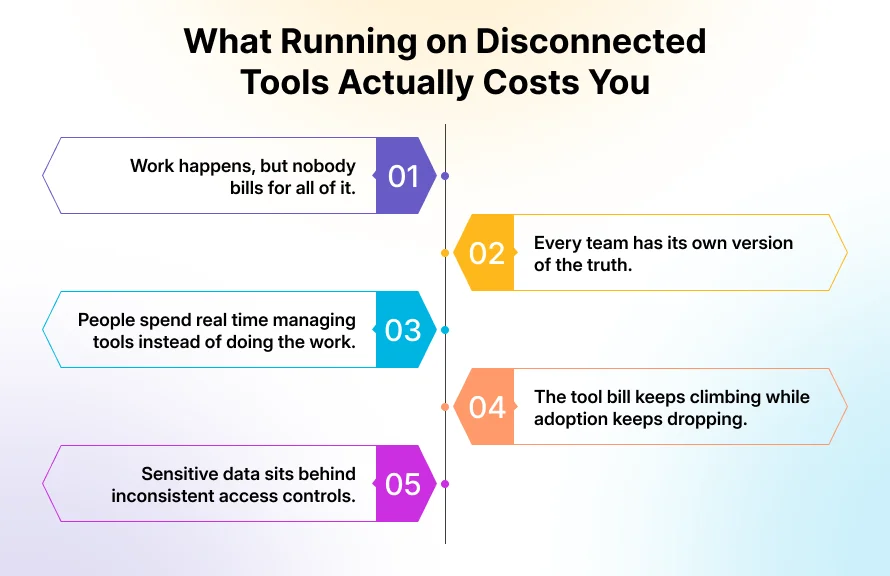
Work happens, but nobody bills for all of it. When delivery data lives in one tool and billing lives in another, hours quietly go untracked, scope creep goes unnoticed, and change requests never make it into an invoice. This is lost revenue that never even gets flagged as lost.
Every team has its own version of the truth. Sales see a deal as closed. Delivery sees a project as unstaffed. Finance sees an invoice as pending. None of it is wrong, but none of it is the same story, so leadership ends up managing instinct rather than one shared picture.
People spend real time managing tools instead of doing the work. Updating three systems to reflect one status change, chasing timesheets across platforms, manually pulling numbers into a deck before a review. This overhead is invisible on paper but very real on the calendar.
The tool bill keeps climbing while adoption keeps dropping. Every new subscription looks small on its own. Together, they add up to a meaningful line item, often a set of tools that overlap more than they complement.
Sensitive data sits behind inconsistent access controls. Client details, contracts, payroll, and performance data spread across separate systems means separate permission models, separate audit trails, and more places for something to go wrong.
What a Business Operating System Actually Is
A Business Operating System (BOS) is not another app added to the stack. It’s the layer that replaces the stack, a single environment where the functions that run a service business live together and share the same data.
For an IT or service business, that typically means:
People Management: One live record of who’s on the team, their availability, skills, attendance, and leave, instead of an HR tool that nobody outside HR opens.
Project & Resource Management: Planning, staffing, and tracking delivery against real capacity, not a task board disconnected from those who are free to do the work.
Sales & CRM: A pipeline that carries context all the way from first conversation to signed deal, so delivery isn’t starting from a cold handoff.
Recruitment: Hiring that’s driven by real project demand and skill gaps, not a separate ATS guessing at headcount.
Invoicing: Compensation and billing tied directly to logged time and delivered work, so nothing gets paid or billed on assumption.
Client Portal: One place clients and leadership both go for status, instead of status living in someone’s inbox.
The point isn’t that each module is impressive on its own. It’s that they share one dataset. A change in one place is immediately visible everywhere else it matters.
Why “Every Team. Every Function.” Is the Real Test
Most software is built for one function and tolerated by the rest. A BOS is judged differently: does it make things better for everyone who must use it, not just the department it was bought for.
- Leadership gets one view of the business instead of six dashboards that don’t reconcile.
- Operations get to connect demand, capacity, and delivery instead of guessing bandwidth.
- Sales get to sell what delivery can actually support, with real visibility into capacity.
- Project managers get budget, scope, and staffing in one place instead of three.
- HR and recruitment get to hire against real, current demand instead of a headcount request with no context.
- Finance gets billing that’s traceable straight back to delivered work.
- Employees get clarity on what they’re doing next and less friction logging it.
That’s the actual bar for “one system”: not that it exists, but that no team must leave it to get their job done.
What Changes When Everything Runs on One System
A single source of truth. When people, projects, sales, and finance share one dataset, “what’s the real status” stops being a question that needs a meeting to answer.
Delivery and billing stay in sync. Logged work becomes visible in commercial data. Unbilled hours, scope creep, and missed change requests get caught while they’re still small.
Utilization improves because planning gets smarter. Staffing by real availability and skill match, instead of who happened to be free, means fewer overloaded people and less idle capacity.
Operational overhead drops. Fewer systems to reconcile, less duplicate data entry, and fewer subscriptions to manage translate directly into time and cost saved.
The business can scale without chaos scaling with it. Adding a new team, service line, or client doesn’t mean adding another disconnected tool to the pile, it means configuring the system you already have.
Security gets simpler, not harder. One set of access controls and one audit trail is easier to secure and easier to prove compliant than ten separate ones.
Moving From Scattered Tools to One System
The switch doesn’t have to happen at all at once, and it shouldn’t.
- Map what you actually use today. Every tool, every team, every workaround. You can’t consolidate what you haven’t inventoried.
- Identify where the real pain is. Unbilled hours? Data that never matches between teams? Start where the cost is clear.
- Pick a system that’s modular by design. You should be able to start with the functions you need most and expand later, not commit to everything on day one.
- Migrate in stages. Move one function or one team first, prove the value, then expand. A phased rollout beats a risky big-bang switch.
- Standardize as you go. The new system, the same old inconsistent process, is a missed opportunity. Use the migration to fix workflows.
Conclusion
Tool sprawl doesn’t happen on purpose, it happens one reasonable-looking decision at a time. Undoing it takes a deliberate one too: choosing a single system built to run the whole business, not just one corner of it.
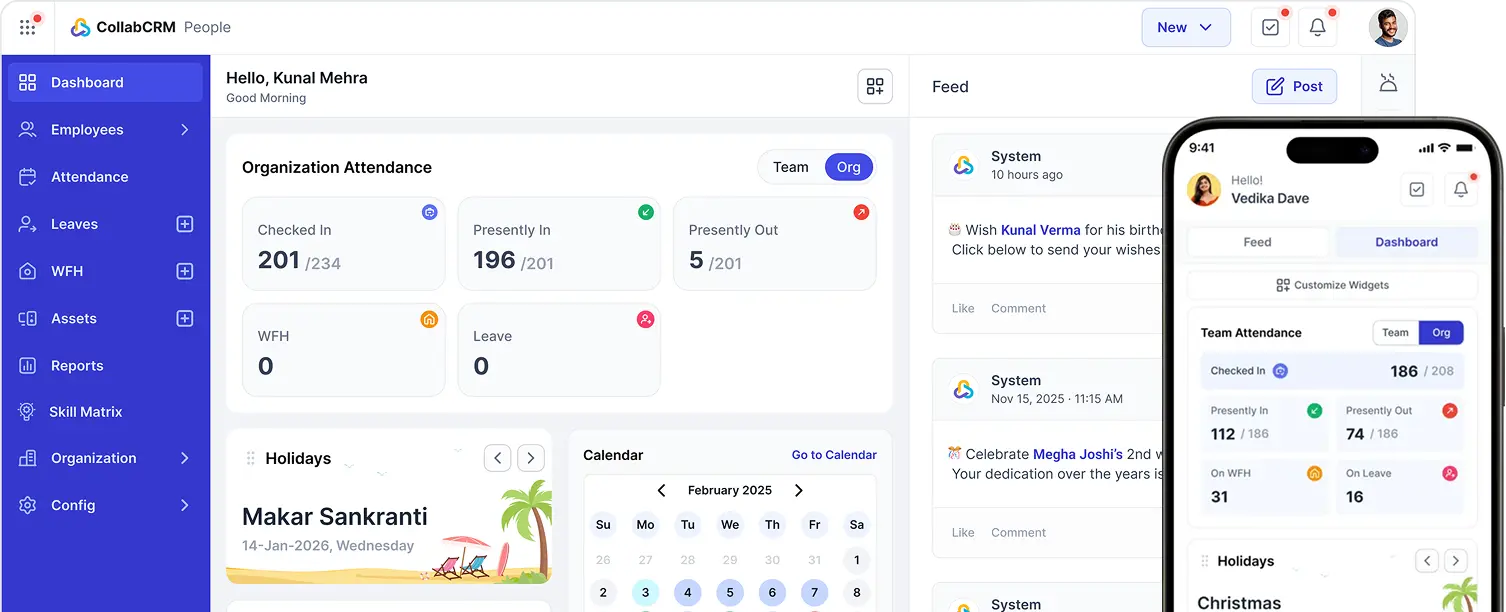
CollabCRM was built on exactly this premise, one connected platform for people, projects, sales, recruitment, payroll, and client delivery, so that every team works from the same data instead of their own version of it. It’s modular, so you start with what you need and grow into the rest, and it’s built so that delivery evidence and commercial terms never drift apart again.




 Priority Onboarding