
Payroll in India is not just about paying salaries on time. It means getting Provident Fund, Employee State Insurance, Professional Tax, and TDS right every month, across every state you operate in. One missed filing can mean penalties, and one wrong calculation can mean an upset employee.
With the four new Labor Codes now in force and salary structures shifting under the new wage rules, choosing payroll software has become a bigger decision than it used to be. Businesses evaluating payroll as part of a broader HR stack can also compare HRMS software for Indian IT companies before making a decision.
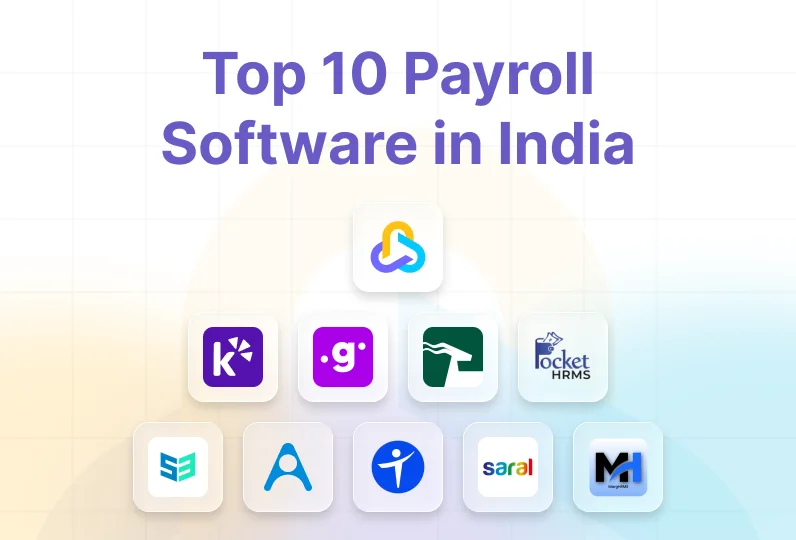
This guide compares the 10 best payroll software Indian businesses search for most, from all-in-one business systems to point solutions built for a single use case. We look at what each one does well, who it fits best, and where it falls short, so you can shortlist faster.
TL;DR: Best Payroll Software in India
| Software | Best For | Standout Strength | Deployment |
| CollabCRM | IT & software companies, startup to enterprise | All-in-one: payroll + HR + CRM + projects + invoicing; full statutory coverage with multi-state PT handling | Cloud, live in 1-2 weeks |
| Keka HR | SMBs & mid-market (50-1,000 employees) | Intuitive interface with strong Indian statutory compliance | Cloud |
| greytHR | Small & medium enterprises | Payroll-first focus, wide adoption across India | Cloud |
| HROne | Mid-market to enterprise (250-5,000+ employees) | Configurable workflows and a built-in ROI dashboard | Cloud |
| Pocket HRMS | SMBs & growing mid-size businesses | AI-assisted payroll with a modular, pay-as-you-grow structure | Cloud |
| SalaryBox | Small businesses with frontline or field staff | Mobile-first attendance with offline mode | Mobile app |
| Attendo (Former: Petpooja Payroll) | F&B, retail & hospitality small businesses | Fast shift-based attendance to payroll workflow | Cloud & mobile |
| FactoHR | SMEs to large enterprises | Modular HCM with geofenced, face-recognition attendance | Cloud |
| Saral HRM | Small to mid-size businesses | Cloud or on-premise flexibility | Cloud & on-premise |
| MargHRMS | SMBs on the Marg ERP ecosystem | Payroll bundled with accounting & ERP tools | Cloud & desktop |
Deployment and fit are based on publicly available product information and verified user reviews as of 2026
How We Built This List
This list considers payroll capabilities that matter to Indian businesses: statutory coverage, employee-data management, attendance and leave inputs, multi-state readiness, compensation configuration, reporting, and implementation fit.
Payroll compliance is an important operating responsibility at scale. The Employees’ Provident Fund Organization, or EPFO, reports that it maintains 29.88 crore member accounts in its published annual-report information. This highlights the scale of formal payroll and social-security administration in India.
The list is not a universal ranking. The best payroll tool depends on your employee count, operating states, existing HR systems, salary complexity, and need for connected business operations.
What to Look for in Payroll Software for India
Before choosing software, map your current payroll process. Identify where data starts, who approves it, how exceptions are handled, and how payroll information reaches finance and employees.
Look for these areas:
- Statutory support: Check whether the system supports applicable PF, ESI, TDS, Professional Tax, Labor Welfare Fund, gratuity, bonus, and related records.
- Multi-state payroll: Confirm that location-specific Professional Tax and Labor Welfare Fund rules can be configured correctly.
- Connected employee data: Attendance, leave, reimbursements, loans, advances, and employee details should flow into payroll without repeated manual entry.
- Flexible salary structures: The system should support the salary components, allowances, deductions, bonuses, and pay schedules used by your business.
- Employee self-service: Employees should be able to access payslips, tax declarations, investment proofs, claims, and payroll-related information securely.
- Reporting and controls: Review payroll registers, audit trails, access permissions, approvals, and finance-ready reports.
- Implementation support: Ask about data migration, payroll setup, training, customer support, and expected go-live time.
Moreover, as your headcount grows, the right payroll platform should also help you build a scalable HR system rather than create another isolated software layer.
The Indian Payroll Compliance Regime
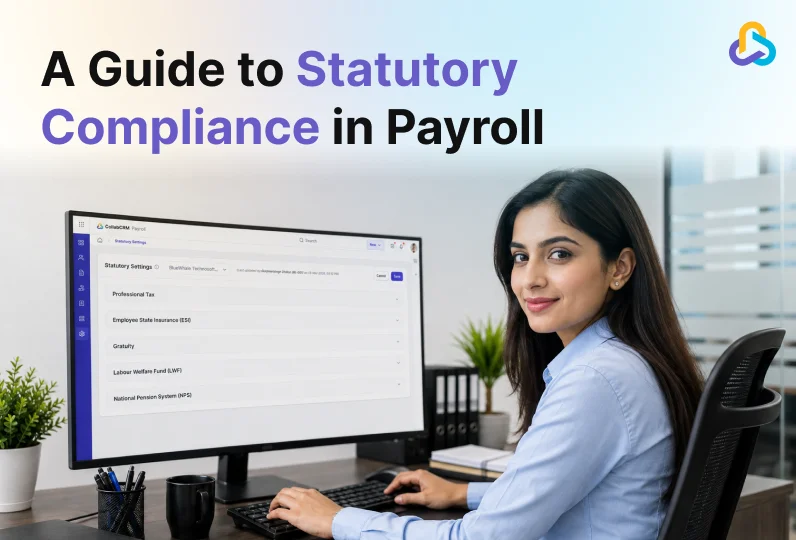
Payroll software should help businesses manage applicable statutory requirements. The exact obligations depend on employee eligibility, employer category, state, compensation structure, and current regulations.
Common payroll components include:
- Provident Fund, or PF/EPF: Employee and employer contributions, ECR-related records, and applicable reporting.
- Employees’ State Insurance, or ESI/ESIC: Contribution calculations and records where coverage applies.
- Tax Deducted at Source, or TDS: Tax computation, declarations, proof collection, Form 16 support, and reporting processes.
- Professional Tax, or PT: State-specific slabs, registrations, deductions, remittances, and filings where applicable.
- Labor Welfare Fund, or LWF: State-based applicability, contribution rules, and deadlines.
- Gratuity and bonus: Calculations and compliance processes where applicable.
Always verify your current obligations with a qualified payroll, tax, or legal professional. EPFO provides official information and updates related to provident-fund administration in India. With this you will leverage the benefits of streamlining HR operations.
Top 10 Payroll Software in India for 2026
Here is the list of top 10 Payroll software in India, based on our truest knowledge.
1. CollabCRM
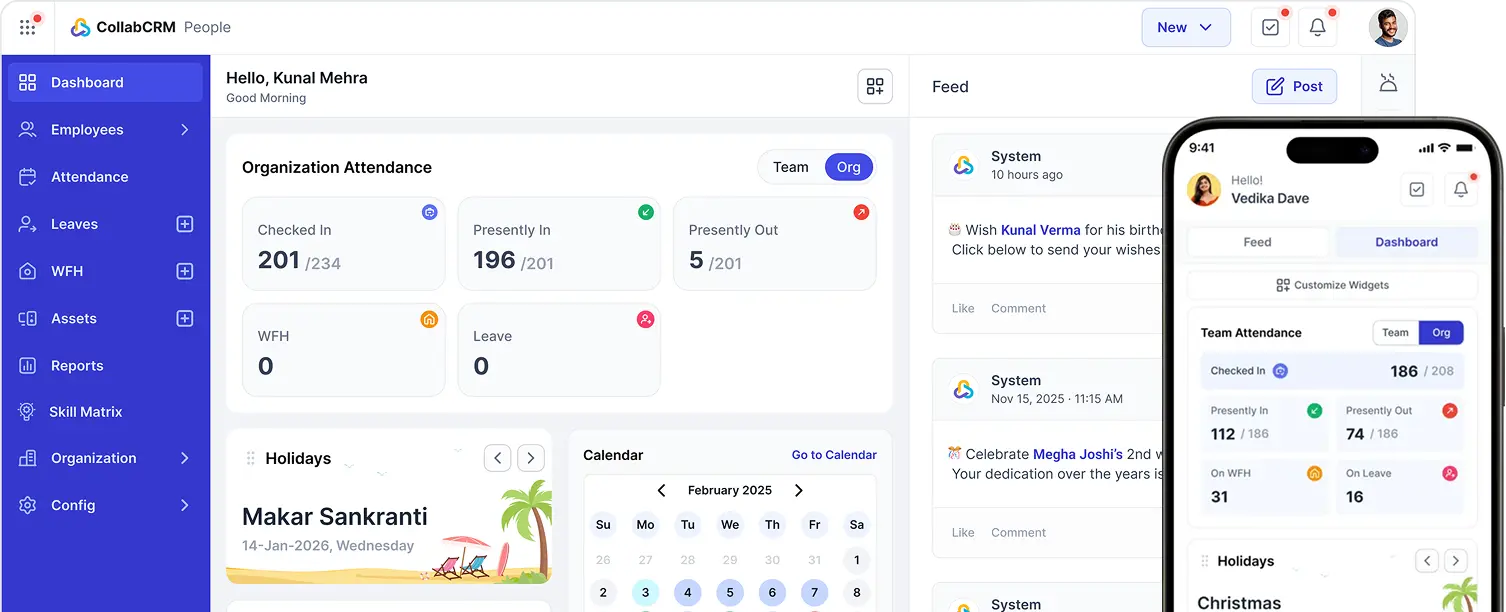
CollabCRM is a business operating system built by MindInventory, designed to run HR, payroll, recruitment, CRM, projects, and invoicing from one platform rather than as separate tools.
For IT and software companies, this means payroll does not sit in isolation. It draws attendance, leave, and People module data directly, so salary runs reflect actual worked days without manual reconciliation between systems.
For companies looking to replace multiple tools with one business operating system, this connected approach can simplify day-to-day operations.
Key capabilities:
- Full statutory coverage, including PF, ESI, Professional Tax, TDS, and LWF, with rates updated as regulations change.
- Multi-state PT handling: companies with offices across several Indian states get the correct professional tax slab applied per employee location automatically, without separate manual setup for every branch.
- Payroll synced with the People module, so leave, WFH, and attendance data feeds directly into salary calculation.
- Employee self-service portal for payslips, tax declarations, and reimbursement tracking.
- Fast implementation: typically 1 to 2 weeks, with free setup support, guided data migration, and a dedicated customer success manager included at no extra cost.
- Transparent, flat pricing at ₹499 per user per month (with a yearly discount), with every module included and no locked features or paid add-ons for core functionality.
Ideal for: IT services companies, software product businesses, and staffing or recruitment agencies, from early-stage startups to enterprise-scale organizations, that want payroll to work as part of one connected system rather than a bolted-on tool.
It is a strong fit for companies operating across multiple states that want PT and statutory filings handled without extra manual setup per location.
Limitations: Because CollabCRM is purpose-built for IT and software-driven businesses, organizations in very different sectors, such as manufacturing with shift-based wage structures, may still need a more industry-specific tool alongside it.
2. Keka HR
Keka HR is an HRMS platform that includes payroll, attendance, leave, employee records, performance management, recruitment, and related HR workflows. It is commonly considered by growing businesses looking for a modern HR and payroll system.
Key capabilities: Cloud HRMS with payroll, statutory compliance (PF, ESI, PT, TDS), biometric and geofenced attendance, an employee self-service portal, plus hiring and performance tracking tools.
Ideal for: SMBs and mid-market IT and services companies, roughly 50 to 1,000 employees, especially single-entity Indian firms.
Limitations: The base plan is billed for up to 100 employees regardless of actual headcount, which makes it costlier per head for smaller teams. Its payroll depth is built around India, so companies with international payroll needs will need a separate solution for that.
3. greytHR
greytHR is an India-focused HR and payroll platform used by many small and medium businesses. It is generally evaluated for payroll processing, HR administration, employee records, and statutory payroll workflows.
Key capabilities: Cloud-based payroll processing, leave and attendance management, statutory compliance automation, and an employee self-service portal.
Ideal for: Small and medium enterprises that want a straightforward, payroll-first tool without a steep learning curve.
Limitations: Users report an interface that feels dated, occasional errors during payroll runs, and support that can be slow to resolve since queries go through a shared desk rather than a dedicated contact.

4. HROne
HROne is a cloud HRMS platform with payroll and employee-management workflows. It is an option for businesses that want to digitize their HR processes while managing payroll through the same system.
Key capabilities: Cloud HCM platform covering payroll, attendance, recruitment, performance management, and configurable approval workflows, with a built-in ROI dashboard for tracking time and cost savings.
Ideal for: Mid-market and large enterprises, generally 250 to 5,000-plus employees, especially those managing multiple legal entities.
Limitations: Pricing is quote-based and not published. Go-live can take longer for large, multi-entity rollouts, and some reviewers note occasional slowness during high-traffic periods like month-end payroll.
5. Pocket HRMS
Pocket HRMS offers HR and payroll software for Indian organizations. It is designed to help teams manage HR operations, payroll work, and employee self-service through a central platform.
Key capabilities: AI-assisted payroll and HR management, PF, ESI and TDS handling, biometric attendance integration, a chatbot-based employee assistant, and a mobile self-service app.
Ideal for: SMBs and growing mid-size businesses looking for a modular, pay-for-what-you-need HR and payroll suite.
Limitations: Reviewers point to limited report customization, an interface that feels behind newer competitors, and added complexity when configuring statutory rules across multiple states.
6. SalaryBox
SalaryBox focuses on workforce-management tools, including attendance, salary, and employee operations. It can be considered by small businesses that want a simpler way to manage a distributed workforce.
If you run a small company, the best payroll for small business may be a simpler platform focused on attendance, salary calculations, statutory compliance, and employee self-service.
Key capabilities: Mobile-first attendance and payroll app with selfie and GPS-based check-ins, geofencing, automated salary calculation, digital payslips, offline mode, and support for multiple Indian languages.
Ideal for: Small businesses with frontline, retail, field, or daily-wage staff who need simple attendance-to-payroll tracking from a phone.
Limitations: Built for simpler wage structures rather than complex, multi-state statutory setups, and lighter on HR functions like recruitment or performance management that larger organizations typically need.
7. Attendo
Attendo (Formerly known as Petpooja Payroll) is positioned around attendance and HR processes, with payroll-related functionality for businesses that want workforce data and attendance to inform employee administration.
Smaller companies often need payroll software for small business that handles statutory requirements without the complexity or implementation burden of an enterprise HCM platform. Attendo caters to it.
Key capabilities: Fingerprint, face, and location-based attendance, shift management for overnight or multi-shift schedules, automated payroll calculation, and leave tracking.
Ideal for: Small businesses in food and beverage, retail, and hospitality with hourly or shift-based staff.
Limitations: Designed around fast attendance-to-payroll workflows for frontline staff, so it carries less breadth in statutory compliance and enterprise HR features than platforms built for larger, multi-department organizations.
8. FactoHR
FactoHR is an HRMS and payroll solution for Indian businesses. It can be considered by companies looking to manage HR operations, workforce data, and payroll from a broader software suite.
Key capabilities: Cloud HCM suite with payroll, geofenced and face-recognition attendance, leave management, recruitment, performance tracking, and an employee self-service portal.
Ideal for: Businesses ranging from SMEs to large enterprises that want a modular suite they can scale into over time.
Limitations: Reviewers mention a learning curve for new users, slower report generation, and limited customization for workflows and reports compared to some competitors.
9. Saral HRM (Saral PayPack)
Saral HRM provides HR and payroll software for businesses seeking a central system for employee information and payroll administration.
Key capabilities: End-to-end payroll from attendance capture to payslip generation, statutory compliance for PF, ESI, PT, and TDS, and both cloud and on-premise deployment options.
Ideal for: Small to mid-size businesses that prefer an on-premise setup for data control, and organizations already using Saral’s tax and accounting products.
Limitations: Initial setup and configuration take real time upfront, and the interface feels less modern than newer cloud-first platforms.
10. MargHRMS
Marg HRMS is an HR and payroll software option for organizations that want to organize employee data and payroll processes.
Key capabilities: Payroll processing, attendance and leave tracking, and compliance management, bundled with the broader Marg ERP suite of accounting and business tools.
Ideal for: Small and medium businesses already using Marg’s accounting or ERP products who want payroll in the same ecosystem.
Limitations: The interface feels less modern than newer entrants; some users report the software slowing down after frequent updates, and it leans more toward core payroll than advanced HR workflows.
How to Choose the Right Payroll Software for Your Enterprise in India
The best payroll management software in India should fit your workforce structure, operating locations, salary complexity, compliance requirements, and existing HR systems.
There is no single best answer, only the best fit for your business. Start with these questions:
- How many states do you operate in? If you have employees in more than one state, Professional Tax and Labor Welfare Fund rules will differ. Confirm the software applies these automatically instead of needing manual updates per branch.
- What is your workforce type? Office-based salaried staff, field teams, and shift workers need different attendance-to-payroll workflows. Match the tool to how your people actually clock in.
- How connected does payroll need to be? If HR, attendance, recruitment, and finance already live in separate tools, a connected system reduces double entry and reconciliation errors. This can also help prevent tool sprawl as your business adds more HR and finance applications over time. If you only need payroll, a focused tool may be enough.
- How fast do you need to go live? Longer implementation timelines mean more payroll cycles run on your old process. Ask vendors for a realistic go-live date, not just a demo.
- Is the vendor ready for the Labor Codes? With the new wage definition rule now in force, confirm the software has already updated its PF, gratuity, and bonus calculations to reflect it.
- What does the pricing actually include? Per-employee pricing can look cheaper on paper but cost more once base fees, minimum headcount billing, and add-on modules are factored in. Ask for one all-in monthly number for your actual headcount.
Final Takeaway
There is no single payroll software that fits every Indian business. The right choice depends on company size, employee locations, payroll complexity, existing software, compliance requirements, and internal operating processes.
For IT companies and growing service organizations, CollabCRM is a strong all-in-one choice. It connects payroll with people management, attendance, leave, projects, recruitment, sales, invoicing, and administration. This can reduce manual reconciliation and unnecessary switching between disconnected tools.
CollabCRM offers full statutory coverage, multi-state Professional Tax handling, employee self-service, configurable salary structures, payroll automation, reimbursements, loans, tax declarations, and bank-ready payroll files. Its stated implementation timeline is 1 to 2 weeks.
FAQs
Payroll software helps businesses calculate salaries, manage deductions, generate payslips, process reimbursements, maintain payroll records, and support compliance-related workflows.
If you’re researching the best payroll software in India, the choice depends on your employee count, operating locations, salary structure, statutory needs, existing HR stack, and desired implementation timeline.
CollabCRM is a strong option for IT businesses that need payroll connected with people, projects, attendance, leave, recruitment, and business operations.
Many payroll systems support these workflows. However, businesses should confirm the exact statutory coverage, update process, state-specific rules, and filing responsibilities before selecting a tool.
Yes. Many modern payroll solutions connect attendance and leave information with payroll calculations. CollabCRM supports payroll alongside attendance and leave records to help reflect working days, leave, and applicable deductions in payroll processing.
Implementation time varies by data quality, employee count, salary complexity, number of locations, and migration needs. CollabCRM’s payroll implementation timeline is 1 to 2 weeks.
CollabCRM combines payroll with people management, attendance, leave, projects, recruitment, sales, invoicing, and administration. It helps businesses reduce manual payroll work, improve visibility, and manage employee operations from one platform.
The best HR payroll software in India depends on whether you need payroll alone or a broader HR platform. Businesses that want attendance, leave, employee records, recruitment, and payroll in one system may benefit from an integrated HRMS rather than a payroll-only product.



 Priority Onboarding