

- A salary is regular, recurring pay for an employee performing ongoing work, processed through payroll with TDS, PF, and other statutory deductions.
- A stipend is a fixed, purpose-specific payment for training, internship, apprenticeship, or research, and its tax and compliance treatment depends on the real nature of the arrangement, not the label used.
Salary and stipend are both forms of payment, but they serve different purposes. A salary pays an employee for ongoing work, while a stipend usually supports a learner, trainee, apprentice, intern, or a specific work-related expense.
For employers, using the right term is more than a documentation detail. It affects payroll process, tax treatment, statutory compliance, employee expectations, and the nature of the working relationship. For interns and early-career professionals, it affects take-home income, benefits, job security, and career progression.
This guide explains stipend vs salary in simple terms, with practical examples and an India-focused compliance perspective.
Stipend vs Salary: At a Glance
| Basis | Stipend | Salary |
| Meaning | A fixed payment given to support training, learning, research, apprenticeship, internship, or specific work-related expenses | Regular compensation paid to an employee for ongoing work and job responsibilities |
| Primary purpose | Supports participation in a time-bound program or covers a defined expense | Pays an employee for performing a continuing role within the organization |
| Typical recipient | Intern, trainee, apprentice, fellow, student, researcher, or employee receiving a specific allowance | Full-time, part-time, probationary, or contractual employee |
| Nature of relationship | Usually training-based, program-based, or purpose-specific | Employer-employee relationship |
| Payment frequency | Can be monthly, one-time, milestone-based, or program-based | Usually paid monthly through the payroll cycle |
| Duration | Fixed for the internship, training, apprenticeship, fellowship, or allowance period | Continues throughout the employment period |
| Work expectations | Focuses primarily on learning, mentorship, supervised exposure, or a defined objective | Involves regular responsibilities, deliverables, performance expectations, and business outcomes |
| Amount | Usually a fixed amount decided for the program or purpose | Based on role, skills, experience, market benchmarks, salary structure, and company policy |
| Payroll treatment | Depends on the actual purpose and nature of the arrangement | Generally processed through the company payroll system |
| Payslip | May or may not be issued, based on company policy and payment treatment | Usually issued with a monthly salary breakup and deductions |
| Tax treatment | Depends on why it is paid. A scholarship granted to meet education costs is exempt under Section 10(16), but not every stipend is tax-free. | Generally taxable as salary income. Employers must deduct TDS under Section 192 when salary income exceeds the applicable basic exemption limit. |
| PF and ESI | Depends on the actual relationship, legal classification, and applicable rules | May apply when the employee and establishment meet statutory eligibility requirements |
| Benefits | Usually limited to program support, mentorship, training, certificates, or purpose-specific allowances | May include paid leave, PF, ESI, insurance, bonuses, gratuity, reimbursements, and company benefits |
| Best used when | The arrangement is genuinely for training, apprenticeship, research, internship, fellowship, or a defined expense | The individual performs ongoing work as an employee and contributes to regular business operations |
| Key compliance point | Do not use a stipend label to avoid payroll or employment obligations when the person works like a regular employee | Maintain proper employment documentation, payroll records, tax deductions, and applicable statutory compliance |
Quick takeaway: A stipend is best for a clearly defined learning, training, apprenticeship, or expense-support arrangement. A salary is appropriate when an individual is hired as an employee to perform ongoing work for the organization.
What is a Salary?
A salary is a fixed and recurring amount that an employer agrees to pay an employee for performing their role and responsibilities.
It is commonly expressed as an annual Cost to Company, or CTC, and paid monthly in India. The salary structure may include components such as basic salary, house rent allowance, special allowance, bonus, and other applicable benefits.
Under the Code on Wages, 2019, wages include remuneration payable to a person employed in respect of their employment or work done. The statutory definition includes basic pay, dearness allowance, and retaining allowance, subject to listed exclusions.
Key characteristics of a salary
- It is paid for ongoing work performed as part of an employer-employee relationship.
- It is generally paid on a regular cycle, usually monthly in India.
- It is documented in an employment offer letter or contract.
- It appears on payslips and payroll records.
- It is generally subject to TDS when the employee’s taxable income exceeds the applicable exemption threshold.
- The employer responsible for paying salary must deduct tax at source under Section 192 when salary income exceeds the basic exemption limit.
- It may attract PF, ESI, professional tax, gratuity, bonus, leave, and other statutory or company benefits, depending on eligibility and applicable laws.
- It can change through increments, promotions, compensation revisions, or performance-linked components.
Salary example
A software developer joins an IT company with an annual CTC of ₹8,40,000.
The employee receives a monthly salary through payroll. The company provides a payslip that shows salary components, deductions such as TDS and PF where applicable, and the final net pay credited to the employee’s bank account.
The employee is hired for an ongoing role, works under company direction, contributes to client projects, and receives formal employment benefits. This is a salary-based employment arrangement.
What is a Stipend?
A stipend is a fixed payment provided for a specific purpose. It is commonly offered to interns, trainees, apprentices, fellows, researchers, or students who are gaining practical exposure, learning a skill, or participating in a defined program.
Unlike salary, a stipend is not necessarily intended to fully compensate a person for ongoing employment. It is often designed to support living costs, travel, training, housing, meals, learning, or participation in a program.
However, labels alone do not determine the legal position. Calling a payment a “stipend” does not automatically make it exempt from tax, payroll obligations, or labor-law considerations. The actual duties, supervision, work hours, duration, and nature of the relationship all matter.
Key characteristics of a stipend
- It is generally paid for a specific purpose, training period, or program.
- It may be paid monthly, quarterly, as a one-time amount, or against milestones.
- It is commonly used for internships, apprenticeships, fellowships, research programs, and training assignments.
- It may also be used as an additional allowance for remote work, travel, learning, internet, meals, or relocation.
- It is usually fixed for the duration of the program.
- It may not include the same employment benefits available to salaried employees.
- Its taxability and statutory treatment depend on the payment’s purpose and how the relationship is structured.
Stipend example
A final-year computer science student joins a six-month software development internship. The organization pays ₹15,000 per month to support the student during the learning period.
The intern receives mentorship, works on supervised assignments, attends training sessions, and is evaluated at the end of the internship. The offer letter clearly states the duration, stipend amount, learning objectives, reporting manager, work expectations, and conversion criteria, if any.
This may be a genuine stipend-based arrangement if the role is structured around training and learning. But if the individual performs the same core work as a regular employee under fixed hours and close control, the organization should seek professional advice on whether the arrangement creates employment obligations.
Stipend vs Salary: Key Differences
The core difference between salary and stipend is the purpose of the payment.
A salary is paid to an employee for ongoing work, responsibilities, and business outcomes. It is usually part of a formal employment arrangement and is processed through payroll.
A stipend is usually paid to support a person during training, education, research, apprenticeship, internship, fellowship, or a specific expense-related arrangement. It is often time-bound and may not include the same benefits available to salaried employees.
Purpose of payment
Salary compensates an employee for the work they perform as part of the organization’s normal operations.
A stipend supports learning, participation, training, or a defined expense. For example, an intern may receive a monthly stipend while learning through supervised assignments, while a salaried software engineer is paid to deliver regular work on client or product projects.
Employment relationship
Salary generally indicates an employer-employee relationship. The employee has an assigned role, regular responsibilities, reporting structure, performance expectations, and ongoing employment terms.
A stipend-based arrangement may involve an intern, trainee, apprentice, fellow, researcher, or student. However, the label is not enough. If the person works like a regular employee, the employer should assess whether employment-related obligations apply.
Pay structure and duration
Salary is normally paid on a recurring monthly cycle and continues for the duration of employment. It may be revised through appraisals, promotions, or compensation changes.
A stipend may be paid monthly, as a one-time amount, or against milestones. It is usually fixed for the duration of a training program, internship, apprenticeship, research assignment, or specific allowance period.
Tax, payroll, and benefits
Salary is generally processed through payroll and may involve TDS, PF, ESI, professional tax, paid leave, insurance, bonuses, gratuity, and other applicable benefits.
A stipend’s tax and statutory treatment depends on its purpose and the underlying arrangement. A scholarship received to meet the cost of education is exempt under Section 10(16) of the Income-tax Act. However, a payment called a stipend is mostly taxable if it is paid for work or services.
Career progression
Salary is usually connected to a defined job role, appraisal cycle, pay progression, promotion opportunities, and long-term career development.
A stipend-based program may lead to a full-time offer, but it does not guarantee employment unless the organization states that commitment clearly in writing.
Stipend vs Salary: A Quick Example
Consider two people working at the same IT company.
| Scenario | Intern on stipend | Software engineer on salary |
| Role | Six-month internship in software testing | Full-time QA engineer |
| Payment | ₹12,000 monthly stipend | ₹6,00,000 annual CTC |
| Main purpose | Gain hands-on learning and supervised work exposure | Perform ongoing testing responsibilities for business projects |
| Duration | Fixed six-month program | Continues under the employment agreement |
| Work structure | Training plan, mentorship, limited project tasks | Defined KPIs, client deliverables, performance reviews |
| Benefits | May receive a certificate, training, and limited allowances | May receive paid leave, PF, ESI where applicable, insurance, and other benefits |
| Outcome | May receive a full-time offer after successful completion | Has an established employee role and career progression path |
The key difference is not simply the amount paid. It is the underlying purpose and relationship.
Common Types of Stipends
Stipends can take several forms. The organization should define the purpose, amount, eligibility, duration, and tax treatment in writing.
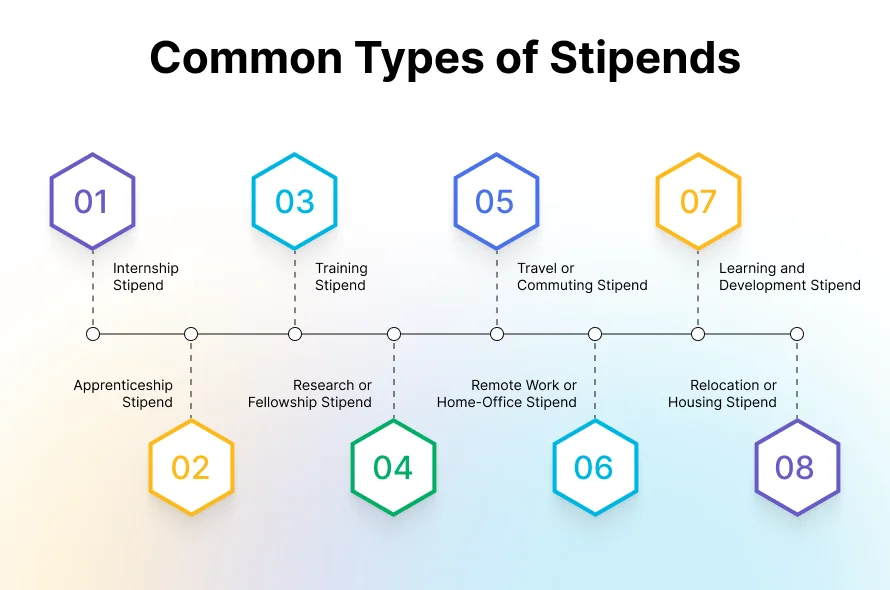
1. Internship stipend
An internship stipend supports students or fresh graduates while they gain practical work exposure.
Example: A digital marketing intern receives ₹10,000 per month for a three-month internship that includes training, campaign research, content support, and weekly mentorship sessions.
2. Apprenticeship stipend
An apprenticeship stipend is paid to apprentices receiving practical training under an apprenticeship arrangement.
The Apprentices Act, 1961 requires employers to pay every apprentice a stipend at no less than the prescribed minimum rate, or the applicable rate specified in the apprenticeship contract where higher.
Example: A graduate apprentice joins a manufacturing company under a formal apprenticeship contract and receives the prescribed monthly stipend during the training period.
3. Training stipend
A training stipend supports participants undergoing a structured program before they take on a regular employee role.
Example: A company hires a group of fresh graduates for a four-month Java training program and pays a fixed stipend while they complete coursework, assessments, and supervised project assignments.
4. Research or fellowship stipend
Research institutions, universities, nonprofits, and innovation teams may provide stipends to support research, study, or fellowship work.
Example: A research fellow receives a monthly payment to support work on a data-analysis project connected to an academic research program.
5. Travel or commuting stipend
A travel stipend helps cover transportation costs related to an internship, training program, field assignment, or work requirement.
Example: A company provides a ₹2,000 monthly travel stipend to interns who must commute to the office three days a week.
6. Remote work or home-office stipend
Some organizations provide an additional stipend to employees for home-office, internet, equipment, or utility costs. In this case, the stipend is not a replacement for salary. It is a targeted allowance or reimbursement on top of regular pay.
Example: A remote employee receives a ₹1,500 monthly internet allowance in addition to their monthly salary.
7. Learning and development stipend
A learning stipend supports professional development, certifications, courses, books, conferences, or exam fees.
Example: An IT company offers a ₹25,000 annual learning allowance to employees for approved cloud certifications, technical courses, or professional memberships.
8. Relocation or housing stipend
A relocation or housing stipend may support a person who moves for a training program, internship, project, or job.
Example: A new campus hire relocating to Bengaluru receives a one-time relocation allowance to help with initial travel and accommodation costs.
When Should Employers Use a Stipend?
Employers should use a stipend when the payment has a clear and legitimate purpose beyond replacing regular wages.
A stipend works best when it supports learning, participation, or specific expenses. It should be supported by clear terms, written documentation, and a process that matches the real nature of the arrangement.
Use a stipend for internships and learning programs
Internships are a common use case for stipends. A well-designed internship should offer practical experience, supervision, skill development, structured feedback, and a clear duration.
For example, an IT company can offer a stipend to interns during a three-month training program focused on testing, web development, data analysis, or support operations.
The organization should avoid treating interns as low-cost substitutes for full-time employees. If interns perform essential ongoing work under the same control, schedule, and expectations as employees, the arrangement may create compliance concerns.
Use a stipend for apprenticeships
A formal apprenticeship is another appropriate use case. The Apprentices Act, 1961 recognizes apprenticeship training and requires employers to pay a prescribed stipend to apprentices.
The Directorate General of Training notes that apprenticeship is intended to supplement institutional learning with practical training at the workplace.
Use a stipend for defined, work-related costs
Companies can provide stipends or allowances for specific needs, such as:
- Internet and home-office expenses
- Travel and commuting
- Mobile phone use
- Learning and professional certifications
- Relocation support
- Wellness or employee engagement programs
For regular employees, these should generally supplement salary rather than replace it.
Use a stipend for fellowships and research assignments
Research, academic, social-impact, and fellowship programs may use stipends to help participants cover expenses while working toward defined learning or research outcomes.
For example, a university-industry research initiative may pay a stipend to a fellow working under faculty and industry mentorship.
Use a stipend for time-bound talent pipelines
Some companies run campus, trainee, or graduate programs to identify future full-time talent. A stipend can work during the initial learning period if the program has defined objectives, supervision, duration, and evaluation criteria.
The organization should clearly state whether successful completion may lead to a full-time offer. It should not imply guaranteed employment unless that is the actual commitment.
Some government-backed initiatives, such as internship and skilling schemes for startups and MSMEs, may also apply. Founders should check current eligibility before designing a pipeline program.
When is Salary the Better Choice?
Salary is the appropriate model when the person is working in an ongoing employee role and contributes to the organization’s normal business operations.
In most regular employment situations, the choice is not salary versus stipend. Salary forms the main compensation structure. A stipend, allowance, or reimbursement may be added separately if the company wants to support a specific expense or benefit.
Use salary for regular, ongoing roles
A person hired as a developer, HR executive, project manager, sales professional, customer-support executive, or finance specialist usually performs ongoing work that supports the business.
These roles need a clear employment agreement, structured payroll, regular compensation, defined responsibilities, and applicable benefits.
Example: A full-time frontend developer builds features for client projects, attends daily stand-ups, reports to an engineering manager, and works under a continuing employment agreement. Salary is the appropriate compensation model.
Use salary when the role requires long-term accountability
Salary is better for roles where the business expects consistent delivery, defined work hours, performance measurement, confidentiality, intellectual-property protection, and long-term contribution.
This includes roles that are critical to business operations, client delivery, product development, leadership, and revenue generation.
Use salary when statutory compliance applies
Salary provides a more established framework for handling payroll, payslips, TDS, PF, ESI, leave, bonus, and other applicable obligations.
The Income Tax Department states that employers paying salary must deduct TDS under Section 192 when the employee’s salary income exceeds the basic exemption limit.
Use salary to support compensation planning and retention
A salary structure helps organizations define pay bands, compare market compensation, conduct appraisal cycles, plan increments, manage promotions, and review internal pay equity.
For employees, salary offers predictable income. It also helps them plan for rent, loans, insurance, savings, taxes, and other long-term financial commitments.
Can an Employee Receive Both Salary and Stipend?
Yes. A salaried employee can receive a stipend, allowance, or reimbursement in addition to regular salary.
This is common when companies want to support a specific employee need without changing the employee’s base salary.
Examples of salary plus stipend
- A software engineer receives a monthly salary plus an internet allowance for remote work.
- A sales executive receives a salary plus a mobile-phone allowance.
- An employee receives a salary plus an annual certification stipend.
- A new hire receives a salary plus a one-time relocation allowance.
- A manager receives a salary plus a travel reimbursement for official client visits.
The company should define each payment clearly. It should state whether the amount is a taxable allowance, a reimbursement against bills, or a benefit with specific eligibility conditions.
This distinction matters because tax and payroll treatment may differ.

Tax Treatment of Salary and Stipend in India
Tax treatment is one of the most important parts of the stipend vs salary discussion.
Salary is generally taxable as income from salary.
A stipend’s tax treatment depends on how it functions: stipends for genuine training, scholarships, or research (such as those covered under Section 10(16)) are typically exempt, while stipends that function like regular compensation are usually taxable in the recipient’s hands.
This section is for general information. Employers and recipients should consult a chartered accountant, tax professional, or legal advisor for decisions involving their specific facts.
How salary is taxed
Salary income is generally taxable. Employers calculate taxable salary, consider declarations and eligible deductions, deduct TDS where applicable, and issue Form 16 to employees.
The Income Tax Department states that an employer responsible for paying salary must deduct tax under Section 192 if the salary income exceeds the basic exemption limit.
A salaried employee may see the following on their payslip, depending on eligibility and company policy:
- Basic salary
- House Rent Allowance
- Special allowance
- Bonus or incentive
- TDS
- Employee PF contribution
- ESI contribution, where applicable
- Professional tax, where applicable
- Insurance or other voluntary deductions
Is a stipend taxable?
A stipend is not automatically tax-free. Its taxability depends on its purpose, the recipient’s relationship with the organization, the nature of services performed, and the applicable tax provisions.
For example:
- A genuine scholarship paid to cover education costs typically qualifies for exemption under Section 10(16).
- A stipend paid for work that resembles regular employment is treated as taxable income, since the substance of the arrangement matters more than its label.
- A remote-work allowance paid to an employee is taxable unless it is structured as a valid reimbursement under applicable rules, with supporting documentation.
- A reimbursement against documented business expenses is treated differently from a flat cash allowance, since the former offsets an actual cost and the latter is discretionary income.
Educational scholarship exemption
Section 10(16) of the Income-tax Act exempts scholarships granted to meet the cost of education. The Income Tax Department explicitly lists “any scholarship received for meeting the cost of education” as exempt income under Section 10(16).
However, not every payment called a stipend qualifies as a scholarship. The actual purpose matters.
A company should not assume that a stipend is tax-exempt simply because it is paid to an intern or trainee. Tax treatment should be assessed based on the specific arrangement and supporting documentation.
Practical tax rule for employers
Do not make tax assumptions based only on labels.
Before paying a stipend, HR and finance teams should clarify:
- Why is the payment being made?
- Is it for education, training, work, or a defined expense?
- Is the recipient an employee, intern, apprentice, trainee, fellow, consultant, or student?
- Is the payment a flat allowance or a bill-backed reimbursement?
- Should it be processed through payroll?
- Is TDS applicable?
- What document will be issued to the recipient?
- Does the arrangement need review by a tax or legal advisor?
How stipends are typically recorded
Stipends are commonly booked as a training or program expense rather than a payroll cost, since the underlying arrangement is usually not an employer-employee relationship. Salary, by contrast, is recorded through payroll as an employee compensation cost.
This distinction affects how each is reported in financial statements and how it is treated in budgeting and cost-center allocation. Finance teams should confirm the correct treatment with their accountant, since it depends on the specific arrangement.
PF, ESI, and Compliance Considerations
Employers should not rely only on the words “stipend,” “intern,” or “trainee” when deciding statutory treatment.
The actual relationship is important, and organizations should assess statutory payroll compliance requirements before deciding whether PF, ESI, minimum-wage, and other labor-law obligations apply.
Salary and statutory contributions
Salaried employees may be covered by PF, ESI, gratuity, paid leave, bonus, professional tax, and other statutory obligations depending on the establishment, salary thresholds, nature of employment, and applicable laws.
The Code on Wages, 2019 defines wages broadly as remuneration payable to a person employed in respect of employment or work done in employment.
Apprentices and stipends
The Apprentices Act, 1961 provides for payment of stipends to apprentices. It states that employers must pay every apprentice a stipend that is not less than the prescribed minimum rate, or the rate specified in the apprenticeship contract if that rate is higher.
The Act also distinguishes apprentices from workers. Government apprenticeship FAQs state that, under Section 18 of the Apprentices Act, 1961, an apprentice is not a worker.
Still, employers should ensure that apprenticeship arrangements are genuine, properly documented, and aligned with applicable requirements.
The risk of misclassification
Misclassification happens when an organization describes a person as an intern, trainee, or stipend recipient, but the person actually performs work under conditions that resemble a regular employee relationship.
Potential warning signs include:
- The person works full-time for an extended period without a training framework.
- The person performs core business work with little or no learning component.
- The person is held to the same performance targets as regular employees.
- The organization uses trainees to fill permanent vacancies.
- The person has fixed working hours, ongoing supervision, and operational responsibilities similar to employees.
- There is no written internship, apprenticeship, or training agreement.
- The company repeatedly extends a stipend arrangement without a clear reason.
A written agreement is important, but it cannot by itself correct an arrangement that functions as regular employment in practice.
If an arrangement is later found to function as regular employment, the organization may face retrospective PF and ESI contributions with interest and penalties, back-wages liability, and scrutiny from labor authorities. A written internship or stipend agreement helps, but it does not override the actual working relationship if a dispute arises.
Separately, if a stipend-based role does not meet the criteria for a genuine training or apprenticeship arrangement, minimum wage law may apply, which can create additional back-pay exposure beyond PF and ESI.
Document retention: Employers should retain internship, apprenticeship, and training agreements, along with stipend payment records, for the period required under applicable labor and tax laws (commonly 3–8 years depending on the record type). These documents are the first thing a labor authority or auditor will request if an arrangement is questioned.
Pros and Cons of Stipend for Employers
| Advantages of Stipend | Limitations of Stipend |
| Can support training, internships, apprenticeships, research, or defined employee expenses | Cannot be used as a shortcut to avoid regular wage and employment obligations |
| Fixed, predictable cost for a time-bound program | May create tax and compliance complexity if purpose and classification are unclear |
| Useful for building campus and trainee talent pipelines | May not provide the stability, benefits, or retention value of a salaried role |
| Can fund targeted needs such as learning, remote work, or travel | A flat cash stipend is generally taxable and requires appropriate payroll or tax handling. |
Pros and Cons of Salary for Employers
| Advantages of Salary | Limitations of Salary |
| Provides stable, recurring compensation for ongoing work | Creates a continuing fixed cost for the organization |
| Supports employee trust, long-term retention, and career planning | Requires structured payroll, tax, and statutory compliance |
| Helps build pay bands, appraisal systems, and promotion paths | Increases need for compensation benchmarking and pay-equity governance |
| Provides clearer documentation of the employer-employee relationship | Is less flexible than a short-term, purpose-specific stipend program |
Stipend vs Salary: The Cost Perspective
For founders and business owners, the practical difference often comes down to cost structure, not just compliance.
A stipend is typically a fixed, budgeted cost for a defined period. It does not usually escalate through appraisals, statutory benefit accrual, or long-term commitments, which makes it easier to plan against a training or hiring-pipeline budget.
A salary is a recurring, compounding cost. Beyond the base pay, it accumulates PF, ESI, gratuity, leave encashment, and future increments. This is appropriate for roles the business depends on long-term, but it is a different financial commitment than a time-bound stipend program.
For an early-stage company, using a stipend-based trainee or intern pipeline can be a lower-risk way to build a talent bench before committing to full-time headcount, as long as the arrangement is a genuine learning or training program.
How to Choose Between Stipend and Salary
Use the following questions before deciding how to structure payment.
Choose a stipend when
- The engagement is primarily focused on learning, training, research, or apprenticeship.
- The person is participating in a defined, time-bound internship or training program.
- The organization is supporting specific expenses such as travel, internet, learning, or relocation.
- There is a documented purpose, duration, eligibility criteria, and payment structure.
- The stipend is not being used to replace appropriate wages for regular work.
- HR, finance, and legal teams have reviewed tax and compliance requirements.
Choose a salary when
- The person is hired for ongoing work that directly supports business operations.
- The role includes regular job responsibilities, deliverables, and performance expectations.
- The organization controls how, when, and where the person performs work.
- The position requires long-term accountability, confidentiality, intellectual-property protection, and career progression.
- The company expects people to work like regular employees.
- Payroll, statutory deductions, payslips, and benefits are required or appropriate.
Choose salary plus stipend when
- The employee needs support for a specific work-related cost.
- The company wants to offer a learning, wellness, remote-work, travel, or relocation benefit.
- The organization wants to improve total rewards without changing basic salary.
- The stipend has a documented policy, eligibility criteria, and appropriate tax treatment.
How to Write a Clear Stipend or Salary Offer Letter
A clear offer letter prevents misunderstandings and supports better HR administration.
For a stipend-based offer
Include:
- Program title, such as Internship, Traineeship, Fellowship, or Apprenticeship
- Start date and end date
- Monthly or total stipend amount
- Payment frequency
- Learning objectives and training plan
- Reporting manager or mentor
- Expected work hours or attendance requirements
- Scope of work and projects
- Whether the arrangement may convert to full-time employment
- Tax treatment, if known and applicable
- Confidentiality and intellectual-property clauses, where relevant
- Termination or early-exit conditions
For a salary-based offer
Include:
- Designation and department
- Date of joining
- Annual CTC and monthly gross salary
- Salary breakup
- Probation period, if applicable
- Working hours and work location
- Reporting manager
- Leave and benefits
- PF, ESI, insurance, bonus, and other applicable components
- TDS and payroll deductions
- Confidentiality, intellectual property, and code-of-conduct requirements
- Notice period and termination terms
Clear documentation does not only protect the employer. It helps interns, trainees, and employees understand what they are accepting.
How HR Teams Can Manage Stipends and Salaries Better
Managing stipends and salaries manually can create payroll errors, inconsistent documentation, and compliance gaps.
A structured HR and payroll process can help organizations:
- Maintain separate records for interns, trainees, apprentices, and employees.
- Create consistent offer-letter templates.
- Track stipend start and end dates.
- Manage salary structures and revisions.
- Process monthly payroll accurately.
- Generate payslips and maintain payment records.
- Track TDS, PF, ESI, professional tax, and other applicable deductions.
- Store employee and trainee documents securely.
- Set approval workflows for stipend payments and reimbursements.
- Prepare audit-ready records.
For IT companies managing interns, trainees, and full-time employees at the same time, one connected platform can reduce repetitive work and improve visibility across employee records, compensation administration, and a scalable HR system.
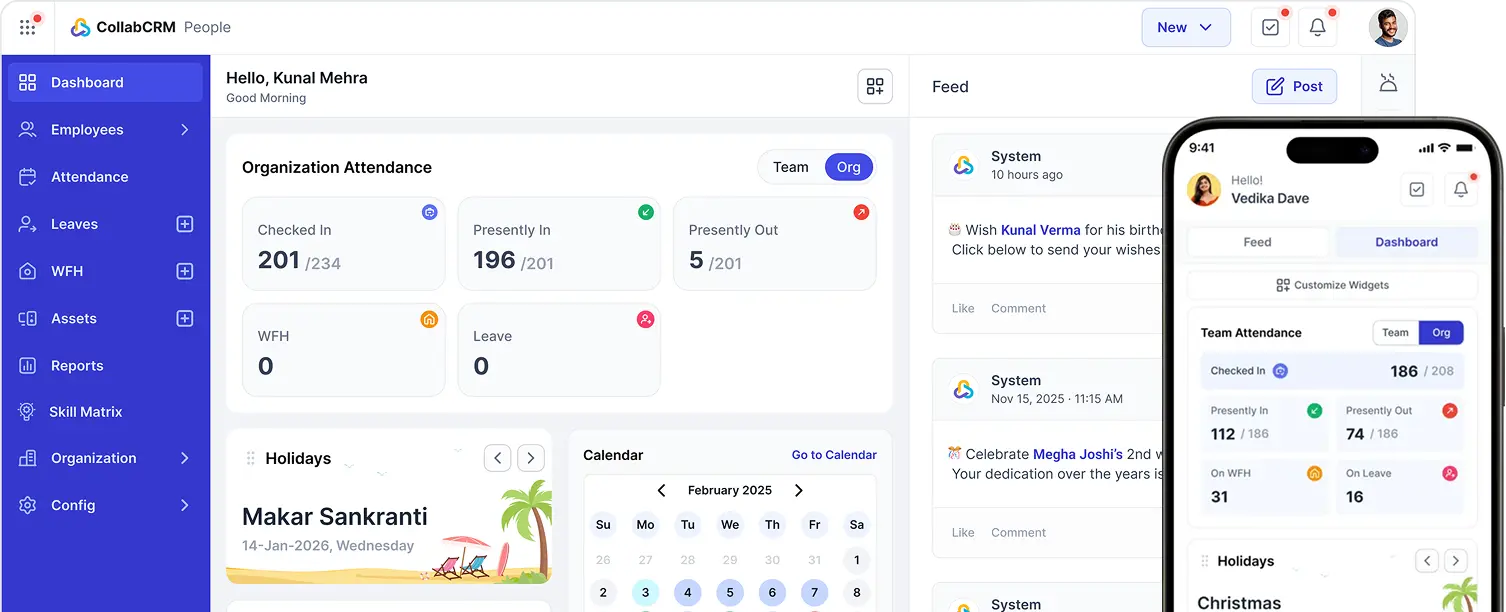
How CollabCRM Helps Manage Employee Compensation Workflows
CollabCRM supports IT companies with connected people, recruitment, projects, sales, administration, and reporting workflows. It can help HR teams maintain more organized employee records and streamline the movement from recruitment to onboarding and workforce management.
CollabCRM provides payroll management software for IT companies to help teams manage salary calculations, tax deductions, reimbursements, bonuses, and payslip generation in a more structured workflow.
CollabCRM is most useful when compensation administration needs to work alongside wider IT operations. It gives teams a unified environment for people management and business coordination, rather than managing HR information in isolated spreadsheets and tools.
Final Thoughts
The real question in the stipend vs salary conversation is not which payment type is universally better. It is which payment structure matches the actual relationship and purpose.
Use a stipend when the arrangement is genuinely focused on learning, training, apprenticeship, research, or clearly defined expense support. Use salary when someone is performing ongoing work as an employee. Use salary plus a stipend or allowance when you want to support specific needs without replacing base compensation.
The safest approach is clarity. Define the role, payment purpose, duration, responsibilities, tax treatment, benefits, and future employment expectations in writing. When the arrangement is complex or unclear, involve HR, finance, and legal professionals before finalizing it.
Frequently Asked Questions
Salary is regular compensation paid to an employee for ongoing work and job responsibilities. A stipend is a fixed payment usually given to support training, education, internships, apprenticeships, research, or defined expenses. The actual relationship and purpose matter more than the payment label.
A salary is a fixed, recurring payment an employer gives an employee for work performed. In India, it is generally paid monthly through payroll and may include components such as basic pay, allowances, incentives, and applicable statutory benefits.
A stipend is a fixed amount paid for a specific purpose. It is commonly offered to interns, trainees, apprentices, fellows, researchers, or students during a defined learning or training period. It may also be given as an allowance for work-related costs such as internet, travel, learning, or relocation.
Not necessarily. A stipend is different from salary when it is genuinely intended for training, education, apprenticeship, research, or defined expense support. However, if a person performs regular employee-like work, the payment may need to be treated differently for tax, payroll, and labor-law purposes.
It depends on the purpose and nature of the payment. A scholarship granted to meet the cost of education is exempt under Section 10(16) of the Income-tax Act. However, not every stipend qualifies for this exemption. A stipend paid for work or services is usually taxable, so employers and recipients should seek tax advice for their specific situation.
Yes. Salary is generally taxable under the head “Income from Salary.” Employers must deduct TDS under Section 192 when the employee’s salary income exceeds the applicable basic exemption limit.
Yes. An employee can receive a salary as regular compensation and an additional stipend, allowance, or reimbursement for a specific purpose, such as home-office expenses, internet, travel, learning, mobile phone use, or relocation support.
The answer depends on the actual nature of the internship, the laws that apply, and whether the person is genuinely an intern, trainee, apprentice, or employee. A formal apprentice under the Apprentices Act is not treated as a worker under Section 18 of that Act. However, organizations should review the actual arrangement and obtain professional advice rather than relying only on the title “intern.”
A company should not use a stipend as a substitute for salary when a person is effectively employed to perform regular, ongoing business work. A stipend is appropriate for genuine learning, training, apprenticeship, research, or expense-support arrangements. Misclassifying employees as stipend recipients can create payroll and compliance risks.
An employer should consider conversion when the person moves from supervised learning into an ongoing business role with regular responsibilities, defined performance expectations, long-term accountability, and the same operational expectations as other employees. The conversion should include a formal employment offer, salary structure, payroll setup, and applicable benefits.
There is no single national law mandating a stipend for every intern. Formal apprentices are covered by the Apprentices Act, 1961, which sets a prescribed minimum stipend. For general internships outside a formal apprenticeship scheme, payment is typically governed by the offer terms rather than a blanket statutory minimum, though this can vary by state and sector. Employers should confirm applicability with a labor law advisor before finalizing internship terms.
Misclassification can expose an employer to back-wages liability, retrospective PF and ESI contributions with interest and penalties, and scrutiny from labor authorities. It can also weaken the company’s position in a dispute if the person later claims employee status. Reviewing the actual working relationship, not just the offer letter label, is the safest way to avoid this risk.
Generally, no. CTC (Cost to Company) refers to the total compensation structure for an employee, including salary components and statutory benefits. A stipend, when paid for a genuine training or internship arrangement, is usually treated separately and not folded into a CTC figure. If a stipend-based role converts to a full-time position, the new offer typically restructures the payment into a formal CTC.






 Priority Onboarding