

You open your project tool to check a task, switch to another app to see the budget, then open a third tool just to message your client about both. By the time you have your answer, ten minutes have passed and you have lost your train of thought twice. If this sounds familiar, you are dealing with tool sprawl, even if you have never called it that.
This is one of the most common, and most overlooked, problems facing project managers and IT team leads today. As teams grow, tools pile up one at a time, until no one fully remembers why each one was added.
In this blog, we will answer the question, what is tool sprawl, explain why it happens, and walk through clear, practical steps to fix it. We will also look at how a centralized platform for business operation management can help your team stop switching between tools and start working from one connected view.
Key Takeaways:
- Tool sprawl happens when teams end up using too many tools that do similar jobs, without any plan or coordination
- It usually builds up slowly, one tool at a time, not from a single bad decision
- Common signs include checking multiple tools to answer one question, copying updates manually, and slow onboarding for new hires
- Tool sprawl costs real time and money, including wasted spend on unused tools and lost focus from constant switching
- Fixing it starts with an honest audit of what your team uses, not just what was purchased
- Not every fix means cutting tools. The right move is to rationalize, consolidate, or optimize, depending on the tool and the need of the teams
- A centralized platform can reduce manual handoffs and give your team one connected view of tasks, time, and communication
- Preventing tool sprawl from returning depends more on consistent habits and clear ownership than on any single tool
What Is Tool Sprawl?
Tool sprawl is a situation which happens when teams end up using too many tools that do similar jobs, and none of them talk to each other properly. As a result, information gets scattered across platforms, workflows become fragmented, and employees spend more time switching between apps than getting work done.
It usually starts small. One tool gets added to fix one problem. Then another tool gets added for a different team. Over time, the stack grows, but no one is watching how all these tools fit together.
| Aspect | Tool Sprawl | Shadow IT | SaaS Sprawl |
| Definition | Excessive use of multiple overlapping tools across the organization | Use of tools without approval from IT or leadership | Uncontrolled growth of cloud-based subscription software |
| Primary Concern | Complexity, inefficiency, and fragmented workflows | Lack of governance, security, and compliance risks | Rising software costs and redundant subscriptions |
| Focus | Number and overlap of tools | Whether the tool was officially approved | Proliferation of SaaS applications |
| Who Typically Manages It | Operations, IT, and business leaders | IT and security teams | Finance, procurement, and IT teams |
| Includes Approved Tools? | Yes | No | Yes |
| Includes Non-SaaS Tools? | Yes | Yes | No |
| Examples | Multiple project management platforms, legacy systems, spreadsheets, internal tools | Employees using unapproved file-sharing or messaging apps | Too many paid subscriptions for CRM, marketing, and collaboration software |
| Main Risk | Reduced productivity, data silos, duplicate work | Security vulnerabilities and compliance issues | Wasted spending and license redundancy |
| Relationship to Tool Sprawl | Broad umbrella term | Can contribute to tool sprawl | A specific type of tool sprawl |
| Example Scenario | Teams use five different task management tools with overlapping functions | An employee adopts a free app without notifying IT | Different departments subscribe to separate SaaS tools that perform similar functions |
Tool sprawl is the bigger umbrella term. It covers any situation where too many tools exist without proper coordination, no matter how those tools were bought or where they run.
For a project manager or team lead, this is not just an IT headache. It directly affects how your team plans work, tracks progress, and reports to stakeholders. When project data lives in five different places, you spend more time chasing updates than managing the project.
How Does Tool Sprawl Happen?
Tool sprawl rarely happens on purpose. It builds up slowly, through decisions that made sense at the time. Here are the most common ways it happens.
1. Tools are Added for Every New Problem
A team faces a specific problem and buys a tool to solve it and then another tool to address other concerns. Over time there is stack of tools purchased without thinking how these tools work together as a whole system.
This pattern is sometimes described as the Street Lamp Effect. Instead of stepping back to understand the root problem and choosing the best overall solution, teams tend to look for answers where solutions are easiest to find.
Much like a person searching for lost keys under a street lamp because the light is better there, not because that’s where the keys were dropped organizations often adopt familiar or readily available tools rather than evaluating what truly fits their needs. The result is a collection of disconnected tools chosen for convenience rather than cohesion.
2. Teams Add Tools Without Coordination
Your marketing team may pick one tool while engineering pick another. Each department has its own challenge which they try to solve in isolation without looking into what other teams may already be using to solve same problems.
There is no shared approval process and no one person responsible for reviewing these choices before they are made. Without that central oversight, the company ends up with several tools doing the same job, each chosen for a different reason, by a different team, at a different time.
3. Company Growth Outpaces the Tech Strategy
As your business scales, the tools that you may have been using, may not grow in the planned way. New offices, new teams, and new clients all add pressure to move fast.
Tools get added to keep up, but the technology strategy does not get updated at the same pace. This gap is where sprawl quietly takes hold.
4. Former Employees Leave Active Licenses Behind
At times when employees leave, or when projects end, the tool license is often forgotten and left active without being used. These forgotten subscriptions add up over months and years, increasing both cost and confusion.
Signs Your Team Has Tool Sprawl
Most IT teams do not notice tool sprawl until it starts slowing them down. It builds up quietly, and by the time it becomes obvious, it has already cost time, money, and energy.
Here are the clearest signs that your team may be dealing with tool sprawl.
1. Same Task with Different Statuses in Different Tools
Often when different teams are using multiple tools, same task is listed in all the tools with different status updated in-front of them.
A task is marked done in your project tool, but the related ticket is still open in another system. No one is sure which version is correct, so someone must check both before trusting either one.
For instance, a developer marks a task done in the project tracker, but the related support ticket still shows as open in the helpdesk tool. The project manager must message both teams just to confirm which status is correct.
2. Integration Fatigue from Constant Workarounds
Your team relies on workarounds just to stay in sync. For example, a team lead takes a screenshot of a dashboard and pastes it into a chat message every Friday, because the chat tool and the reporting tool do not share data automatically. None of this is built into how the tools work.
It is a patch, not a solution, and it adds to what practitioners call integration fatigue, the mental tax of constantly switching between systems and reconciling information that should already match.
3. People Quietly Stop Using Certain Tools
One of the less visible signs of tool sprawl is when employees stop using certain applications without formally abandoning them. If a tool feels slow, complicated, or disruptive, teams often create their own workarounds instead of raising concerns.
For instance, a company may continue paying for a time-tracking platform, but employees might gradually switch to logging hours in a shared spreadsheet because it is faster and easier. The subscription remains active and the work still gets done, but the value of the tool quietly disappears while data becomes fragmented.
4. New Hires Take Longer to Onboard Because of Tool Overload
Tool sprawl creates unnecessary complexity for new employees. Instead of focusing on learning their role and understanding team processes, they must first figure out a multiple applications, permissions, and workflows.
A new project coordinator, for instance, may spend their first week juggling five different logins, asking coworkers whether tasks belong in one platform or another, and trying to understand where files, approvals, and updates are stored.
This added cognitive load slows onboarding and delays the time it takes for new hires to become productive.
5. Finding Answers Takes Too Many Tools
When information is spread across multiple systems, even simple questions become time-consuming. Teams waste valuable time switching between applications and piecing together scattered data instead of focusing on meaningful work.
For instance, when a client asks for a project update, the account manager may need to check the task management tool for progress, the time-tracking software for hours logged, and email threads for recent approvals. A question that should take seconds to answer ends up taking ten minutes because no single tool has the complete picture.
Impact of Tool Sprawl on Businesses
Tool sprawl does not just create small annoyances. It costs real time, real money, and real trust within a team. Here is how it plays out inside a business.
1. Wasted Money on Tools Nobody Uses
When tools pile up, some of them quietly stop being used, but the company keeps paying for them. According to a 2024 Gartner survey of over 5,000 employees, only 23% of digital workers said they were completely satisfied with their work applications.
Low satisfaction is often a sign that people are using tools out of obligation, not because the tools help them. For example, a mid-sized agency may be paying for three different reporting tools, but only one of them is opened each week. The other two sit there, draining budget every month with nothing to show for it.
2. Lost Time from Constant Tool Switching
Every time someone switches between tools, they lose momentum and focus. This adds up fast across a day, a week, and a year. Microsoft’s 2025 Work Trend Index found that employees are interrupted every two minutes during core work hours, adding up to roughly 275 interruptions a day.
When information is spread across multiple tools, these interruptions increase as employees repeatedly switch contexts to find the data they need.
For example, a project coordinator managing five client accounts may spend more time logging into different platforms each morning than reviewing project progress.
3. Reduced Visibility and Slower Decisions
When data is scattered across disconnected tools, leaders struggle to get a clear picture of what is happening. Teams spend more time gathering information and reconciling reports than making decisions.
The problem only grows as organizations adopt more specialized applications. A 2025 GitLab survey found that 60% of organizations use more than five tools for software development, while 49% use more than five AI tools, creating productivity bottlenecks and fragmented workflows.
The impact is felt every day. A delivery head preparing a project health update for a client may have to pull progress data from one dashboard, resource utilization from another, and financial metrics from a third. By the time the information is consolidated, the numbers are already outdated, making it harder to respond quickly and confidently.
4. Breakdown in Team Collaboration
When different teams use different tools for the same kind of work, they stop working from the same information. One team trusts their dashboard, another team trusts theirs, and each of them work in their data silos.
For example, the sales team marks a client project as delivered in their CRM, while the delivery team still shows it as in progress in their project tool. The client ends up getting two different answers from two different people, which damages trust faster than any single tool failure would.
5. Slower Response When Something Goes Wrong
When a problem comes up, teams need to investigate quickly, using clear data from one central place. Practitioners in IT operations track this using a metric called MTTR, or mean time to resolution. MTTR measures the average time it takes to identify, diagnose, and resolve an issue after it occurs.
The more tools involved in tracking an issue, the longer that resolution time tends to stretch. For example, a server outage that should take an hour to diagnose can take half a day if the alert, the logs, and the team chat all live in three different, disconnected systems.
How to Tackle Tool Sprawl: 11 Practical Tips
Fixing tool sprawl does not require removing everything and starting from zero. It requires a clear, repeatable process.
Here is a step-by-step approach that works for teams of any size.
Tip 1: Audit Your Current Tools and Usage
Start by listing every tool your team uses. Check who logs in, how often, and for what purpose. IT teams that run regular audits like this can often significantly remove number of tools that are barely used at all.
For example, a project manager might discover that two different teams are paying for separate time tracking tools because no one ever checked if the company already had one.
Tip 2: Decide With a Clear Framework, Not Just Instinct
Once you know what tools are being used by all teams, do not jump straight to removing them to reducing tool sprawl. Leaders in IT teams often think of three options.
- Rationalize means removing a tool that no longer earns its place
- Consolidate means merging overlapping tools into one connected platform
- Optimize means keeping or even adding a tool, if it genuinely improves how the team works
Run every tool decision through these three questions before acting on instinct alone. For example, a team might rationalize an unused reporting tool, consolidate two overlapping task trackers into one, and still optimize by adding a dedicated time tracking tool if nothing else does that job well.
Tip 3: Map Your Team’s Actual Workflows
Before adding or removing anything, write down how work flows not just within a time, but also amongst different teams such as design, development and marketing.
This step will help you to understand where tools genuinely help and where they just add friction.
Consider a client who requests a new feature. The sales team records the request in their CRM, then manually shares the details with the design team. The designers create specifications in a separate document and send them to engineering team, which enters the work into their project management tool.
Once development is complete, the account manager updates the client through yet another platform. At every stage, information is copied from one system to another. This creates delays, increases the risk of errors, and makes it harder to maintain progress and track it.
With a connected workflow, the same request could move through the entire process without repeated manual handoffs.
Tip 4: Assign Ownership for Every Tool
Every tool in your stack should have a clearly defined owner. This person is responsible for evaluating whether the tool is still needed, managing renewals, overseeing adoption, and acting as the point of contact when issues arise.
Without clear ownership, tools often remain in use simply because they have always been there, even when they no longer provide value.
A practical way to prevent tool sprawl is to assign ownership based on the team that relies on the tool most heavily.
For example, if a company uses a project management tool to track delivery work, the Project Manager should be accountable for reviewing its effectiveness and justifying its continued use.
Similarly, to ensure effective resource utilization, organizations should assign ownership for workforce planning and capacity management processes. The designated owner is responsible for maintaining accurate resource data, monitoring allocation patterns, and ensuring the platform continues to support business needs.
This table gives a brief sight into how tool ownership can look like:
| Tool Category | Example Owner | Ownership Responsibilities |
| HRMS Tool | HR Manager | Manage licenses, oversee employee adoption, review usage, and determine whether the platform still meets HR needs. |
| Work Management Tool | Scrum Master | Ensure teams use the tool consistently, optimize workflows, manage configurations, and evaluate whether it supports agile processes effectively. |
| Project Management Tool | Project Manager or PMO Lead | Maintain project tracking standards, manage user access, review adoption, and ensure the tool continues to support project delivery goals. |
| Resource Management Tool | Resource Manager or Delivery Manager | Monitor resource planning processes, maintain data accuracy, evaluate utilization reporting, and ensure the tool supports capacity management needs. |
When every tool has an owner, organizations are less likely to accumulate unused software with duplicate functionality, and unnecessary subscriptions.
Tip 5: Set a Simple Approval Process for New Tool Requests
Before any new tool is purchased, someone should check two things.
Does the company already have something that does this job
Will this tool be used by more than one or two people
This does not need to be a long, slow process. It just needs to exist. For example, before purchasing a new tool, employees could complete a short request form that asks questions such as:
- What problem does this solve?
- Which team will use it?
- What tools do we already have that perform a similar function?
A quick review by IT, operations, or a designated tool owner can often reveal that an existing platform already meets the need.
These simple checks take only a few minutes but can prevent duplicate purchases, reduce software costs, and keep the technology stack from growing unnecessarily.
Tip 6: Choose Tools That Work Together
When you are choosing new tools or replacing old ones, look for tools designed to share data and connect easily, rather than tools that only solve one specific problem in isolation.
This is what IT teams call tool consolidation, bringing overlapping functions into fewer, better-connected platforms. It does not mean using only one tool for everything. A company can still use specialized tools for specific jobs, if those tools are chosen carefully and connected properly, instead of being added randomly without any thought to how they will work alongside what the team already has.
The goal is not fewer tools for the sake of it, but a smoother flow of information between the tools you keep.
It means making sure the tools you do use talk to each other. For example, a team that manages tasks, time tracking, and client communication within a connected platform spends far less time copying information between systems by hand.
Tip 7: Roll Out Changes Gradually
Do not switch everything at once. Sudden changes can overwhelm teams and increase the chance that people quietly go back to their old habits.
Your roll out to a new tool or processes should be in stages, starting with one team or one workflow, and expand once it is working well.
For example, a company moving to a centralized business operating system might start with just the project tracking workflow for one department, fix any issues that come up, and then expand to other departments once the process is proven.
Tip 8: Make Tool Reviews a Habit
Avoiding tool sprawl should not be a one-time project, but a regular habit. IT leads need to follow a data driven approach, using real-time insights such as adoption rates and mean time to resolution, or MTTR, to decide if a tool is still earning its place.
For example, a quarterly review may reveal that only 20% of employees actively use a reporting tool, or that incident resolution times have not improved despite a new monitoring platform. These insights help organizations reduce tool sprawl by identifying tools that can be consolidated, replaced, or retired.
Tip 9: Check Compliance Requirements Before You Add or Remove Tools
When you have too many tools at work, it becomes harder to track where client data lives and who can access it. This becomes a serious risk once you operate across regions with strict data rules.
For instance, companies serving clients in the United States need to consider regulations like HIPAA for healthcare data. Similarly, teams working with European clients must follow GDPR, which controls how personal data is stored and shared.
Before adding a new tool or shutting one down, check if it stores sensitive data and whether removing it could leave gaps in your compliance records.
| Country/Region | Compliance Regulation | What It Is For | Why It Matters When Managing Tool Sprawl |
| USA | HIPAA (Health Insurance Portability and Accountability Act) | Protects healthcare and patient information | IT teams must ensure healthcare data is stored only in approved tools and does not spread across unauthorized systems. |
| UK | UK GDPR | Regulates the collection, storage, and use of personal data | Multiple disconnected tools make it difficult to track, secure, and delete personal data when required. |
| European Union | GDPR (General Data Protection Regulation) | Governs personal data privacy and processing | Tool sprawl increases the risk of storing customer data in systems that do not meet GDPR requirements. |
| UAE | UAE Personal Data Protection Law (PDPL) | Protects personal data and governs data processing practices | IT teams need visibility into where data is stored and transferred across tools to remain compliant. |
| Canada | PIPEDA (Personal Information Protection and Electronic Documents Act) | Regulates how private-sector organizations collect and use personal information | Too many tools can create challenges in managing consent, access controls, and data retention. |
| India | Digital Personal Data Protection Act (DPDP Act) | Governs the processing and protection of personal digital data | Organizations must know which tools contain personal data and ensure proper security and governance controls. |
| Japan | APPI (Act on the Protection of Personal Information) | Protects personal information and regulates data handling | Disconnected systems make it harder to monitor data access, transfers, and compliance obligations. |
The more tools an organization uses, the harder it becomes to maintain a clear record of where sensitive information resides. Regular compliance reviews help ensure that efforts to reduce tool sprawl do not unintentionally create legal, security, or audit risks.
Tip 10: Reduce Tool Dependency Through Automation
If your team relies on manual work and constantly updates multiple apps, your tools are not really doing their job. This kind of manual patchwork is often what causes tool fatigue in the first place, since people end up doing the work the tools were supposed to handle.
Look for platforms with built in automation that can route tasks, trigger actions, and remove repeat work without relying on quick fixes that break easily.
The real goal is not just using fewer tools. It is to reduce the number of handoffs between people and systems, so work moves forward on its own instead of depending on someone remembering to update three applications at once.
Tip 11: Use Centralized Tool for IT Operations Management
A centralized project management platform gives IT teams one connected view of tasks, tickets, and tool usage instead of scattered dashboards that never quite match. This matches what developers and designers describe as moving away from hero dependent systems, where only one or two people understand how everything connects, toward shared visibility that any team member can rely on.
When you manage tool sprawl through a single platform, you reduce the manual checking and cross referencing that eats up time every day. For example, an IT lead can track ticket status, resource load, and project timelines in one place, instead of piecing together updates from five different tools each morning.
Integration vs. Consolidation: Which Should You Choose?
Once you have realized which platforms are not required anymore, the next step is to decide whether to connect what you have or replace it with something better.
Let’s examine both approaches to understand the difference between the two:
How can integration help reduce tool sprawl?
Tool integration is the process of connecting different software applications so they can automatically share data, synchronize updates, and support workflows without manual intervention.
Integration helps organizations get more value from existing tools instead of constantly adding new ones. When systems communicate effectively, teams spend less time switching between applications, copying data, or maintaining duplicate records.
Integration helps in managing tool sprawl by:
- Eliminating the need for separate tools that perform overlapping functions
- Creating a single flow of information across teams and departments
- Reducing manual data entry and duplicate records
- Improving visibility without adding more reporting platforms
- Making existing tools more useful, reducing pressure to buy new software
How can consolidation help reduce tool sprawl?
Tool consolidation is the process of replacing multiple overlapping applications with fewer platforms that can perform the same functions more efficiently.
It helps organizations simplify their technology stack by reducing the number of tools IT teams need to learn, manage, and maintain.
Instead of spreading work across several disconnected systems, teams can operate from a smaller set of platforms that provide broader functionality and better visibility.
- Consolidation helps in managing tool sprawl by:
- Removes redundant tools with overlapping features
- Reduces software licensing and maintenance costs
- Simplifies training, onboarding, and user adoption
- Improves visibility by centralizing data and workflows
- Creates a more manageable and efficient technology stack
| Aspect | Tool Integration | Tool Consolidation |
| Definition | Connects different tools so they can share data and work together. | Reduces the number of tools by replacing overlapping applications. |
| Goal | Improve communication between tools. | Simplify the technology stack. |
| Number of Tools | Usually stays the same. | Usually decreases. |
| Main Benefit | Eliminates data silos and manual data transfer. | Reduces complexity, costs, and tool overload. |
Best Practices to Prevent Tool Sprawl from Returning
Without a few consistent audits and efforts, the same problem can come back soon. These five practices help keep your tool stack lean for the long term.
1. Review Your Tool Stack Twice a Year
Set a fixed time, twice a year, to review every tool your team uses. Check who logs in, how often, and whether the tool still solves a real problem. This keeps tool sprawl from quietly building back up between audits.
For example, a team might use the start of each half year to confirm every active subscription still earns its place.
2. Ask If You Already Have This Before Buying Anything New
Before approving any new tool, ask one simple question. Does the team already have something that does this job. This single habit stops a large share of unnecessary purchases before they ever happen.
For example, a manager might discover the company already has a reporting feature inside an existing platform, saving the cost of a brand-new tool.
3. Limit Who Can Approve New Tool Spend
Keep tool approval limited to a small, clear group of people instead of letting every department decide on its own. This avoids the independent, uncoordinated purchases that quietly cause tool sprawl in the first place.
For example, a company might require any new tool request to pass through one operation lead before payment is approved.
4. Build Onboarding Around Core Tools Only
Train new hires on the few tools your team depends on daily, not every tool that has ever been added. This reduces cognitive load and helps people focus on their actual job faster.
For example, a new coordinator should learn the main project and communication portals first, with anything else explained only if it becomes relevant.
5. Treat Tool Sprawl as a People Problem First
Fixing tool sprawl is not only about the technology you choose. It is about clear ownership, consistent processes, and people following them.
For example, two well-chosen tools used consistently by a disciplined team will always outperform five tools used inconsistently by a team with no clear process in place.
How can CollabCRM Help Avoid Tool Sprawl?
If you are still figuring out how to tackle tool sprawl in your own team, the right platform can make the process much easier.
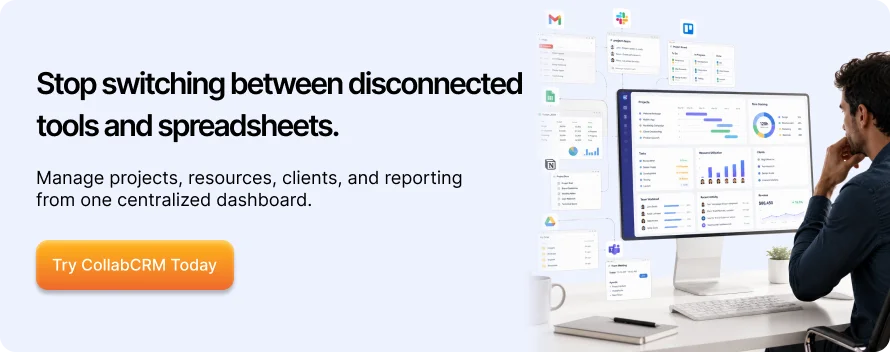
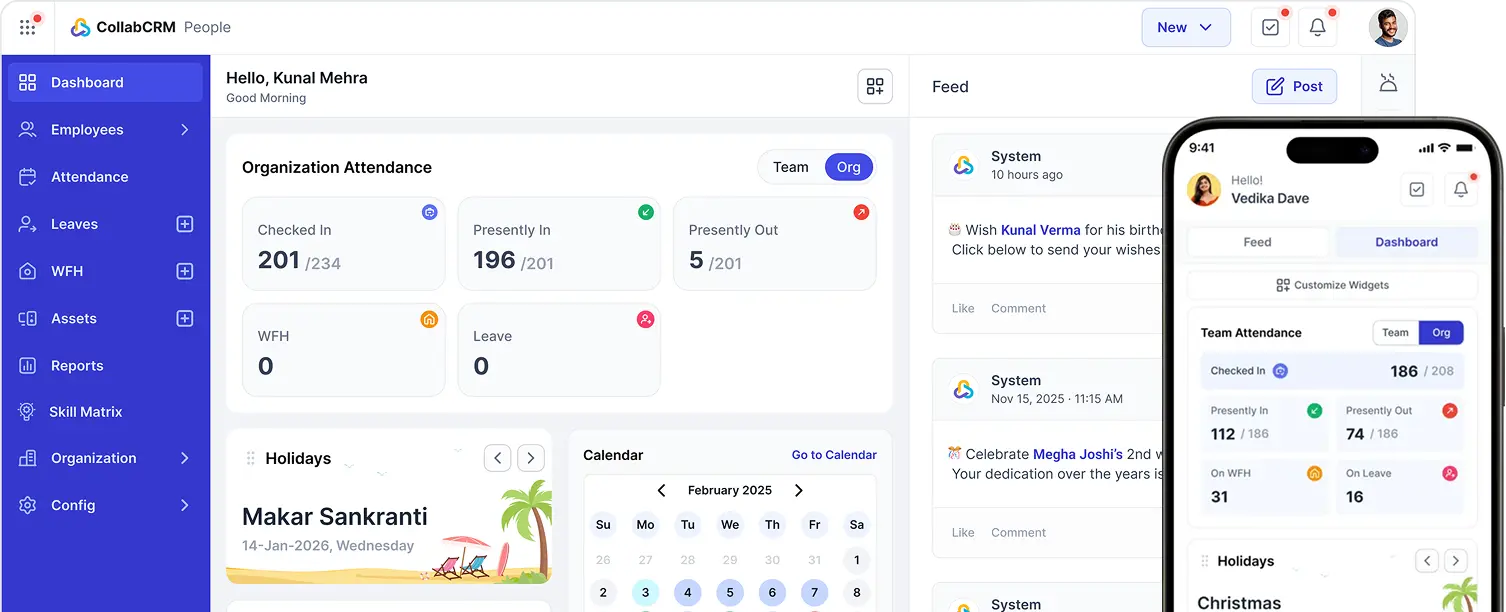
CollabCRM brings tasks, time tracking, client communication, and reporting into one centralized project management dashboard, so your team is not switching between five different logins just to get a clear picture of a project.
Instead of gathering updates together manually, your team can see task status, resource load, and client conversations in one connected view.
This does not mean blindly removing every tool your teams are using. It means giving your team one reliable platform to manage the work that matters most, without the manual handoffs that cause confusion and wasted time.
If your current setup feels mismanaged, using CollabCRM can bring all your work into one connected place.
FAQs
There is no fixed number. But a small team likely has too many tools when employees switch between multiple applications to complete simple tasks, maintain duplicate data, or struggle to determine which tool should be used for a particular process.
No tool sprawl is not just a problem specific to IT teams. While IT teams often manage software, tool sprawl affects the entire organization. It can reduce productivity, create data silos, increase costs, complicate reporting, slow decision-making, and make collaboration more difficult across departments such as sales, marketing, HR, finance, and operations.
Yes tool sprawl can happen in a team of any size. Any team can experience it if different employees adopt separate tools for similar tasks, creating duplicate data, disconnected workflows, and unnecessary complexity that slows collaboration and decision-making.
Start by creating an inventory of all tools currently in use and identifying those with overlapping functions. From there, eliminate unused applications, assign ownership to remaining tools, and look for opportunities to consolidate or integrate systems to reduce complexity.
Most organizations should review their tool stack at least once every quarter. Regular audits help identify unused software, duplicate functionality, low adoption rates, and unnecessary costs before they grow into larger tool sprawl problems.






 Priority Onboarding