

Days sales outstanding (DSO) is the average number of days a company takes to collect payment after a sale. You calculate it by dividing accounts receivable by total credit sales, then multiplying by the number of days in the period. A services business with ₹2.7 crore in receivables against ₹4.5 crore of quarterly billing has a DSO of 54 days, which means roughly two months of delivered work is sitting unpaid at any given moment.
For IT and service companies the number carries extra weight, because salaries go out on the 1st whether or not the client has paid.
TL-DR: key takeaways
- DSO = (Accounts Receivable ÷ Total Credit Sales) × Number of Days in the period.
- Compare your DSO against your own payment terms, not an industry average. More than a third above your terms usually points to an internal process problem.
- Much of the delay in services is created before the invoice goes out, in the gap between finishing a milestone and raising the bill. DSO does not measure those days at all.
- Best Possible DSO shows the floor your terms allow. The gap between actual and best possible is the part you control.
- The cheapest fix is almost always speed of invoicing, not harder collections.
What is days sales outstanding?
DSO measures how long cash stays tied up in receivables. A lower number means you turn delivered work into bank balance faster.
DSO = (Accounts Receivable ÷ Total Credit Sales) × Number of Days
Worked example for a quarter:
- Accounts receivable at quarter end: ₹2.7 crore
- Credit sales for the quarter: ₹4.5 crore
- Days in period: 90
(2,70,00,000 ÷ 4,50,00,000) × 90 = 54 days
If your contracts say 30 days, those extra 24 days are working capital you are lending clients free of charge.
Exclude cash sales, since including them flatters the result. And run the calculation quarterly if your billing is milestone-based, because one large invoice landing on the wrong side of a month end can swing a monthly figure by a week.
Best Possible DSO
Best Possible DSO uses only current, not-yet-overdue receivables in the numerator. It shows the lowest DSO your terms would allow if every client paid exactly on time.
Using the same quarter, suppose ₹1.5 crore of that ₹2.7 crore receivable is still within terms and ₹1.2 crore is overdue:
(1,50,00,000 ÷ 4,50,00,000) × 90 = 30 days
So your floor is 30 and your actual is 54. That 24-day difference is delay rather than contract, and it is the number worth working on. Chasing your DSO below 30 would mean renegotiating terms; closing the gap to 30 only means fixing your own process.
What counts as a good DSO?
There is no universal benchmark, because terms differ by contract and by client. Compare against your own.
| Your terms | Healthy DSO | Needs attention |
| 15 days | Under 25 days | Above 30 |
| 30 days | Under 45 days | Above 55 |
| 45 days | Under 60 days | Above 75 |
| 60 days | Under 75 days | Above 90 |
A practical rule: if DSO exceeds your terms by more than a third, the delay is coming from inside your own process rather than from difficult clients.
Indian service firms registered as micro or small enterprises have a statutory position on payment timelines as well, which changes what terms you can agree to in the first place. That is covered separately in our guide to the MSME 45-day payment rule.
Why DSO runs longer at service companies
Product businesses invoice at the point of sale. Service businesses invoice after work is delivered, approved, and reconciled against a timesheet, which creates several places for days to disappear before the clock even starts.
The delivery-to-invoice gap is the one most companies miss. A milestone closes on the 5th. The project manager mentions it in a status call on the 9th. Finance asks for the hours on the 14th. The invoice goes out on the 20th. Fifteen days are gone, and your DSO clock started on none of them, because the invoice date is the start point. Those days are invisible in the metric and very visible in the bank account.
Rejected invoices drain the rest. A missing PO number, a GST detail that does not match, or an invoice sent to someone who left the company can sit unresolved for weeks, and client systems often reject silently with no notification.
Where the days actually go
| Stage | Typical delay | Who controls it |
| Milestone closed to finance informed | 3 to 10 days | You |
| Timesheet collection and approval | 2 to 7 days | You |
| Invoice raised to invoice delivered | 1 to 5 days | You |
| Client approval and PO matching | 5 to 15 days | Shared |
| Client payment run | 15 to 45 days | Client |
Add the first three rows. For most service firms that is 6 to 22 days of self-inflicted delay sitting entirely inside their own operations, and it is the cheapest part to fix because it needs no negotiation with anyone.
How to cut DSO without annoying your clients
Close the delivery-to-invoice gap first. Set a rule that a completed milestone triggers an invoice within 48 hours. This one change often removes more days than every collections effort combined.
Make timesheets a delivery requirement. If hours are not logged, the invoice cannot be raised accurately. Choosing the right time tracking software matters less than enforcing a weekly deadline people actually meet.
Validate billing details before the first invoice rather than after the first rejection. Confirm the billing entity, GSTIN, PO requirement, submission portal, approver, and currency during onboarding. Most rejected invoices fail on something that could have been checked once, at the start.
Invoice more often on long projects. Fortnightly or milestone-linked billing on a six-month engagement keeps the receivable smaller and the conversation lighter than one large invoice at the end.
Automate reminders. A note seven days before the due date, one on the due date, and one at seven days overdue recovers most slippage without anyone making an uncomfortable call. Giving clients a client portal with logged hours and approved scope also removes disputes that come from surprise rather than bad faith.
Track DSO by client, not only in aggregate. One consistently slow payer hides behind a company average that looks fine, and segmenting turns the metric into a decision about terms, advances, or whether the account is worth keeping.
How CollabCRM helps
Most of that delay exists because the information needed to raise an invoice lives somewhere other than the invoicing system. Hours in one tool, project status in another, deal value in a third. Somebody has to assemble it, and assembly takes days. It is a version of the hidden costs of spreadsheets problem most growing service firms recognize immediately.
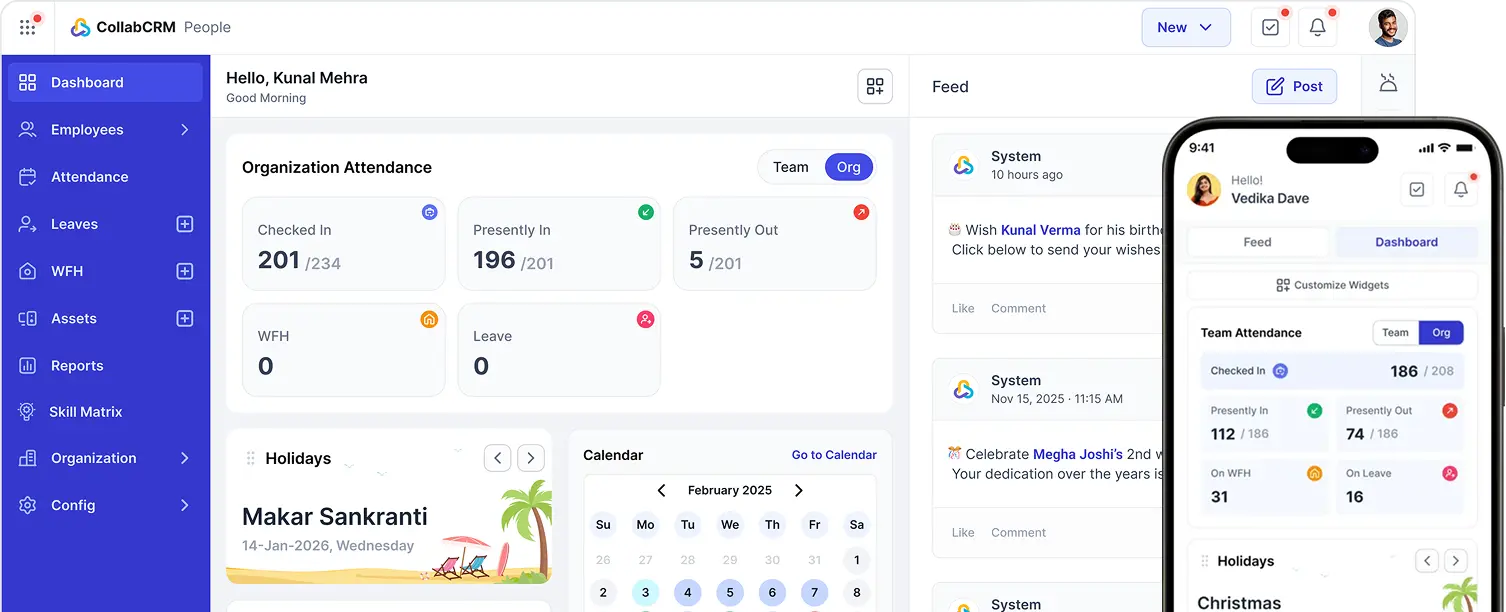
CollabCRM removes the assembly step by connecting the chain. A deal becomes a project, the team logs time against that project, and the invoicing module generates the bill from data already linked to both. The dashboard shows outstanding payments and due dates in real time, reminders go out automatically, and overdue or high-value invoices are prioritized for follow-up. Its revenue leak detection also surfaces billable work and scope changes that were never invoiced at all, which is the part DSO does not measure. For a number before changing anything, the revenue leakage calculator gives an estimate in about a minute.
Start with your own number
Pick your last five invoices and check one thing: how many days passed between the milestone closing and the invoice going out?
If that number is higher than you expected, it is already costing you. The free revenue leakage calculator estimates how much is sitting in unbilled hours, delayed invoices and absorbed scope right now. It takes about a minute, with no card and no signup.
Frequently asked questions
DSO = (Accounts Receivable ÷ Total Credit Sales) × Number of Days in the period. Use 90 for a quarter and 365 for a year, and exclude cash sales from the denominator.
Compare against your own payment terms rather than an industry figure. On 30-day terms, a DSO under 45 days is healthy and anything above 55 usually signals an internal process delay.
Not always. A very low DSO can mean your terms are tighter than competitors offer, which may cost you deals, or that you are discounting heavily for early payment.
DSO uses total receivables. Best Possible DSO uses only current, not-yet-overdue receivables, showing the lowest figure your terms allow. The gap between the two is delay you can act on.
Quarterly for most service businesses. Monthly figures swing too much when billing is milestone-based and one large invoice can distort the result.
No, and that is its main blind spot. Work delivered but never invoiced sits outside the calculation, so a company can show a healthy DSO while losing revenue to unbilled hours.
Product firms invoice at the point of sale. Service firms invoice after delivery, approval and timesheet reconciliation, so several days of internal process sit between the work and the invoice.






 Priority Onboarding