
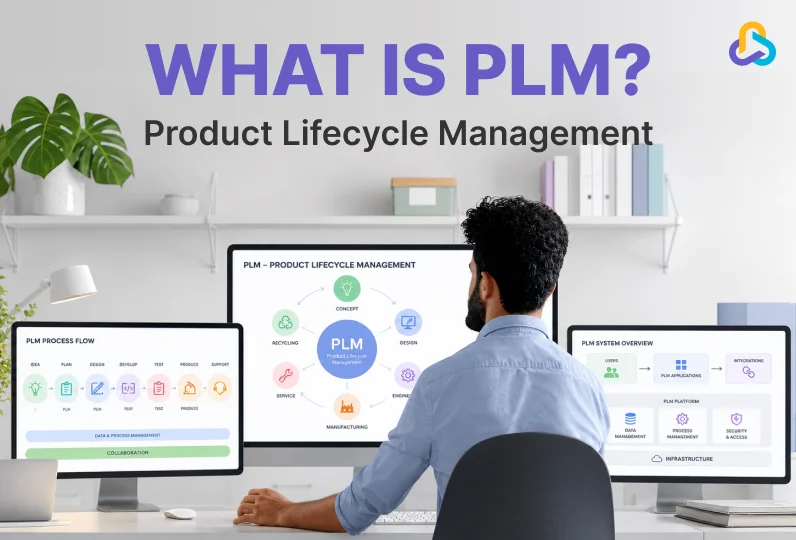
Building a product is never a straight line. It moves through ideas, design, development, launch, and support, often across several teams at once. Somewhere in that journey, most companies lose track of a decision, a file, or a conversation.
Product lifecycle management, or PLM, exists to fix exactly that. This blog breaks down what PLM means, why it matters for growing teams, and how a connected platform makes the whole process easier to run.
Key Takeaways
- PLM is the practice of managing a product from first idea to end of life, using one connected system instead of scattered tools.
- Every product moves through five main stages: ideation, design and development, launch, growth and support, and retirement.
- Disconnected tools are a real business risk. Poor communication is a contributing factor in 56% of projects that fail to meet their original goals (PMI, 2013).
- Centralizing product data speeds up launches, cuts rework and gives leadership real visibility without extra status meetings.
- Startups and SMBs do not need heavy, manufacturing-grade PLM software. A lightweight, connected platform like CollabCRM covers the same ground without complexity.
What is Product Lifecycle Management?
Product lifecycle management is the process of managing a product from the moment it is an idea to the moment it is retired. It covers every stage in between: concept, design, development, launch, support, and sunset.
At its core, PLM is about keeping one version of the truth. Instead of specs living in one tool, feedback in another, and bearing the hidden cost of spreadsheets, everything sits in a single connected system. Teams work from the same data, so nothing gets lost between handoffs.
PLM started in manufacturing, where it tracked physical parts, CAD files, and bills of materials. Software and product-led companies have since adopted the same thinking. For them, PLM means managing requirements, sprints, releases, and customer feedback in one place instead of ten.
The 5 Stages of Product Lifecycle Management
The Product Lifecycle Management (PLM) process is typically divided into five key stages: ideation, design and development, production, market growth and support, and end-of-life.
Understanding each stage helps businesses improve product quality, accelerate time to market, and maximize long-term value.
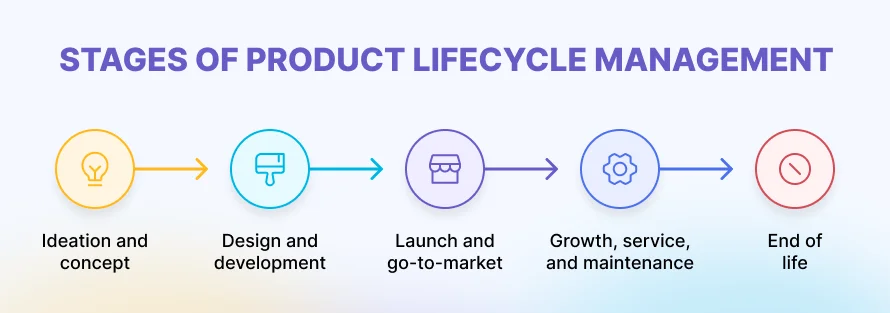
1. Ideation and concept
This is where it starts. Teams gather market research, customer feedback, and internal ideas. They validate demand and build a rough business case before committing budget or engineering time.
2. Design and development
The concept turns into something real. Designers create wireframes, engineers write specs, and developers build prototypes. Teams test, adjust, and repeat until the product is ready to ship.
3. Launch and go-to-market
Marketing, sales, and support line up around the release. Documentation gets finalized, and the product reaches customers. Coordination matters most here. One missed handoff can delay an entire launch.
4. Growth, service, and maintenance
Once live, the focus shifts to keeping customers happy. Teams release updates, fix bugs, and add features based on real usage. This stage often lasts the longest and shapes customer loyalty.
5. End of life
Every product eventually retires or gets replaced. Good end-of-life planning protects existing customers, documents lessons learned, and feeds directly into the next product’s ideation stage.
Why Disconnected Tools Slow Down Product Teams
Most teams do not struggle with PLM because they lack effort. They struggle because their information is spread across tools that do not talk to each other. Specs live in a doc. Tasks live in a tracker. Feedback lives in email or chat threads. Nobody has the full picture.
This is not a small problem. The PMI report 2013 found that poor communication is a contributing factor in 56% of projects that fail to meet their original goals. The same research found that more than half of the budget at risk on a $1 billion project, close to $75 million, is on the line because of ineffective communication alone.
When product data sits in silos, three things tend to happen. Decisions get made twice. Handoffs get missed. And leadership loses visibility into what is actually happening, until a launch slips.

Key Benefits of Product Lifecycle Management
The benefits of Product Lifecycle Management go beyond organizing product data. A well-implemented PLM strategy improves cross-functional collaboration, streamlines product development, minimizes costly errors, and enables businesses to deliver high-quality products more efficiently.
- Faster launches. Parallel workflows replace sequential handoffs. McKinsey’s 2025 analysis of the automotive sector found that leading manufacturers have cut concept-to-launch cycles to about 24 months, roughly half the 40 to 50 months typical at legacy competitors.
- Lower development costs. Teams reuse existing components and catch problems early, when they are cheaper to fix, instead of after launch.
- Better product quality. Everyone works from the same specs and the same version history, so fewer errors slip through.
- Clear compliance and audit trails. Every approval and change gets logged automatically, which matters for regulated industries and enterprise clients alike.
- Real visibility for leadership. Managers see status in one place instead of chasing updates across five tools.
- AI-assisted acceleration. McKinsey’s 2024 research on generative AI in product design found that applying AI methods well can cut development cycle times by up to 70% in some cases.
PLM vs Project Management vs CRM: What’s the Difference?
Many businesses confuse PLM with project management or CRM software. While they share some capabilities, each platform solves a different business challenge.
Here’s a clear comparison to help you understand what PLM does, where project management fits, and how CRM supports customer relationships throughout the product lifecycle.
- PLM manages the product itself, from concept through retirement. It tracks specs, versions, and decisions tied to what you are building.
- Project management manages the work of building it: tasks, timelines, owners, and deadlines.
- CRM in project management manages the relationship with the customer: leads, deals, support tickets, and feedback.
In practice, these three overlap constantly. Customer feedback from your CRM should shape your next product decision. Project timelines should reflect what your roadmap says is coming next.
Most growing teams do not need three separate systems for this. They need one platform where product, project, and customer data can talk to each other.
What to Look for in a PLM Platform
Traditional PLM software was built for manufacturers managing thousands of parts. Most startups, SMBs, and growing enterprises do not need that level of complexity. What they need is simpler:
- One place to store product requirements, specs, and decisions
- A clear view of what stage each product or feature is in
- Automatic workflows for approvals and handoffs
- A direct link between customer feedback and the roadmap
- Version history, so nobody works from an outdated file
Look for a platform that gives you this without months of setup or a dedicated admin team. Cloud-based tools built for how modern teams actually work can be running within weeks, not quarters.
Managing Your Product Lifecycle with CollabCRM
CollabCRM is a business operating system built for IT companies and growing software teams. It brings project management, CRM, and client collaboration into one platform, which covers most of what a lean PLM process needs.
Here is how it maps to the PLM stages:
- Ideation and planning: customer feedback and requests captured through CollabCRM’s CRM module feed directly into your product backlog, so ideas are not stuck in someone’s inbox.
- Design and development: the Project Management module keeps specs, tasks, and timelines on one board, with clear ownership at every stage.
- Launch coordination: teams see the same status in real time, so marketing, delivery, and support are never working off outdated information.
- Service and growth: the CollabCRM Client Portal gives customers a direct channel for feedback and support requests, closing the loop between what customers ask for and what gets built next.
- Full visibility: leadership gets a single view of every product and project, instead of piecing updates together from five different tools.
CollabCRM was not built to replace manufacturing-grade PLM systems. It was built for teams who need one connected place to manage products, projects, and clients together, without extra software or extra cost.
Final Thoughts: Bringing Order to Your Product Lifecycle
PLM is not a buzzword. It is a practical answer to a problem every growing team knows well: information scattered across too many tools. Understanding the five stages, and connecting them in one system, is what turns a chaotic product process into a predictable one.
You do not need enterprise manufacturing software to get this right. You need a platform that keeps your product, project, and customer data in one place. That is what CollabCRM is built for.
FAQs
PLM stands for product lifecycle management. It is the practice of managing a product from its first idea through design, launch, support, and retirement, using one connected system instead of scattered tools.
The five stages are ideation and concept, design and development, launch and go-to-market, growth and service, and end of life.
No. PLM started in manufacturing, but software companies, startups, and service businesses use the same principles to manage features, releases, and customer feedback in one place.
PLM manages the product itself, including specs and versions. Project management manages the work of building it, including tasks, timelines, and ownership.
CollabCRM combines project management, CRM, and client collaboration in one platform. It gives growing teams the core benefits of PLM, a single source of truth and clear workflows, without the cost or setup time of enterprise PLM systems.
Yes. Small teams often see the biggest gains, since they usually run on fewer resources and cannot afford time lost to miscommunication or duplicate work.
The primary goals of PLM are to centralize product information, improve collaboration between teams, reduce development delays, maintain version control, and ensure every stakeholder works from the same source of truth throughout the product lifecycle.
PLM is valuable for startups, SMBs, enterprises, manufacturers, and software companies. Any business that develops, improves, or manages products can benefit from having a structured process that keeps product data, tasks, and customer feedback connected.
Yes. A PLM approach creates a shared workspace where product managers, designers, developers, sales teams, and customer support can access the same product information. This reduces miscommunication and improves cross-functional collaboration.
A modern PLM solution should include product documentation, version control, workflow automation, project tracking, approval workflows, collaboration tools, reporting, and integrations with CRM and project management systems.
PLM reduces costs by minimizing duplicate work, preventing version conflicts, improving communication, and identifying issues earlier in the development process when they are less expensive to fix.
Cloud-based PLM is often easier to deploy, requires less maintenance, supports remote collaboration, and scales as your business grows. On-premise solutions may be preferred by organizations with strict infrastructure or compliance requirements.
A company should consider PLM when product information becomes difficult to manage across spreadsheets, documents, emails, and multiple tools, or when teams begin experiencing delays caused by disconnected workflows.
Yes. Modern PLM solutions often integrate with project management, CRM, ERP, and collaboration platforms so product, customer, and operational data remain connected throughout the product lifecycle.
PLM maintains a complete history of product changes, approvals, and revisions. This ensures teams always work with the latest specifications while preserving previous versions for reference and auditing.
PLM helps solve common challenges such as scattered product information, duplicate work, poor communication, missed approvals, delayed product launches, lack of visibility, and disconnected customer feedback.



 Priority Onboarding