

Most software projects do not fail because of bad code. They fail because of poor team management. Missed deadlines, unclear goals, miscommunication, and burnout are far more common reasons a project goes off track than a technical error.
Managing a software development team comes with its own set of challenges. The work is complex, the timelines are hard to predict, and the pressure to deliver is constant. Without the right software team management best practices in place, even the most skilled developers will struggle to perform at their best.
This guide covers 10 practical tips to help you lead your development team more effectively. From setting clear goals and using a team management tool to building a culture where people do their best work, each tip is direct, actionable, and built for real teams.
Key Takeaways:
- Effective software development team management is the difference between projects that deliver on time and projects that fall apart mid sprint
- Set clear goals and define what “done” means before any development work begins
- Assign tasks based on skills, not just who is available
- Structure communication around daily standups, weekly syncs, and sprint reviews
- Use Agile correctly by acting on retrospective feedback, not just running the ceremonies
- Delegate with clear outcomes and stop micromanaging
- Track DORA metrics to measure real engineering performance, not hours or lines of code
- Include your team in decisions that affect their work
- Invest in structured onboarding and continuous learning to retain good developers
- Recognize specific contributions, not just general effort
- Treat failures as system problems, not people problems, and use blameless postmortems to improve
What Makes Software Development Team Management Challenging?
Managing a software development team is complex. T leaders must balance shifting priorities, evolving requirements, technical debt, resource constraints, and delivery timelines, all while maintaining product quality and team morale.
Unlike many business functions, software development work is often difficult for non-technical stakeholders to estimate or visualize. A feature that takes two weeks to build may look like “just a button” to a stakeholder. That gap in understanding creates friction at every level of the organization.
This gap in understanding frequently creates misaligned expectations, communication challenges, and delivery pressure across the organization.
- The first challenge is measurement. Unlike sales, where numbers tell the story clearly, engineering output is harder to quantify. Lines of code written or hours logged say very little about actual progress or quality. Managers who try to measure the wrong things end up making decisions based on bad data.
- The second challenge is that engineers need two things at once, autonomy and structure. They need the freedom to think through problems and explore solutions. At the same time, they need clear goals, realistic deadlines, and defined processes to deliver consistently. Getting that balance wrong in either direction causes problems.
- Then there are the day-to-day pressures that compound over time. Scope creep quietly expands projects beyond their original boundaries. Onboarding is rushed, leaving new developers underprepared. Stakeholders from sales, product, and business teams push competing priorities without understanding technical constraints. Developer burnout becomes a real risk when teams are expected to ship constantly without recovery time.
These challenges are not unique to one type of company. IT service firms, in house product teams, and enterprise software departments all face versions of the same problems. The scale differs. The fundamentals do not.
10 Tips for Effective Software Development Team Management
Here are 10 direct, practical tips on how to manage a software development team that delivers consistently, communicates clearly, and stays motivated through every project.
Tip 1: Set Clear Goals Before Writing a Single Line of Code
Your software development journey should begin with answering the question ‘what does success look like?’ The answer to this question is you end goal. Without this answer, developers make assumptions, product managers make guesses, and the final output rarely matches what the business needed.
Define three things:
- the project scope
- the expected deliverables
- the metrics that will tell you whether you achieved your goal
One practical way to do this is through OKRs, which stands for Objectives and Key Results. OKRs connect engineering work directly to business outcomes.
For instance, instead of telling a developer to “build the login module,” tell them that the goal is to reduce sign up drop off by 20%, and that a faster, simpler login flow is how the team plans to get there. That context changes how a developer approaches the task.
When goals are vague, the the teams build features that get scrapped. Work gets redone. Deadlines slip because requirements keep changing mid sprint.
Once goals are defined, document them in a centralized project management tool that every team member can access. Goals that live only in project managers head or in some email threads are not goals. They are intentions.
Tip 2: Assign Tasks Based on Skills
You need right people at the right place for a team to be successful. In an IT company, a team which is a composition of skilled talent with bandwidth, is more likely to produce consistent quality work on time.
For instance, a team may have strong frontend developers, backend specialists and some with deep experience with databases, APIs, or DevOps pipelines. Assigning a backend task to a frontend developer simply because they are available creates unnecessary struggle, slower delivery, and code that often needs to be rewritten later.
Therefore, the right approach is to match tasks to skills first and then look at availability. If the right person is not free right now, it is worth trying to put the task on hold, readjust the scope or workload across the team.
Poor resource management is one of the top reasons projects fail globally, with inadequate resource forecasting cited as a primary factor in budget and schedule overruns.
Therefore, a practical tool to support better task assignment is a skill matrix. This is a simple document or spreadsheet that maps each team member’s skills, experience level, and areas where they are actively developing.
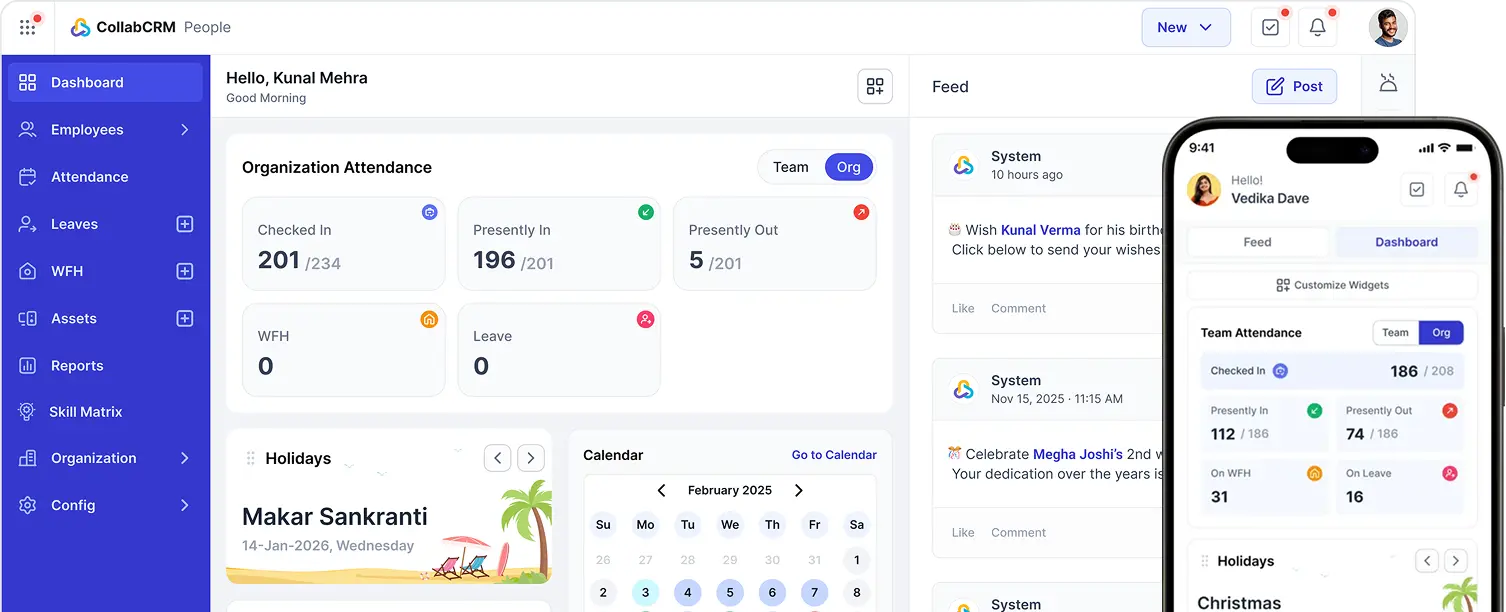
Many business management tools such as CollabCRM have in-built skill mapping feature that can help save time, effort and cost.

There is a second layer to this. Senior developers are a limited and expensive resource. A common mistake in software development team management is assigning senior engineers’ tasks that a mid-level or junior developer could handle with the right guidance.
When senior developers spend most of their time on routine tasks, the team loses the higher value work they are best positioned to do, such as architecture decisions, code reviews, and solving complex technical problems.
Tip 3: Communicate Expectations Clearly and Consistently
Clear communication helps to fill in the gaps full of assumptions. Those assumptions are often wrong and fixing the resulting work costs more time than the original task.
Here is a simple framework to build communication into your process:
Define what completed tasks looks like. Create a definition of done that the whole team agrees on. It should cover:
- Code quality standards
- Testing requirements
- Documentation expectations
- Review and sign off criteria
Structure your check ins around three levels:
- Daily standups to surface blockers and nothing more
- Weekly syncs to keep the team aligned on priorities
- Sprint reviews to give stakeholders a clear view of what was delivered and what comes next
Always give context with every task assignment:
- Explain why the task matters
- Show how it connects to the larger product goal
- A developer who understands the purpose behind their work makes better decisions independently
For remote and hybrid teams, communication norms need to be written down. Define expected response times, which tools are used for which types of communication, and how decisions get documented.
The cost of getting this wrong is significant. According to the 2025 State of Internal Communication Report from Axios HQ, poor communication costs businesses anywhere between $3,640 and $37,440 per employee per year, depending on their salary level.
Tip 4: Utilize and Implement Agile Methodology Properly
Agile methodology helps in team management by breaking complex projects into small, manageable development cycles called sprints, promoting continuous feedback. This flexible approach allows teams to quickly find gaps and adapt to changes, accelerate time-to-market, improve overall product quality, and maintain high customer satisfaction.
However, Agile can only work when it is implemented properly. Many times, teams run daily standups that just remain a status meeting. They hold retrospectives but never act on the feedback. They call themselves Agile while still working in a waterfall mindset.
To implement Agile in true sense, start by choosing the right framework for your team’s work style.
- Scrum works best for teams with predictable sprint cycles and clearly defined deliverables
- Kanban works best for teams managing continuous or unpredictable workloads
- Hybrid works for teams that need elements of both
Once you pick a framework, commit to its core practices. In Scrum, that means sprint planning with realistic capacity, daily standups focused only on blockers, and retrospectives where problems are fixed in the next sprint.
The retrospective is the most important Agile process. It helps teams identify what is slowing them down and identify specific fix. If your retrospectives end with no action items, they are a waste of time.
In the end, Agile is not only for the engineering team. Sales and product teams also play a role. They should share inputs and requirements with the engineering team early and regularly.
But the engineering team must be the one to decide how long something takes to build. Deadlines should be set based on what the team can realistically deliver, not based on what has already been promised to a client.
Tip 5: Delegate and Stop Micromanaging
Micromanagement in software development team management can slow delivery, reduce motivation, and signals to your team that you do not trust them. When developers feel that they are being watched constantly. They stop taking initiatives and wait for instructions.
- This makes effective delegation very crucial. However, delegation does not mean disappearing. Good delegation entails:
- Assigning a task with a clearly defined outcome
- Taking a step back once the task is assigned
- Telling your developer what needs to be achieved, not how to achieve it
Watch for these signs that you are micromanaging:
- Asking for progress updates on tasks that are less than a day old
- Reviewing every decision before it moves forward
- Rewriting code or copy that was already good enough
- Sitting in on meetings where your presence adds no value
The root cause of micromanagement is usually one of two things. They include a lack of trust in the team or a lack of visibility into progress. Both have better solutions than hovering over your teams.
Build trust through clear goals and consistent check ins. Get visibility through a project management tool, not through constant interruptions.

Tip 6: Track the Right Performance Metrics
Many software development teams track the wrong things. Hours logged, lines of code written, and number of tickets closed are easy to measure but say very little about real team performance or delivery quality. A developer can close 30 tickets in a sprint and still produce code that breaks in production.
The industry standard for measuring engineering team performance is DORA metrics. DORA stands for DevOps Research and Assessment. It tracks four things:
- Deployment Frequency: How often does your team ship working code?
- Lead Time for Changes: How long does it take from writing code to deploying it
- Change Failure Rate: How often does a deployment cause a problem in production
- Time to Restore Service: How quickly does the team recover when something breaks?
These four metrics can give you an accurate picture of both speed and stability.
Beyond DORA, you can track sprint velocity over time to improve planning accuracy. In addition, you can also use cycle time to find where work gets stuck in your pipeline.
One important warning: never use performance metrics as a pressure tool. They exist to identify problems and improve processes, not to punish developers.
Tip 7: Have Inclusive Decision-Making
Engineers who build the product every day have context that no manager has. When you exclude them from decisions that affect their work, you lose that context. You also lose their active participation in the development journey.
Inclusive decision making does not mean every decision goes to a vote. It means the right people are consulted before a decision is made. Here is a simple way to approach it:
- Architecture and Technical Decisions: Involve the senior engineers who will own the implementation
- Sprint planning and Prioritization: Involve the whole team so capacity is assessed realistically
- Roadmap Decisions: Share the product direction early so engineers can flag technical risks before they become expensive problems
- Process Changes: Ask the team what is slowing them down before deciding how to fix it
This approach is one of the most underused software project management tips in fast growing IT companies. Teams that are consulted feel ownership over outcomes. Teams that are only given instructions feel like executors.
There is a direct connection to deliver quality too. When developers understand why a decision was made, they implement it better.
Tip 8: Invest in Onboarding and Continuous Learning
Poor onboarding is one of the most expensive hidden costs in software development team management.
When a new developer joins and spends their first two weeks figuring out where things are, who to ask, and how the codebase works, that is lost productivity that compounds every single day.
- A structured onboarding process should cover:
- System access and tool setup on day one
- A walkthrough of the product architecture and codebase
- An introduction to team workflows, communication norms, and documentation standards
- An assigned buddy or mentor for the first 30 days
Do not leave new developers to figure things out on their own. Pair them with a senior team member who can answer questions and provide context.
Beyond onboarding, continuous learning keeps your team’s skills current and reduces attrition. Developers who feel they are growing within a company are far less likely to leave.
Tip 9: Recognize and Reward Good Work
A feature that took three weeks of complex problem solving looks like a simple button on a screen. This means that backend engineering efforts are often invisible and less talked about.
This makes team recognition more important. Developers who feel their work is seen and valued are more engaged and far less likely to leave.
Recognition does not always mean a monetary award. Simple and consistent acknowledgment goes a long way. Here are some ways to recognize good work:
- A public callout in a team meeting or company channel
- A direct message from a senior leader acknowledging a specific contribution
- Highlighting a developer’s work in a sprint review or client update
- Nominating team members for internal awards or certifications
Two things to keep in mind.
First, be specific. “Great job this sprint” means less than “the way you resolved that API conflict saved the release.” Specific recognition tells the developer exactly what behavior to repeat.
Second, reward outcomes and behaviors, not just effort. Effort without results is not a sustainable standard to reinforce.
Tip 10: Eliminate Blame Culture
Blame culture is the fastest way to kill innovation, honesty, and psychological safety in a development team.
When developers fear blame, they stop taking risks. They stop flagging problems early. They hide mistakes until those mistakes become crises. By the time the issue surfaces, it is far more expensive to fix.
The alternative is a blameless approach to failure. This means treating every bug, missed deadline, or failed release as a system problem, not a people problem. Ask these questions instead:
- What in our process allowed this to happen?
- What information was missing or unclear?
- What can we change to prevent this from happening again?
After any significant failure, the team should sit down, document what happened, identify the root cause, and agrees on a specific fix.
This approach is used by some of the highest performing engineering organizations in the world, including Google and Netflix, both of which have published their post mortem practices publicly.
Common Mistakes in Software Development Team Management
Even experienced managers make mistakes. The difference between a high performing team and a struggling one often comes down to a handful of recurring errors.
If you are learning how to manage a software development team, avoiding these mistakes will save you significant time, money, and team morale.
1. Skipping Retrospectives or Ignoring their Outcomes
Retrospectives only work when the team acts on what they discuss. A retrospective that ends with no action items is a meeting that wastes everyone’s time. If your team has stopped taking retrospectives seriously, it is usually because nothing changed after the last one.
2. Overloading Senior Engineers with Routine Tasks
Senior developers are your most expensive and most valuable resource. Hence, filling their schedule with tasks a junior developer could handle with guidance is a costly mistake.
It blocks their higher value contributions and slows the growth of junior team members who need challenging assignments to develop.
3. Ignoring Technical Debt
Technical debt accumulates when teams take shortcuts to meet deadlines. One of the most practical software project management tips is to schedule regular time to address technical debt before it becomes a structural problem.
Teams that never address it spend more time working around broken foundations instead of building new features.
4. Managing Distributed Teams
Remote and hybrid teams need different communication structures, documentation standards, and check in rhythms. Applying an in-office management style to a distributed team leads to misalignment, missed context, and disengagement.
5. Measuring Productivity by Hours or Lines of Code
This is one of the most common mistakes in software development team management. Output volume is not a reliable measure of quality or progress. A developer who writes 50 clean, well-tested lines of code delivers more value than one who writes 500 lines that need to be rewritten next sprint.
6. Setting Deadlines Without Engineering Input
Deadlines that are set by sales or leadership without consulting the engineering team are almost always unrealistic. When engineers are not part of the estimation process, the team is set up to fail before the sprint even begins.
How CollabCRM Supports Software Development Team Management
The 10 tips above work best when your team has a single platform that brings all operations together. That is exactly where CollabCRM comes in.
Effective team management in project management requires visibility across people, projects, workloads, and finances at the same time. Most IT companies try to manage this across six to ten separate tools. The result is missed information, wasted time, and revenue that quietly slips through the gaps.
CollabCRM is built specifically for IT companies. It connects project management, people management, recruitment, invoicing, CRM, and client communication in one platform.
Project managers get instant visibility into resource availability. IT teams resolve tickets faster. HR teams hire and onboard more efficiently. Finance teams can track invoice statuses and catch revenue leaks before the month closes.
The productivity impact is measurable. Based on IT service industry data, CollabCRM saves teams an average of three hours per employee per week by eliminating redundant tasks and the constant switching between tools.
If you are ready to put these software development team management practices into action with the right operational foundation behind them, CollabCRM is built for exactly that.
FAQs
Leading a software development team effectively comes down to a few core practices: set clear goals, communicate expectations consistently, delegate with trust, use Agile methods correctly, track the right metrics, and build a culture where developers feel safe to raise problems early. These habits separate good teams from great ones.
Clear communication is the foundation of effective software team management. It keeps everyone aligned on goals, prevents costly misunderstandings, and ensures every team member has a voice in decisions that affect their work.
Popular choices include Jira for issue tracking, Slack for team communication, and GitHub for code collaboration. However, IT companies that manage people, projects, invoicing, and client communication across multiple tools often lose time and visibility in the process. A platform like CollabCRM brings all these functions into one place, giving managers a single source of truth across every team and project.






 Priority Onboarding