
Hiring a new employee is not complete when the offer is accepted. The real experience begins between acceptance and the first few weeks at work. A structured onboarding process helps HR, managers, IT, finance, and new employees stay aligned.
The best employee onboarding software gives businesses one place to organize employee details, joining documents, task ownership, payroll setup, and first-day readiness. For Indian businesses, it must also support local payroll and statutory requirements.
Gallup research shows that only 12% of employees strongly agree their organization does a great job of onboarding new employees. Gallup also found that employees with an exceptional onboarding experience are 2.6 times more likely to be extremely satisfied with their workplace.
This makes onboarding more than an HR checklist. It is an early investment in employee experience, operational readiness, and retention.
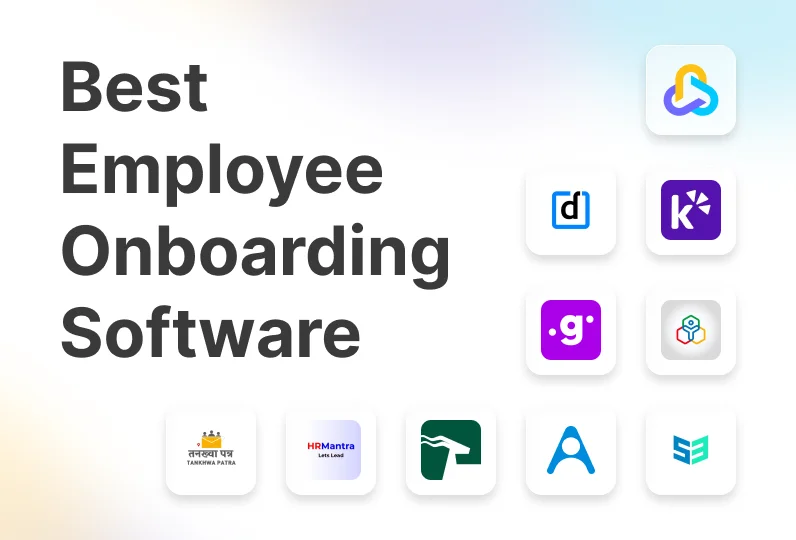
TL;DR: Top Onboarding Software in India
| Software | Best Suitable for | Key Onboarding Capabilities | Limitations (Potential Consideration) |
| CollabCRM | Small, mid-sized & Enterprise IT and service businesses | Upcoming-joining visibility, employee profiles, recruitment funnel, cross-team coordination | Particularly aligned with businesses that want onboarding connected to recruitment, payroll, projects, and operations |
| Keka | Growing businesses and organizations of different sizes | Preboarding, onboarding workflows, checklists, digital documentation, e-signatures, task assignment, payroll and attendance integration | Broad HR platform, so businesses seeking only basic onboarding may not need its full feature set |
| Darwinbox | Mid-sized and enterprise organizations | Preboarding, onboarding journeys, document workflows, employee lifecycle management | Better suited to organizations looking for a broader enterprise HR platform |
| Zoho People | SMEs and businesses using the Zoho ecosystem | Candidate and employee onboarding, offer/appointment letters, e-signatures, onboarding reports, customizable workflows | Payroll is handled through Zoho Payroll or other supported payroll integrations rather than directly within Zoho People |
| greytHR | Growing businesses and HR teams | Employee onboarding forms, document collection, employee information, approvals, onboarding workflows | Stronger fit for businesses looking for broader HR and payroll capabilities alongside onboarding |
| SalaryBox | Small businesses and attendance-focused workforces | Employee document verification, background verification, employee records | Onboarding capabilities should be validated against the specific workflow requirements |
| Attendo | Businesses needing attendance and payroll-focused workforce management | Employee setup, attendance and payroll management | Current positioning is expanding beyond its former restaurant-focused market, so onboarding depth should be validated |
| HROne | Organizations seeking broader HR management | Employee lifecycle and onboarding capabilities | Specific onboarding workflow depth should be validated for the business’s requirements |
| HR Mantra | Mid-sized and larger organizations | HR lifecycle and onboarding capabilities | Specific onboarding functionality and implementation requirements should be validated |
| Tankhwa Patra | Growing businesses and field/attendance-heavy teams | Preboarding, document collection, offer acceptance, onboarding checklists, e-signatures, employee onboarding, self-service | Particularly strong where onboarding needs to connect with attendance, payroll, and workforce management |
What Is Employee Onboarding Software?
Employee onboarding software is a digital system that helps companies bring new employees into the organization in a structured way.
It replaces scattered emails, spreadsheets, paper forms, and manual follow-ups with a defined workflow. HR teams can use it to collect employee information, prepare documents, assign joining tasks, coordinate payroll setup, and track completion status.
For example, when a developer joins an IT company, the onboarding workflow may include:
- Adding employee and bank details
- Completing payroll information
- Collecting PAN, Aadhaar, PF, and UAN details where applicable
- Assigning access and equipment tasks
- Introducing the employee to the manager and project team
- Setting up attendance, leave, and timesheet records
- Preparing the employee for their first payroll cycle
The best HR onboarding software does not only make HR work easier. It creates better coordination across HR, finance, IT, department heads, and new hires.
Why Onboarding Software Matters in India
Indian businesses often manage onboarding alongside payroll, attendance, statutory documentation, reimbursements, and multi-location operations. Streamlining HR operations can help reduce duplicate work and delays across these connected processes.
1. It reduces manual follow-ups
HR teams no longer need to chase employees for documents through email or messaging apps. A centralized process provides clearer ownership and status visibility. Common HR and recruitment mistakes such as poor documentation, unclear ownership, and disconnected processes can create duplicate work and delays.
2. It supports first-day readiness
A new employee should not spend their first day waiting for access, assets, basic information, or payroll registration. Onboarding workflows help internal teams prepare before the joining date.
3. It connects onboarding with payroll
Employee data collected during onboarding should flow accurately into payroll. This reduces repeat data entry and lowers the risk of mistakes in salary setup, deductions, and statutory records.
4. It helps maintain compliance records
Indian organizations need accurate employee information for payroll and statutory processes. This includes relevant records for PF, ESI, Professional Tax, TDS, Labor Welfare Fund, gratuity, and other requirements based on eligibility and location.
5. It supports remote and hybrid work
A centralized platform gives employees a consistent joining experience regardless of whether they work from an office, client site, home, or another city.
How We Evaluated These Software Solutions
This list is not a universal ranking. The right platform depends on your workforce, industry, process maturity, and operational needs.
We reviewed these employee onboarding software platforms based on the following criteria:
- Onboarding workflow support: Ability to organize employee joining steps and track completion
- Employee record management: Centralized handling of employee profiles, documents, and key details
- Payroll connection: Ability to move new-employee details into payroll without repeated manual entry
- India-focused compliance support: Coverage for common statutory payroll workflows
- Cross-functional coordination: Support for HR, finance, IT, managers, and employees
- Scalability: Suitability for startups, SMEs, or enterprises
- Ease of implementation: Setup complexity, configuration needs, and adoption potential
- Self-service experience: Employee access to records, payslips, declarations, claims, and requests
We have not included pricing in this comparison because pricing structures, product bundles, and implementation requirements can vary by organization.
Key Features to Look for in Employee Onboarding Software
The best employee onboarding software should help teams manage the employee journey from offer acceptance to a productive first few weeks.
Look for these essentials:
- Preboarding visibility: Track upcoming joiners so HR, IT, finance, and managers can prepare before day one.
- Centralized employee records: Store personal, job, bank, salary, and document details in one secure place.
- Digital document collection: Collect PAN, Aadhaar, bank details, offer documents, and other required records without manual follow-ups.
- Task checklists: Assign onboarding tasks to HR, managers, IT, and finance with clear deadlines and ownership.
- Payroll-ready setup: Connect employee data with salary structures, attendance, leave, claims, reimbursements, deductions, and tax declarations.
- India-specific statutory support: Check support for PF, ESI, TDS, Professional Tax, LWF, gratuity, and state-specific payroll requirements.
- Employee self-service: Let employees access payslips, tax details, leave, claims, and permitted profile updates independently.
- Business workflow integration: For IT and service businesses, connect onboarding with projects, resource allocation, timesheets, and team operations.
- Role-based access: Protect sensitive employee and payroll data through controlled permissions.
- Easy implementation: Choose a system that is simple to configure, adopt, and scale as the team grows.
Top 10 Employee Onboarding Software in India for 2026
Below are 10 of the best onboarding software options in India for 2026. Each tool is evaluated based on its onboarding capabilities, ideal business fit, and practical limitations to help startups, SMEs, and enterprises choose the right solution.
1. CollabCRM
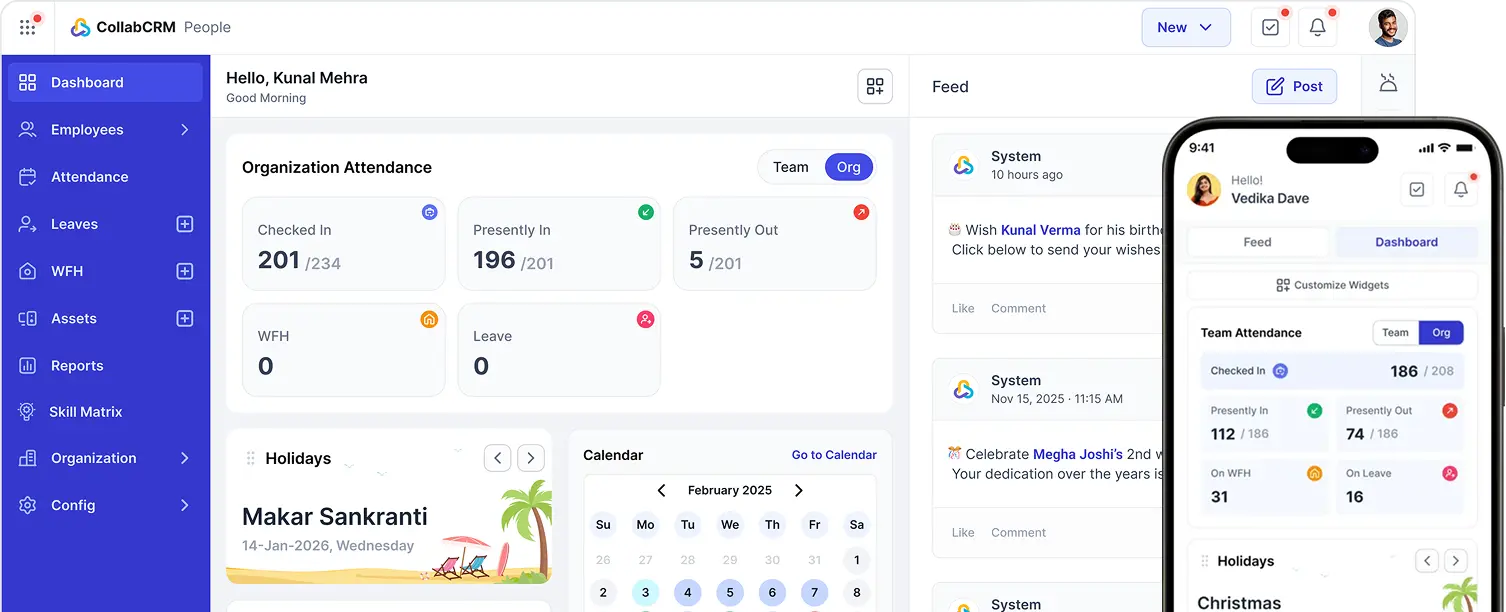
CollabCRM is a strong option for IT companies and service businesses that want onboarding to connect with the wider business operation. It brings people management, recruitment, project operations, resource visibility, sales, invoicing, and administration together in one connected platform.
Rather than treating a new hire as only an HR record, CollabCRM’s People Management Module helps organizations prepare for the person’s broader role in the business. HR can track candidate progress through a recruitment funnel. Admin and IT teams can see upcoming joiners and prepare onboarding essentials. Managers can use employee records, resource availability, project allocation, and timesheet context to support faster transition into active work.
CollabCRM can typically be implemented in one to two weeks, depending on data readiness, workforce policies, payroll configuration, and the scope of migration.
Key capabilities
- Recruitment funnel to track candidates through the hiring journey
- Upcoming-joining visibility for IT and admin readiness
- Employee listing and profiling for centralized people records
- Payroll profiles with salary structure, annual CTC, PAN, Aadhaar, PF, UAN, and bank details
- Tax declarations and investment-proof management
- Payroll processing with salary, deductions, loans, advances, reimbursements, and payslips
- Attendance and leave data connection for more accurate salary processing
- Employee self-service access to payslips, tax summaries, claims, loans, and reimbursement status
- Resource allocation, project, timesheet, and organizational context in the same business platform
- Role-based access controls and sensitive-data protections
Onboarding and first-day readiness
CollabCRM helps teams prepare employees before their joining date by bringing recruitment, employee records, payroll setup, and internal coordination into one system. HR can track upcoming joiners, maintain employee details, and ensure essential information is ready before the employee’s first working day.
The platform also supports smoother coordination between HR, managers, finance, and admin teams. Once a candidate joins, their profile can connect with payroll, attendance, leave, resource allocation, project assignments, and timesheets. This helps new employees move faster from onboarding to active work without managing the same information across separate tools.
Best suitable for
CollabCRM is best suited for small and mid-sized IT companies, software development firms, digital agencies, and services businesses that want a connected platform for hiring, people operations, payroll, projects, resources, billing, and internal operations.
It is especially useful for teams that want to avoid moving employee data between separate recruitment, HR, payroll, project, and resource management tools.
Limitations
CollabCRM is purpose-built around IT company operations. Businesses seeking a highly specialized, standalone onboarding-only product may prefer a narrower tool. Its strongest value comes when organizations use its connected people, payroll, recruitment, projects, and operations capabilities together.
2. Keka
Keka is an HR and payroll platform that includes hiring and onboarding alongside people data, attendance, performance, payroll, expense tracking, and project timesheets. Its platform positions onboarding as part of a broader employee lifecycle workflow.
Key capabilities
- Hiring and onboarding support
- Employee information management
- Payroll and expense tracking
- Attendance and leave management
- Employee self-service features
- Project timesheets and workforce-related workflows
Best suitable for
Keka is suitable for startups and mid-sized organizations that want a people-focused HR and payroll platform with connected hiring and onboarding processes.
Limitations
Its wider HR suite may be more than a small team needs if the organization is looking only for a lightweight onboarding checklist tool.
3. Darwinbox
Darwinbox offers employee onboarding as part of its enterprise HCM platform. It focuses on building a digital joining experience that begins before day one and supports a faster transition to productivity.
Key capabilities
- Digital preboarding
- Employee onboarding workflows
- Candidate-to-employee transition
- Enterprise HCM environment
Best suitable for
Darwinbox is best suited for enterprises and high-growth organizations that need a scalable onboarding process within a larger HR ecosystem.
Limitations
Enterprise HR systems can require more planning, stakeholder involvement, and configuration before rollout.
4. Zoho People
Zoho People is a cloud HR platform with hiring and onboarding workflows, core HR, time and attendance, document management, reports, and integrations with other Zoho applications.
Key capabilities
- Custom onboarding workflows
- Offer letters with e-sign support
- Onboarding reports
- Employee data and document management
- Time and attendance
- Integration with Zoho Payroll and Zoho Expense
Best suitable for
Zoho People is a good option for startups and SMEs, particularly organizations already using Zoho tools for business operations.
Limitations
Businesses should confirm how their desired onboarding and payroll processes work across Zoho People and connected Zoho payroll products.
5. greytHR
greytHR is a hire-to-retire HRMS and payroll platform. It includes recruitment, onboarding, employee records, tasks, checklists, attendance, payroll, and employee self-service capabilities.
Key capabilities
- Recruitment and onboarding workflows
- Employee records, letters, tasks, and checklists
- Payroll with statutory deductions
- Attendance and leave connection
- Employee app for payslips, claims, tax declarations, and leave information
Best suitable for
greytHR is well suited for SMEs and growing businesses that need onboarding connected to everyday payroll and HR administration.
Limitations
Companies with very simple onboarding needs may need to configure the broader platform carefully to keep processes straightforward.
6. SalaryBox
SalaryBox is a workforce management platform for attendance, payroll, employee management, compliance, and new-hire onboarding. It has a strong mobile-first orientation for distributed and operational workforces.
Key capabilities
- New-hire onboarding
- Staff identity verification
- Document management
- Attendance and roster management
- Payroll and statutory compliance
- Employee self-service functions
Best suitable for
SalaryBox is best suited for small businesses, multi-location businesses, retail operations, and field workforce teams.
Limitations
Organizations focused on more complex corporate HR workflows should validate whether the platform matches their onboarding design and approval structure.
7. Attendo
Attendo (formerly Petpooja Payroll) combines attendance hardware and software with payroll, leave, shifts, salary management, and employee app access. Its process is designed to connect employee attendance data directly to payroll.
Key capabilities
- Employee setup tied to attendance and payroll
- Biometric and face-based attendance capture
- Shift and leave management
- Payroll calculations
- PF, ESIC, PT, and LWF support
- Employee self-service access to attendance, leave, and salary records
Best suitable for
Attendo is ideal for SMBs, retail businesses, factories, offices, and shift-based teams that depend on attendance accuracy.
Limitations
Its strongest use case is attendance-led workforce administration, so companies should evaluate fit for more extensive preboarding and corporate onboarding workflows.
8. HROne
HROne is a broad HRMS platform that supports workforce management, payroll, attendance, performance, and recruitment. It positions its employee lifecycle management from onboarding through exit.
Key capabilities
- Workforce and employee lifecycle management
- Recruitment management
- Payroll management
- Attendance and leave workflows
- Integrations and mobile access
Best suitable for
HROne can suit startups, SMBs, and large enterprises that need an extensive HR suite and want to scale their HR processes over time.
Limitations
Because it covers a wide range of HR processes, teams should define their essential onboarding workflow before configuration to avoid unnecessary complexity.
9. HR Mantra
HR Mantra is an established HRMS provider with human resource management capabilities for employee lifecycle administration. It is commonly considered by organizations that need a broad HR and payroll environment.
Key capabilities
- Employee lifecycle management
- HR record management
- Payroll-linked HR administration
- Attendance and workforce process support
- Configurable HR operations
- Best suitable for
HR Mantra may suit mid-sized businesses and enterprises that require structured HR management and payroll-connected employee processes.
Limitations
The right fit depends on the organization’s workflow requirements. Ask for a product demonstration focused on preboarding, document collection, task handoffs, payroll setup, and employee self-service before selecting the platform.
10. Tankhwapatra
Tankhwapatra offers HRMS and payroll solutions designed for organizations ranging from startups to enterprises. Its site highlights HRMS and payroll management for a growing user base.
Key capabilities
- HRMS and payroll management
- Employee data administration
- Workforce process support
- Scalable HR operations
- Best suitable for
Tankhwapatra may be considered by startups, SMEs, and growing businesses seeking a payroll-led HRMS solution.
Limitations
Businesses should confirm the depth of onboarding workflows, document management, task management, and integration requirements during their evaluation.
How to Choose the Right Onboarding Software
The best onboarding software for small business teams is not necessarily the right platform for a 1,000-person enterprise. Start with your internal process, not a feature list.
1. Map your current onboarding journey
List each task from offer acceptance to the first 30 days. Include HR documentation, IT setup, payroll registration, manager check-ins, equipment, access, induction, and department-specific tasks.
This helps you identify where delays and duplicate effort happen.
2. Check payroll connectivity
Employee data should move from onboarding to payroll accurately. Look for workflows that support salary structure setup, bank details, tax declarations, attendance inputs, reimbursements, deductions, and payslip delivery.
3. Confirm Indian compliance coverage
Ask whether the system supports the statutory requirements relevant to your organization. For multi-location businesses, verify state-specific Professional Tax and Labor Welfare Fund handling.
4. Match the platform to your workforce
Consider how your employees work:
- Startups may value quick setup and simple workflows.
- SMEs may need connected onboarding, payroll, leave, attendance, and employee records.
- IT service companies may benefit from tying new hires to project allocation, resource planning, timesheets, and operations.
- Field teams may need mobile-first access, rosters, and attendance support.
- Enterprises may need standardized workflows across departments and locations.
5. Review implementation support
Ask about data migration, configuration, payroll setup, user training, and go-live support. A platform is only useful when employees and administrators can adopt it confidently.
6. Run a pilot
Test the onboarding process with a small group. Measure completion time, missing information, manual follow-ups, payroll readiness, and employee feedback before scaling it across the organization.
Final Takeaway
Employee onboarding software should create a clear, reliable path from candidate acceptance to productive employment. The right system helps HR, finance, managers, IT, and employees complete the right actions at the right time.
For Indian IT companies and growing service businesses, CollabCRM stands out as an all-in-one operating platform. It connects recruitment, employee profiles, upcoming-joiner visibility, payroll, statutory workflows, attendance, project operations, resource allocation, billing, and internal coordination. This reduces the need to move employee information across disconnected tools.
With full statutory coverage, multi-state Professional Tax handling, payroll-linked employee setup, and a typical implementation timeline of one to two weeks, CollabCRM can help teams build a more connected and practical onboarding process.
FAQs
Employee onboarding software is a digital tool that helps companies manage the process of bringing new hires into the organization. It can organize employee details, documents, tasks, payroll setup, and first-day activities in one place.
Indian businesses often need to coordinate employee documentation, payroll setup, attendance, tax declarations, statutory records, and cross-team tasks. Onboarding software reduces manual follow-ups and improves process consistency.
The best employee onboarding software depends on your company size, workforce type, payroll requirements, and operating model. CollabCRM is a strong option for IT companies that want onboarding, payroll, recruitment, projects, resource allocation, and business operations in one platform.
Yes. Small business onboarding software can help lean HR teams avoid spreadsheet-based processes, reduce paperwork, organize employee data, and prepare employees for payroll faster.
Many employee onboarding software platforms connect employee information with payroll. This can reduce duplicate data entry for salary structures, bank details, statutory records, tax declarations, reimbursements, and deductions.
Look for employee record management, document collection, task tracking, role-based approvals, joining-date visibility, payroll setup, statutory support, employee self-service, reporting, and integration with attendance and leave data.
It can centralize employee payroll profiles and support records related to PF, ESI, Professional Tax, TDS, Labor Welfare Fund, gratuity, and other applicable requirements. Always verify that the product supports your specific state and workforce requirements.
Yes. A cloud-based platform lets remote and hybrid employees submit documents, complete tasks, access policies, review payroll information, and communicate with HR without being physically present at an office.
Implementation time depends on company size, data quality, workflow complexity, integrations, and payroll setup. CollabCRM can generally be implemented within one to two weeks, subject to readiness and scope.


 Priority Onboarding