
Hiring the right people is critical for every growing IT company. But hiring without a clear process can lead to inconsistent decisions, delayed recruitment, poor candidate experiences, and compliance risks.
A well-defined recruitment policy gives HR teams and hiring managers a common framework. It explains how hiring needs are approved, how candidates are sourced and evaluated, who makes hiring decisions, and how candidate information is handled.
For Indian IT companies, this becomes even more important as demand shifts toward specialized skills such as AI, cloud, cybersecurity, data engineering, and software development.
NASSCOM’s 2026 Technology Sector Strategic Review notes that hiring in India’s technology industry is expected to shift from volume toward the right skill mix as AI-driven productivity gains increase.
This guide explains what a recruitment policy is, what it should contain, how to write a recruitment policy, and three real-world recruitment policy examples you can use for reference.
Key Takeaways
- A recruitment policy defines the rules and standards an organization follows when hiring employees.
- It helps HR teams create a consistent and transparent recruitment process.
- A good policy should cover hiring approvals, job descriptions, sourcing, screening, interviews, selection, offers, background checks, and candidate data.
- Indian IT companies should align their recruitment practices with applicable employment, privacy, and data protection requirements.
- A recruitment policy template provides a starting structure, but it should be customized to your company.
- Skills-based hiring is becoming increasingly important for technology companies.
- Recruitment software can help HR teams apply the policy consistently across multiple roles and hiring managers.
- A policy should be reviewed regularly as the company, hiring needs, technology, and regulations change.
What is a Recruitment Policy?
A recruitment policy is a formal set of guidelines that defines how an organization attracts, evaluates, selects, and hires employees.
It provides a consistent framework for everyone involved in recruitment. This includes HR professionals, recruiters, hiring managers, department heads, interviewers, and business leaders.
When recruitment is part of a broader effort toward streamlining HR operations, organizations can create more standardized and efficient people processes.
A recruitment policy can also be called a hiring policy or recruitment and selection policy.
It usually covers the complete hiring cycle, from identifying a vacancy to making an offer and completing pre-employment checks.
For an IT company, this may include hiring for roles such as Software developers, Project managers, UI/UX designers, QA engineers, DevOps engineers, Cloud architects, Data engineers, AI and ML engineers, Business analysts, Sales and business development professionals, HR and administrative roles.
The purpose is not to make every hiring decision identical. Instead, the policy creates a common standard while allowing teams to adapt the process to different roles.
Why Do Indian IT Companies Need a Recruitment Policy?
India’s technology hiring environment is becoming more skills-focused. This creates a need for more structured hiring decisions.
Common HR and recruitment mistakes can make this even more challenging, especially when multiple hiring managers follow different processes.
To understand why a solid policy is necessary, look at the market dynamics:
- Attrition: The Indian IT sector witnessed high attrition rates post-pandemic, with some large firms (ex. Infosys) reporting voluntary attrition above 27%. This means you are constantly hiring.
- Volume: The Indian IT industry is expected to add significant net new hires year over year. High volume requires high process discipline.
- Candidate Experience: According to a LinkedIn report, candidates who have a positive experience are likely to apply again or refer others.
- Specialized Roles: Deloitte India’s Campus Hiring Report found that 87% of surveyed engineers were actively upskilling in AI/ML and data science. The study also reported an expected 38% increase in GenAI use across resume screening, assessments, and evaluations. The research covered more than 200 organizations and 500+ campuses.
When you are processing thousands of applications for a Java Developer role, a recruitment policy helps you screen without bias and with speed.
For example, a company hiring an AI engineer may need to evaluate technical skills, practical project experience, problem-solving ability, and knowledge of AI systems. A sales position may require a completely different assessment process.
Without defined guidelines, individual hiring managers may use different standards.
A recruitment policy establishes the standard. Recruitment technology helps the team execute that standard consistently and becomes an important part of building a scalable HR system as the company grows.
Recruitment Policy vs. Recruitment Process
These terms are related but not identical.
A recruitment policy defines the rules and principles that guide hiring. A recruitment process explains the practical steps recruiters and hiring managers follow.
For example:
Recruitment policy:
All new positions must receive appropriate approval before recruitment begins.
Recruitment process:
The hiring manager raises a job requisition, HR reviews it, the department head approves it, and the position is published.
The policy provides the framework. The process puts that framework into action.
Benefits of Having a Recruitment Policy
Here are the benefits of using a structured recruitment and hiring policy for an IT company:
Consistency: It ensures the HR team in Bengaluru hires using the same standards as the team in Pune.
Legal Safety: Indian IT companies must comply with the Companies Act and labor laws regarding non-discrimination. A policy documents your intent to comply.
Faster Onboarding of HR Staff: New recruiters can read the policy to understand company rules instantly.
Brand Protection: Professional hiring processes improve your Glassdoor ratings.
Reduced Bias: A policy enforces structured interviews, which are proven to be more predictive of job performance than unstructured chats (Source: Schmidt & Hunter, 1998, Psychological Bulletin).
Key Elements of a Recruitment Policy
A useful recruitment policy template should cover the major decisions and responsibilities involved in hiring.
Here are the key elements to include.
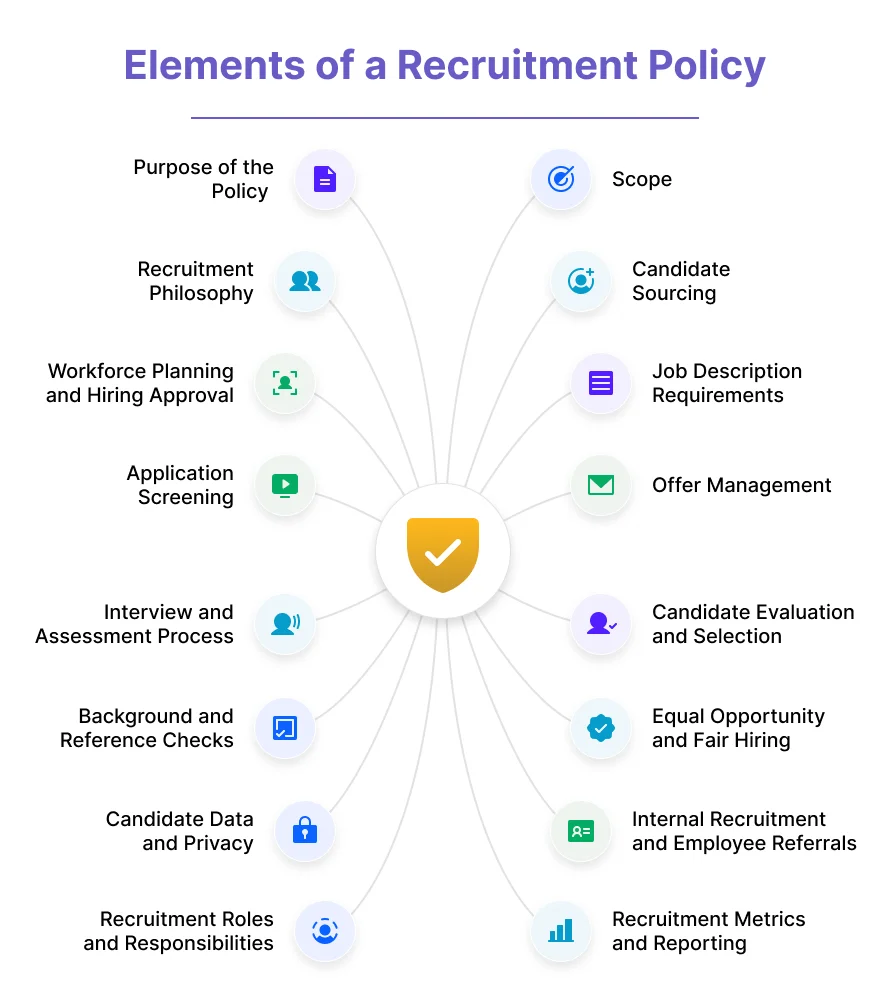
1. Purpose of the Policy
Start by explaining why the policy exists.
For example, the purpose could be to ensure that the company follows a consistent, fair, efficient, and skills-focused recruitment process. (Keep this section short)
2. Scope
Define who and what the policy covers.
You can specify whether it applies to:
- Full-time employees
- Part-time employees
- Contract employees
- Interns
- Temporary workers
- Remote employees
- Internal transfers
- All departments
- All company locations
For an Indian IT company, it is useful to clearly state whether the policy applies to domestic and international hiring.
3. Recruitment Philosophy
This section explains what the organization values when hiring.
A technology company may prioritize:
- Relevant technical skills
- Problem-solving ability
- Practical experience
- Communication
- Collaboration
- Adaptability
- Learning ability
- Leadership potential
- Alignment with company values
The recruitment philosophy should also explain the organization’s commitment to fair and merit-based hiring.
4. Workforce Planning and Hiring Approval
Define who can request a new position and who must approve it.
A typical flow could be:
Hiring need → Job requisition → Budget review → Management approval → Recruitment
The policy can require information such as:
- Job title
- Department
- Employment type
- Required skills
- Experience level
- Location
- Salary range
- Hiring justification
- Expected joining date
- Reporting manager
This prevents informal hiring requests from entering the recruitment pipeline.

5. Job Description Requirements
Every open position should have a clear job description.
It should generally include:
- Job title
- Role summary
- Responsibilities
- Required qualifications
- Technical skills
- Preferred skills
- Experience
- Location or work model
- Reporting structure
- Employment type
For technology roles, separate required skills from preferred skills.
This can help recruiters and candidates understand which capabilities are essential.
6. Candidate Sourcing
Define the channels HR teams can use to attract candidates.
These may include:
- Company careers page
- Job portals
- Employee referrals
- Campus recruitment
- Professional communities
- Recruitment agencies
- Talent databases
- Direct sourcing
The policy can also specify when external recruitment agencies may be used and who approves them.
7. Application Screening
Explain how applications are reviewed.
For example, recruiters may screen candidates against:
- Minimum qualifications
- Relevant experience
- Required technical skills
- Location or work authorization
- Notice period
- Compensation expectations
- Role-specific requirements
Avoid making screening dependent only on resumes.
For technology positions, practical assessments and structured technical evaluations can provide additional evidence of candidate capability.
8. Interview and Assessment Process
Define the standard interview structure. This may include recruiter screening, technical assessment, technical interview, managerial interview, and HR discussion.
Clear ownership and efficient scheduling interviews can help prevent unnecessary delays in the hiring process.
For example:
Recruiter screening → Technical assessment → Technical interview → Managerial interview → HR discussion → Final approval
The exact stages can vary by role.
Your policy should define:
- Who conducts each interview
- What each interviewer evaluates
- How feedback is recorded
- How candidates are scored
- Who makes the final recommendation
- How disagreements are handled
Structured interviews can also make candidate comparisons more consistent.
9. Candidate Evaluation and Selection
Define how the final candidate is selected.
A technology company may use a standardized scorecard covering:
| Evaluation Area | Example |
| Technical skills | Programming, cloud, AI, DevOps |
| Problem-solving | Technical and practical scenarios |
| Experience | Relevant projects and responsibilities |
| Communication | Clarity and collaboration |
| Culture and values | Alignment with company values |
| Leadership | Role-dependent |
| Learning ability | Adaptability to new technologies |
The criteria should match the job description.
10. Background and Reference Checks
If your company conducts background verification, document the process.
The policy should explain:
- Which roles require verification
- What information may be checked
- When checks are conducted
- Who manages the process
- How candidate consent is obtained
- How verification information is stored
Do not collect information simply because it is available. Define what is necessary for the recruitment purpose.
11. Offer Management
Recruitment does not end when an offer is accepted. A well-defined employee onboarding process helps organizations move smoothly from candidate selection to becoming a productive member of the team.
Explain how employment offers are prepared and approved. This may include:
- Salary and compensation
- Employment terms
- Joining date
- Reporting manager
- Location
- Benefits
- Conditions of employment
- Required pre-employment checks
You should also define who has authority to approve compensation exceptions.
12. Equal Opportunity and Fair Hiring
A recruitment policy should clearly state the company’s commitment to fair and merit-based hiring.
Candidates should be evaluated against job-related criteria.
Your policy should also address reasonable accommodations where applicable and prohibit unlawful discrimination.
For example, the University of York’s recruitment policy explicitly emphasizes fair and transparent recruitment, merit and potential, inclusive recruitment, reasonable adjustments, and confidentiality of applicant information.
13. Candidate Data and Privacy
Recruitment involves sensitive personal information.
Applications may contain resumes, contact information, education details, employment history, assessment results, references, and other personal information.
Indian companies should therefore define how candidate information is collected, accessed, stored, shared, retained, and deleted.
India’s Ministry of Electronics and Information Technology notified the Digital Personal Data Protection Rules, 2025 in November 2025, with a phased commencement framework.
Your recruitment policy should be reviewed with the appropriate legal or privacy team to ensure that candidate data practices align with applicable requirements.
14. Internal Recruitment and Employee Referrals
Your policy can define whether existing employees can apply for open positions.
- It can also explain:
- Internal application rules
- Manager notification requirements
- Employee referral eligibility
- Referral incentives
- Conflict-of-interest requirements
This can help companies use their existing workforce and employee networks as talent sources.
15. Recruitment Roles and Responsibilities
Clearly assign responsibilities.
For example:
HR/Recruitment team
- Manage recruitment operations
- Source candidates
- Coordinate interviews
- Maintain candidate records
- Communicate with candidates
Hiring manager
- Define role requirements
- Participate in interviews
- Evaluate candidates
- Recommend candidates
Department head
- Approve hiring requirements
- Approve final selection where applicable
Leadership/Finance
- Approve headcount and compensation based on company policy
16. Recruitment Metrics and Reporting
Your recruitment policy can define the metrics HR should monitor.
Useful recruitment KPIs include:
- Time to hire
- Time to fill
- Cost per hire
- Source of hire
- Interview-to-offer ratio
- Offer acceptance rate
- Candidate drop-off rate
- Quality of hire
- Recruitment funnel conversion
- New-hire retention
These metrics can help HR identify bottlenecks.
For example, if candidates are frequently dropping out between the technical interview and final interview, the company can investigate whether the process is too slow or poorly coordinated.
How to Write a Recruitment Policy
Wondering how to write a recruitment policy for your IT company?
Follow these steps.
Step 1: Define the purpose
Identify what the policy should achieve.
Focus on consistency, fairness, efficiency, compliance, and business alignment.
Step 2: Understand your current hiring process
Document what actually happens today.
Do not start by designing an ideal process that your team cannot follow.
Map the current journey from hiring request to onboarding.
Step 3: Identify process gaps
Look for issues such as:
- Unclear approvals
- Duplicate candidate records
- Long interview cycles
- Missing interview feedback
- Inconsistent evaluation
- Poor candidate communication
- Unclear ownership
- Manual spreadsheet tracking
Step 4: Define roles and responsibilities
Specify who owns each stage.
This reduces confusion between HR, recruiters, hiring managers, department heads, and leadership.
Step 5: Create your recruitment standards
Define the rules for:
- Job requisitions
- Job descriptions
- Candidate sourcing
- Screening
- Interviews
- Assessments
- Selection
- Background checks
- Offers
- Candidate data
- Internal hiring
Step 6: Add role-specific flexibility
Do not force every role through exactly the same interview process.
A senior software architect may need a different assessment than a junior QA engineer.
The policy should define the common standards while allowing role-specific evaluation.
Step 7: Review the policy
Have HR, hiring managers, leadership, and the appropriate legal or compliance stakeholders review it.
Step 8: Train the people involved
A policy only works when people understand it.
Recruiters and hiring managers should know where to find the policy and how to apply it.
Step 9: Review it regularly
Recruitment practices change.
New technologies, business models, workforce strategies, and regulatory requirements can affect how companies hire.
Review the policy periodically and update it when needed.
Recruitment Policy Examples
You must be looking for recruitment policy examples. Instead of providing a generic sample, it is useful to study policies published by established organizations.
These examples show how real organizations structure recruitment principles, responsibilities, selection standards, and candidate handling.
1. University of York
The University of York’s recruitment policy provides a detailed recruitment policy covering recruitment principles, approval requirements, job descriptions, selection panels, shortlisting, candidate assessments, references, offers, and pre-employment checks.
It is particularly useful for understanding how a formal organization documents accountability and fair selection.
The policy states that recruitment should be fair and transparent and that appointments are based on merit and potential. It also requires formal approval before recruitment begins and sets expectations for objective candidate assessment.
2. CUTS International
CUTS International provides a recruitment and selection policy that outlines its commitment to equal employment opportunity and merit-based selection.
Its policy covers the purpose and scope of recruitment, hiring requirements, candidate qualifications, and responsibilities of employees involved in recruitment.
The document is useful for understanding how an organization can connect recruitment objectives with equal opportunity and defined selection standards.
3. Google
Google provides public information about its hiring approach through Google Careers.
Its careers platform outlines equal opportunity commitments and provides information about the application and hiring experience. Google also publishes applicant and candidate privacy information for people using its careers platform.
For IT companies, Google can be a useful reference for thinking about structured hiring, skills and qualifications, candidate experience, and equal opportunity.
A Simple Recruitment Policy Sample for an Indian IT Company
If you are creating your first policy, the following structure can serve as a practical starting point.
| Recruitment Policy 1. Purpose The purpose of this policy is to establish a consistent, fair, transparent, and efficient recruitment process for hiring employees across the organization. 2. Scope This policy applies to all employees and stakeholders involved in recruiting full-time, part-time, contract, temporary, and internship positions, as applicable. 3. Hiring Requirement All new positions must be supported by a defined business requirement and appropriate internal approval before recruitment begins. 4. Job Description Every position must have an approved job description that clearly defines responsibilities, required qualifications, skills, experience, and other role requirements. 5. Candidate Sourcing The HR team may use approved job portals, professional networks, referrals, campus recruitment, recruitment partners, and other appropriate sourcing channels. 6. Screening Candidates will be screened against the requirements defined for the position. 7. Assessment and Interviews Candidates may be evaluated through structured interviews, technical assessments, assignments, behavioral interviews, or other role-specific assessments. 8. Selection Selection decisions must be based on job-related qualifications, skills, experience, assessment results, and other defined criteria. 9. Background Verification Background and reference checks may be conducted for applicable positions with appropriate candidate consent and in accordance with company requirements and applicable law. 10. Offer Management All employment offers must follow the company’s approval and compensation guidelines. 11. Equal Opportunity The organization is committed to fair and merit-based recruitment and does not permit unlawful discrimination in its hiring practices. 12. Candidate Data Candidate information must be collected, accessed, stored, shared, retained, and disposed of according to the organization’s privacy practices and applicable data protection requirements. 13. Recruitment Responsibilities HR, recruiters, hiring managers, interviewers, and approving authorities must follow the responsibilities assigned to them under the recruitment process. 14. Policy Review The HR team will periodically review the policy and update it when business needs, recruitment practices, technology, or applicable requirements change. |
This is a sample structure, not a legal document. Indian IT companies should adapt it to their organizational structure and have applicable legal or compliance requirements reviewed before formal adoption.
The CollabCRM Advantage
You can write the best recruitment policy in the world, but it is useless if it sits in a Google Doc that no one opens.
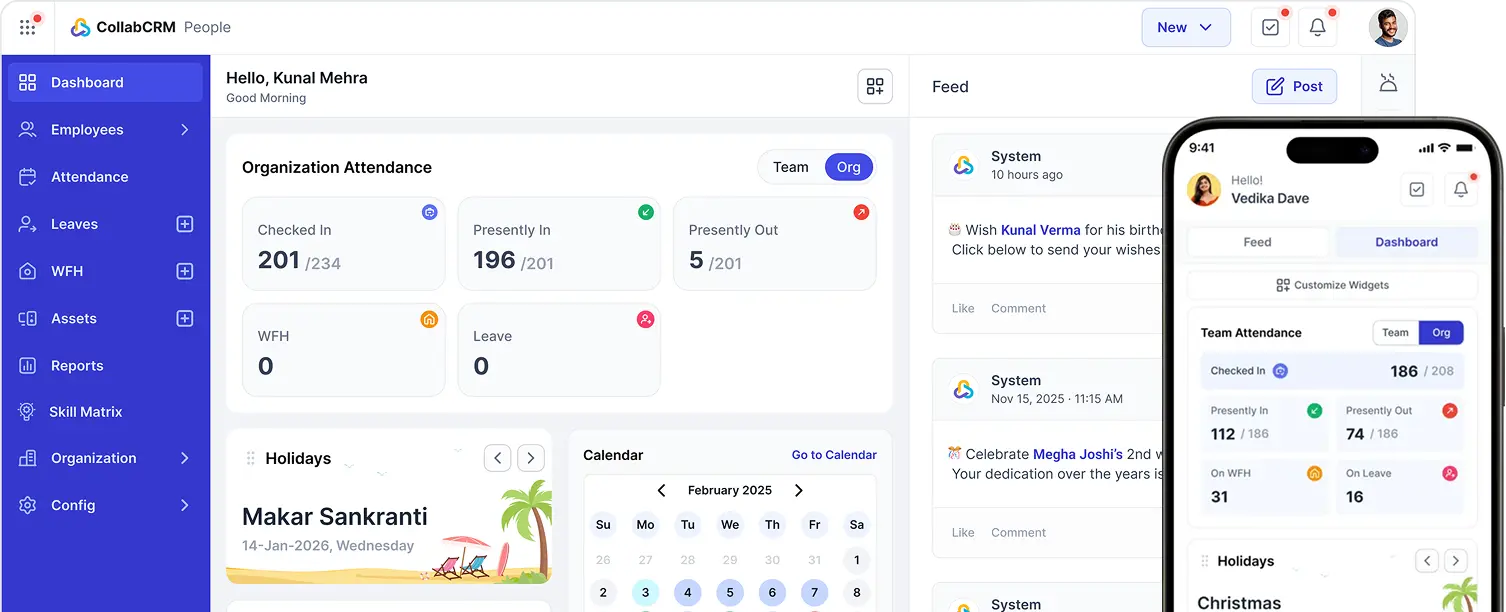
You need to operationalize your policy. This is where CollabCRM comes in.
CollabCRM’s Recruitment Module is designed for modern Indian IT teams. It helps you enforce your policy automatically:
- Structured Hiring: Create custom pipelines that match your policy stages (e.g., Screening -> Technical Test -> Manager Round -> HR Round).
- Centralized Data: All candidate notes are in one place. This supports your policy on “Data Privacy” and consistency.
- Collaboration: Your interview panels can collaborate seamlessly, ensuring the “Two Interviewers” rule from your policy is followed.
- Efficiency: Track offer letters and approvals digitally, ensuring the right people sign off as per your delegation of authority.
CollabCRM turns your static policy document into a live, actionable workflow. It helps you reduce time-to-hire and ensures compliance without manual follow-ups.
Conclusion
A recruitment policy should not be a document that sits in an HR folder and is rarely used. It should become a practical framework for how your company hires.
For growing Indian IT companies, that means combining clear hiring standards, skills-focused evaluation, accountable decision-making, candidate data protection, and a centralized recruitment workflow.
The value of a recruitment & hiring policy goes beyond process documentation. As hiring becomes more skills-focused and technology roles become more specialized, HR teams need consistent ways to manage candidates and collaborate with hiring managers.
A clear policy plus the right recruitment management system can help create a more organized, transparent, and scalable hiring function.
FAQs
A recruitment policy is a set of rules and guidelines that defines how an organization attracts, evaluates, selects, and hires employees. It creates a consistent framework for recruiters, HR teams, hiring managers, and other stakeholders involved in recruitment.
A recruitment policy helps standardize hiring, clarify responsibilities, support fair candidate evaluation, improve candidate experience, and reduce process gaps. It can also help organizations manage recruitment more consistently as they grow.
A recruitment policy should generally include its purpose and scope, hiring approvals, recruitment responsibilities, job descriptions, sourcing, screening, interviews, assessments, selection, background checks, offer management, equal opportunity, candidate data handling, and policy review.
To write a recruitment policy, first define its purpose and scope. Then document your current recruitment process, identify gaps, define responsibilities, establish hiring standards, address candidate data and compliance requirements, review the policy with relevant stakeholders, and update it periodically.
While not explicitly mandated by a single “Recruitment Policy Act,” it is necessary to demonstrate compliance with the Equal Remuneration Act and anti-discrimination laws.
Yes. While the general rules (like anti-discrimination) apply to all, you can have specific addendums for technical roles vs. non-technical roles.
It forces the use of structured interviews and standardized scoring, which removes “gut feeling” bias and promotes fair evaluation.
The key elements of a recruitment policy template typically include purpose, scope, recruitment philosophy, hiring approvals, job descriptions, sourcing, screening, interviews, candidate evaluation, background checks, offer management, equal opportunity, data privacy, responsibilities, and policy review.
A recruitment policy should be reviewed periodically and whenever there are significant changes to the organization’s hiring strategy, workforce structure, recruitment technology, or applicable legal and regulatory requirements.
Yes. Recruitment software can help HR teams apply policy-defined workflows in day-to-day hiring. It can centralize candidate information, track recruitment stages, coordinate hiring activities, improve visibility, and reduce manual recruitment administration. Tools such as CollabCRM can help connect recruitment activities with broader people management and business operations.




 Priority Onboarding