

Sales goals often look straightforward on the surface, yet defining the right ones is where most teams struggle. It’s easy to choose a number, but far more challenging to set goals that genuinely guide action, reflect reality, and lead to consistent revenue. When goals are rushed or disconnected from the actual sales process, they create noise instead of direction.
Strong sales goal setting requires clarity, intent, and a clear understanding of what truly drives results. This blog explores how to set sales goals that are thoughtful, practical, and aligned with business priorities. It tells how to set goals that influence daily decisions and translate effort into measurable revenue growth. Read further to increase your revenue and profitability.
Key Takeaways
- Clear sales targets give teams focus and direction, turning effort into measurable business outcomes.
- Using the SMART framework ensures goals are specific, measurable, achievable, relevant, and time-bound for actionable results.
- Well-structured sales goals improve focus, accountability, and alignment with broader business priorities.
- Different types of goals, like revenue, acquisition, retention, and market expansion, help maintain a balanced growth strategy.
- Reviewing past performance, assessing resources, and breaking objectives into milestones make goals realistic and actionable.
- Centralized tracking, regular reviews, and acting on insights keep progress visible and ensure targets stay on track.
- Practical, real-world examples show how clear, measurable goals consistently translate into predictable revenue growth.
What are Sales Goals?
Sales goals are specific targets that define what a sales team or business aims to achieve within a set period of time. They help provide clear direction and focus for sales activities. These goals often relate to outcomes such as revenue, number of deals closed, or new customers acquired.
Sales goals make it easier to measure performance and track progress. They also help teams prioritize tasks that contribute to business growth. When set clearly, sales goals turn plans into actionable results.
What are SMART Sales Goals?
SMART sales goals follow a structured framework that helps make sales targets clear and actionable. SMART stands for Specific, Measurable, Achievable, Relevant, and Time-bound. Each element ensures that a sales goal is well-defined and focused on real outcomes.
Being specific clarifies what needs to be achieved, while measurable goals make progress easy to track. Achievable goals keep targets realistic, and relevant goals ensure alignment with business priorities. Time-bound goals set a clear deadline, helping sales teams stay accountable and focused.
Why Are Sales Goals Important?
Sales goals provide clear direction, support effective planning and forecasting, and make it easier to measure progress and performance. Well-defined sales goals and objectives also increase accountability across teams and ensure time and resources are used efficiently to maximize overall ROI. Take a look at the benefits that make it important:
1. Help sales teams stay focused
Sales goals help teams concentrate on activities that directly contribute to results. With clear targets in place, sales efforts remain aligned, and distractions are reduced.
2. Provide direction and clarity
Well-defined sales goals clearly outline what needs to be achieved and within what timeframe. This removes confusion and ensures everyone understands expectations.
3. Support planning and forecasting
Sales goals make it easier to plan resources, timelines, and strategies. They also help forecast future revenue more accurately based on defined targets.
4. Help measure progress and performance
Clear sales goals and objectives allow teams to track progress against specific benchmarks. This makes it easier to evaluate performance and identify areas for improvement.
5. Increase Accountability
Sales goals and objectives assign ownership and responsibility to teams or individuals while encouraging accountability and ensuring consistent follow-through on tasks.
6. Help maximize ROI
Sales activities aligned with clear goals use time and resources more effectively. This improves efficiency and helps maximize return on investment.
Types of Sales Goals You Can Set
Types of sales goals like revenue & profitability goals, customer acquisition goals, activity-based goals, growth and retention goals, and market & product goals all play a key role in driving sales performance.
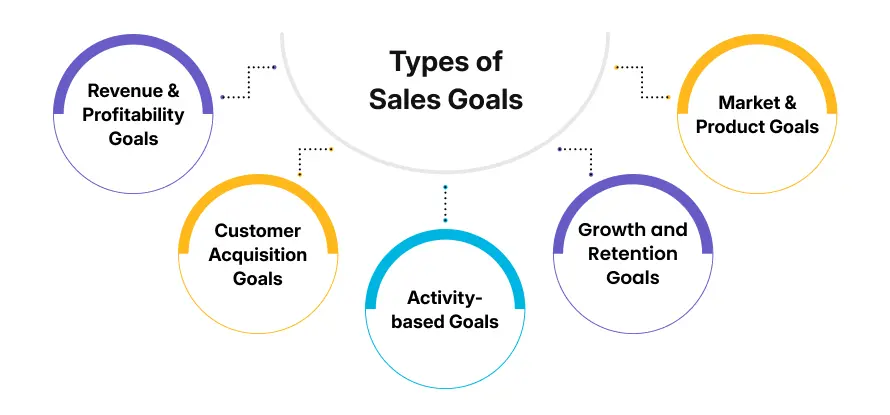
Each type helps teams focus on the right metrics, prioritize efforts, and align activities with business growth. Understanding these goals ensures a balanced approach and maximizes impact. Here’s a closer look at each type:
1. Revenue & Profitability Goals
You can set revenue & profitability goals to boost overall sales and improve profit margins. They help your team focus on high-value deals and ensure efforts translate into measurable financial growth. Tracking revenue and profitability also highlights which strategies or products are performing best.
2. Customer Acquisition Goals
Customer acquisition goals allow you to bring in new customers and expand into untapped markets. They encourage your team to prioritize outreach and lead generation, helping the business grow its customer base steadily over time.
3. Activity-based Goals
You can create activity-based goals to monitor key sales actions, such as making calls, conducting demos, or sending follow-ups. They help maintain consistent effort, reveal which activities lead to results, and improve overall sales discipline.
4. Growth and Retention Goals
Growth and retention goals will help you increase value from existing customers through upselling, renewals, or repeat purchases. They help reduce churn, strengthen relationships, and maximize the lifetime value of each client.
5. Market & Product Goals
These goals are designed to push into new regions, industries, or product lines. They encourage the team to align with business expansion strategies, explore new opportunities, and drive adoption of new offerings.

How to Set Sales Goals?
To set sales goals, review past sales performance, understand current capacity and resources, and decide what you want to improve. Also, break goals into milestones, communicate expectations clearly, and track progress iteratively to ensure they are actionable and achievable. Here’s a closer look at each step to know how to set targets for the sales team:
1. Review past sales performance
Start with a thorough assessment of historical data to understand what has worked and what hasn’t. Look at:
- Total revenue generated over previous periods
- Conversion rates and average deal sizes
- Customer acquisition and retention trends
- Sales activities that produced the best results
Understand these patterns, set realistic targets, and avoid repeated mistakes.
2. Understand current capacity and resources
Evaluate the team’s ability to achieve the goals, considering current resources. Consider:
- Number and skill level of sales reps
- Technology and best CRM tools in use
- Marketing support and lead generation capabilities
- Budget available for sales activities
This ensures goals remain challenging yet achievable without overloading the team.
3. Decide what you want to improve
Clearly define the focus areas for growth. Examples include:
- Increasing total revenue or profit margins
- Expanding into new customer segments or markets
- Improving conversion rates or shortening the sales cycle
- Enhancing customer retention and repeat sales
A focused objective gives the team direction and makes progress measurable.
4. Break down the goals into milestones
Large goals can be overwhelming. Break them into smaller, manageable targets:
- Divide annual goals into quarterly or monthly objectives
- Separate team-wide goals into individual targets
- Link daily activities like calls, meetings, and demos to bigger outcomes
Milestones provide checkpoints for tracking progress and celebrating small wins along the way.
5. Communicate your expectations clearly
Ensure every team member understands the goals, their role, and how success will be measured:
- Share targets in team meetings or dashboards
- Explain the reasoning behind each goal
- Provide clarity on reporting and accountability
Clear communication builds alignment and ownership across the team.
6. Track progress and refine iteratively
Monitor results consistently and adjust strategies as needed:
- Use CRM tools or dashboards for real-time tracking
- Compare actual performance against milestones regularly
- Identify obstacles or underperforming areas early
- Adjust targets or tactics to keep goals realistic and achievable
Iterative tracking ensures continuous improvement and helps the team stay on course.

How to Track and Monitor SMART Sales Goals?
To track and monitor SMART sales goals, clearly define what you are tracking and choose the right metrics to measure progress. Use a single system to track performance and set regular review intervals to maintain consistency.
Compare actual results with targets, share progress with the team, take action based on insights, and review and update goals when necessary to ensure goals stay relevant and achievable. Here’s how each step works in practice:
1. Clearly Define What You Are Tracking
Start with a clear understanding of what each sales goal represents and how success will be measured. Every goal should be linked to a specific outcome, a measurable metric, and a defined timeline. This clarity ensures that tracking remains accurate and consistent. Without clear definitions, progress can become difficult to evaluate.
2. Choose the Right Metrics
Select metrics that directly reflect progress toward your sales goals. Focus on measures that influence results, such as revenue, conversions, or deal movement through the pipeline. Avoid tracking too many metrics, as this can dilute focus. The right metrics provide meaningful insight into performance.
3. Use a Single System to Track Progress
Track all sales data in one centralized system to maintain consistency and visibility. A single business operating system helps avoid data gaps and ensures everyone works with the same information. It also simplifies sales management and reporting and makes progress easier to monitor over time.
4. Set Regular Review Intervals
Establish a routine for reviewing sales performance at set intervals. Regular reviews help identify trends, address issues early, and maintain momentum. Consistent check-ins keep goals active and top of mind.
5. Compare Actual Results With Targets
Evaluate current performance against defined targets during each review. This comparison highlights gaps, progress, and areas performing well. It also helps determine whether adjustments are needed to stay on track.
6. Share Progress With the Team
Make sales goal progress visible to everyone involved. Transparent updates help teams stay aligned and aware of expectations. Sharing progress also encourages accountability and collaboration.
7. Take Action Based on Insights
Use performance insights to guide decisions and improvements. Adjust sales activities, processes, or priorities when trends indicate challenges or opportunities. Action based on data helps prevent small issues from becoming larger problems.
8. Review and Update Goals When Necessary
Reassess sales goals periodically to ensure they remain realistic and relevant. Changes in market conditions, resources, or priorities may require adjustments. Updating goals helps keep them aligned with current business needs.
SMART Sales Goals Examples to Help You Understand Better
SMART sales goals examples include increasing monthly revenue, closing a set number of deals, improving conversion rates, reducing the sales cycle, generating qualified leads, etc. Moreover, increasing average deal value, boosting customer retention, scheduling product demos, expanding into new markets, and improving weekly follow-ups.
The examples below show how setting sales targets works:
- Increase monthly revenue by 15% within the next six months through a stronger focus on high-value accounts and improved deal conversion. This goal clearly defines the outcome, measurement, and timeline.
- Close 20 new deals in the next quarter with a stronger emphasis on qualified leads and consistent follow-ups. Progress can be reviewed weekly to maintain momentum.
- Improve the sales conversion rate from 10% to 15% within three months using better lead qualification and focused sales coaching. This goal directly supports revenue growth.
- Reduce the average sales cycle from 45 days to 35 days over the next two quarters with faster response times and streamlined approvals. Shorter cycles help improve overall efficiency.
- Generate 30 qualified leads each month for the next six months through improved outreach and closer alignment with marketing efforts. Lead quality remains a key measurement.
- Increase average deal value by 10% within four months through relevant upselling and bundled offerings. This goal improves revenue without increasing lead volume.
- Reach a customer retention rate of 90% before year-end with stronger post-sale engagement and regular customer check-ins. Retention supports long-term growth.
- Schedule 10 product demos every month over the next quarter to keep the sales pipeline active and improve close rates. Demos serve as a clear leading indicator.
- Enter two new market segments within six months through targeted research and customized sales messaging. This goal supports expansion efforts.
- Increase weekly follow-up activities by 20% within two months to improve prospect engagement and sales productivity. Consistent follow-ups help move deals forward.
Conclusion
When goals are specific, realistic, and aligned with business priorities, they transform ambition into results, keep teams accountable, and turn effort into predictable growth. The difference between missed targets and consistent revenue isn’t effort; it’s the quality of your goals. Start setting sales goals the right way, and watch them become the engine that fuels your business growth.
How CollabCRM Helps You Achieve Your Sales Goals
CollabCRM is a distinctive business operating system that brings sales goal‑setting and achievement into a unified, practical workflow rather than scattering targets across spreadsheets and apps. With its CRM module, CollabCRM puts your entire sales process under one roof.
The CRM module gives you real‑time visibility into pipeline stages, customer interactions, and deal health, helping teams prioritize high‑impact opportunities and prevent leads from slipping through the cracks. Smart dashboards and visual pipelines make it easy to monitor progress and make data‑informed decisions that drive consistent sales outcomes.
Beyond the CRM, CollabCRM offers multiple integrated modules that work together seamlessly:
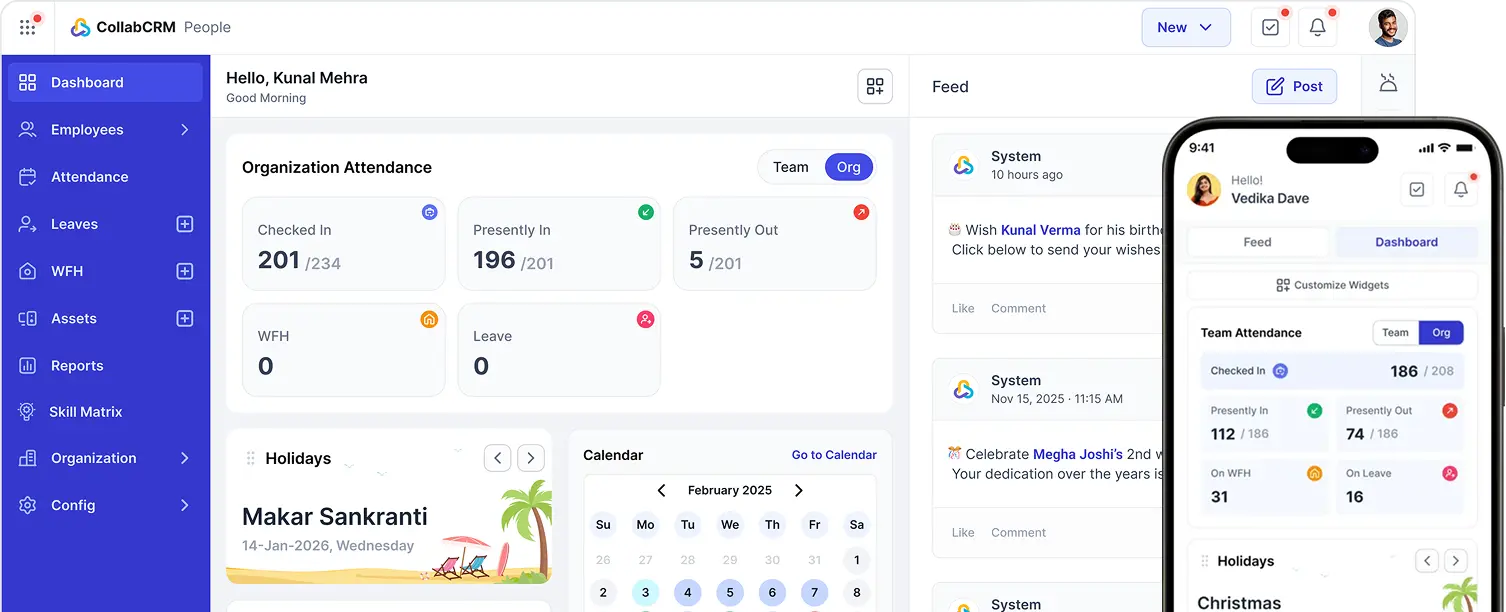
- People Management Module—Looks after employee records, roles, attendance, and performance tracking, helping organizations manage their workforce efficiently and align people with business goals.
- Project Management Module—Helps teams manage tasks, deadlines, and collaboration in one place, aligning project outcomes with sales and business objectives.
- Recruitment Module—Simplifies hiring by managing job postings, applications, interviews, and candidate evaluations, helping organizations attract and hire the right talent faster.
- Administration Module— Centralizes user roles, permissions, and organizational settings, ensuring secure access, operational consistency, and smooth governance across the platform.
- Reports Module—Offers real-time insights across all modules, helping managers monitor performance, identify bottlenecks, and optimize strategies.
By combining these modules, CollabCRM creates a holistic ecosystem where sales goals, customer relationships, project execution, and financial operations are interconnected. This integration ensures that every department works toward aligned objectives, making goal-setting actionable and turning strategy into measurable revenue growth.

FAQs
Sales goals are realistic when they are based on past performance, current team capacity, and market conditions. Reviewing historical data helps set achievable growth targets. Goals should challenge the team without overstretching available resources.
Sales goals should be reviewed regularly to stay relevant and achievable. Short-term goals benefit from weekly or monthly reviews, while long-term goals can be evaluated quarterly. Regular reviews allow early adjustments when performance shifts.
Sales goals should directly support overall business priorities such as growth, retention, or expansion. Understanding company-level objectives helps shape sales targets that contribute to larger outcomes. Alignment ensures sales efforts drive meaningful business results.
Both levels play an important role in goal setting. Team goals encourage collaboration and shared accountability, while individual goals help track personal performance. Combining both creates balance and clarity across the sales organization.
Sales goals stay motivating when they are clear, achievable, and regularly reviewed. Breaking goals into smaller milestones helps maintain momentum. Recognition and feedback also play a key role in keeping teams engaged.
Sales tools and CRMs centralize data and make goal tracking easier. They provide real-time visibility into performance and progress. This helps teams stay aligned and make informed decisions.
Sales goals can be adjusted when business conditions or priorities change. Regular performance reviews help identify when updates are needed. Flexible goals ensure relevance and prevent teams from working toward outdated targets.





 Priority Onboarding