
You invest in marketing campaigns, sales tools, and skilled representatives. Leads come in from your website, ads, referrals, and outbound efforts. Yet deals still stall, follow-ups get delayed, and forecasts feel unreliable. For many sales teams, especially in IT organizations, lead management is where revenue quietly leaks.
The problem is not the volumes of lead. It is how those leads are handled once they enter your system. Too often, leads live across inboxes, spreadsheets, CRMs that are barely used, or tools that do not talk to each other. Sales people chase the loudest opportunities instead of the right ones. Managers struggle to answer basic questions like which leads are active, who owns them, or how likely they are to convert.
As your sales team grows, this chaos multiplies. Longer sales cycles, multiple stakeholders, technical evaluations, and demos make it harder to maintain context. A missed follow-up or unclear handoff can mean losing a high-value deal to a competitor who simply responded faster.
This is why lead management continues to break sales teams, even those with strong products and capable people. This adds to one of the leading challenges of the IT industry. Without a structured system, sales become reactive instead of predictable. You rely on individual effort rather than process, and scaling becomes painful.
Lead management system exists to solve this exact problem. When implemented correctly, it helps you capture, qualify, track, and convert leads with consistency. It gives your sales team clarity, your managers visibility, and your leadership confidence in the pipeline.
In this guide, you will learn what lead management software really is, why it matters for IT sales teams, which tools are worth considering, and how to use them effectively to build a predictable sales engine.
Key Takeaway
- Lead management is the process of capturing, tracking, and converting leads across the entire sales cycle
- Lead management fails when leads are scattered, delayed, or poorly tracked
- Lead management software brings structure, speed, and visibility to sales teams
- Faster follow-ups and clear ownership improve conversion rates
- Sales teams need tools that support long sales cycles and multiple stakeholders
- Choosing software should start with your sales process, not the tool
- CollabCRM is built for IT companies with end-to-end lead and workflow management
What is Lead Management Software?
Lead management software is a system that helps you capture, organize, track, and convert leads throughout your entire sales cycle. Instead of treating leads as scattered contacts or email threads, it gives you a single place to manage every interaction, activity, and status change from first touch to closed deal.
At its core, the lead management solution ensures that no lead is ignored, delayed, or mishandled.
When a new lead enters your system, the software records:
- Where it came from,
- Assigns it to the right sales representative
- Tracks every follow-up, call, email, and
- Reminders for the meeting that is lined up next.
You always know who owns the lead, what stage it is in, and what needs to happen to move it forward.
| Lead Management Software (LMS) vs Customer Relationship Management (CRM) Lead Management Software (LMS) focuses on the start of the sales cycle- capturing, qualifying, and nurturing potential customers. Whereas CRM handles the entire customer journey, from first contact through sales, service, and retention, often incorporating LMS functions as a core part of its broader scope. |
For IT sales teams, this distinction matters. Your leads rarely convert after one call. They involve technical discussions, demos, approvals, and multiple stakeholders. Lead management software keeps all this context intact, so your sales reps do not start from scratch every time they re-engage a prospect.
In simple terms, lead management software turns lead handling from a manual task into a structured workflow. It replaces guesswork with visibility, speed, and consistency, helping your sales team focus on closing deals instead of managing chaos.
Why Lead Management Matters?
Lead management directly affects how much revenue you close and how predictable your sales pipeline becomes, especially in IT sales with long cycles and high-value deals.
- Even small delays or inefficiencies can lead to lost opportunities.
- Faster response times significantly improve lead conversion.
- Following up within the first hour increases your chances of qualifying a lead.
- Responding even after five minutes brings the possibility of a lead drop.
- Structured lead handling improves consistency and forecasting accuracy.
Common Challenges in Lead Management and Their Solutions
As sales grow, your challenges as a sales head or a CEO become evident. Let us check them & see how the right lead management tools bring the solution.
| Lead Management Challenges | Solution: Lead Management Software |
| Lead leakage across multiple channels | Centralizes all leads in one system, regardless of source |
| Duplicate or unqualified leads | Applies structured qualification and lead scoring |
| Slow or missed follow-ups | Automates reminders, tasks, and follow-up workflows |
| Inconsistent sales rep performance | Standardizes lead handling across the team |
| Unclear lead ownership | Automatically assigns leads with clear accountability |
| Deals waiting without action | Tracks lead stage and next steps in real time |
| Poor pipeline visibility | Provides real-time views of lead status and pipeline health |
| Inaccurate sales forecasting | Uses data-driven insights instead of assumptions |
| Reactive sales management | Enables proactive, measurable, and scalable sales processes |
Lead management software replaces guesswork with structure, helping you control every lead, improve conversion rates, and build a predictable sales pipeline.

Key Lead Management Features
Key features to look for in lead management software include Lead Capture from multiple sources, intelligent Lead Tracking & Scoring, robust Analytics & Reporting, visual Pipeline Management, and Task Management, everything in a user-friendly, secure, and scalable platform to boost efficiency and conversion rates.
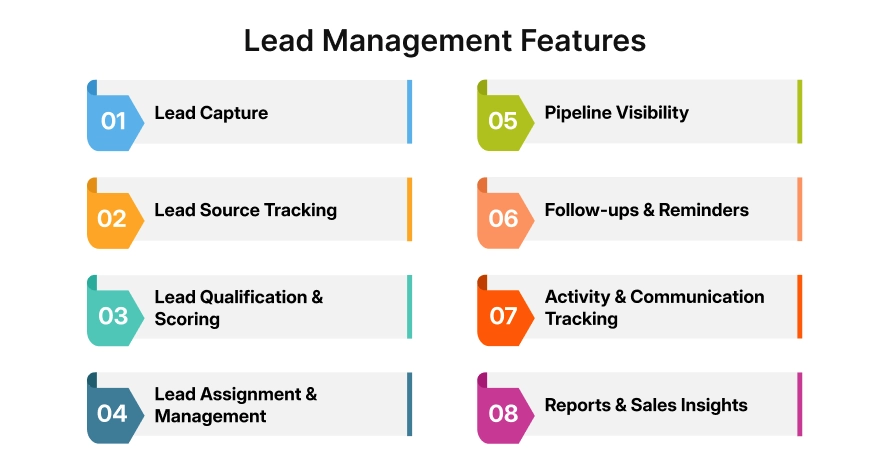
1. Lead Capture
You should be able to capture leads from your website, emails, ads, chat, and referrals in one place. This ensures no lead is missed and every inquiry enters your sales pipeline automatically.
2. Lead Source Tracking
You need to know where your best leads come from. Source tracking helps you understand which channels drive real revenue, and not just form fill-ups.
3. Lead Qualification & Scoring
Not every lead is sales-ready. Lead scoring helps you prioritize high-intent prospects, allowing you to spend time where it matters most.
4. Lead Assignment & Management
Leads should reach the right sales representative instantly. Automated routing removes confusion, improves response time, and creates clear ownership.
5. Pipeline Visibility
You should always know where each lead stands. Visual pipelines and clear stages help you track progress and spot stalled deals early.
6. Follow-ups & Reminders
The software should remind you when to call, email, or follow up. This prevents missed touchpoints and improves buyer experience.
7. Activity & Communication Tracking
Every call, email, and note should stay linked to the lead. This keeps context intact, especially during long IT sales cycles.
8. Reports & Sales Insights
You should be able to track response time, conversion rates, and pipeline health through built-in report management without manual reporting. Clear data helps you make better sales decisions.
In short, strong lead management features help you stay focused, move faster, and build a more predictable sales process.
How to Choose the Right Lead Management Tool?
You must keep these things in consideration when choosing your lead management system software:
- Map your current lead flow before evaluating any tool.
- Pick software that supports your sales stages and buyer journey.
- Prioritize ease of use to drive consistent rep adoption.
- Avoid tools that require heavy setup or constant admin work.
- Ensure leads can be assigned and tracked automatically.
- Look for clear dashboards that show pipeline health at a glance.
- Verify integration with tools your team already uses.
- Choose a solution that can scale with more leads and users.
- Limit over-customization to keep workflows simple.
- Focus on measurable impact on response time and conversions.
5 Best Lead Management Software Tools for Sales Teams
Here, we have summarized five of the best lead management software tools used by sales teams today. Each option is evaluated based on ease of use, core lead management features, scalability, and suitability for different sales needs.
This will help you quickly identify which tool aligns best with how you sell and where your team is headed. There is no one solution that fits every organization, so you must select based on your requirements and workflow operations.
1. CollabCRM
CollabCRM is an all-in-one lead and business management platform built especially for IT companies. Unlike standalone CRMs that only track leads and deals, CollabCRM brings your sales, projects, invoicing, and team data together in one connected system so you can manage everything without switching tools.
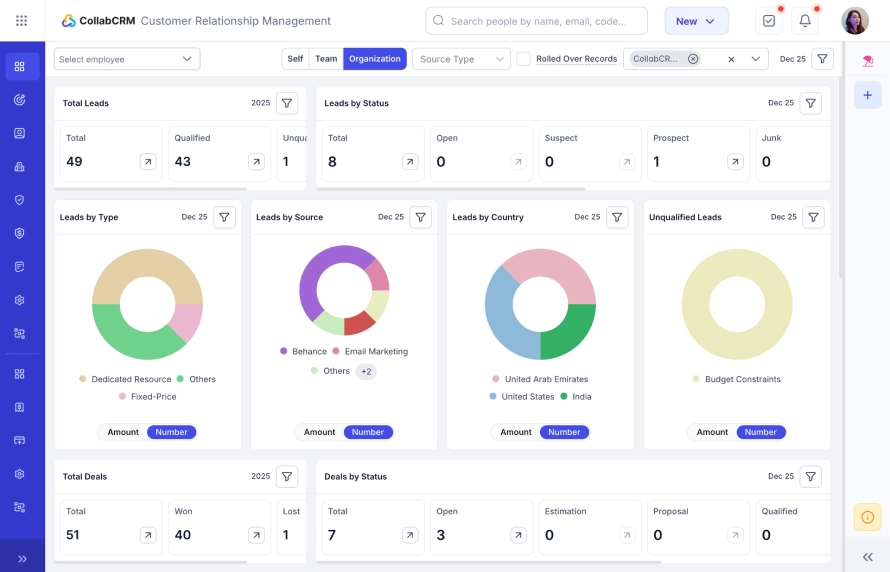
The following features of CollabCRM make it the best lead management software for small businesses.
Real-Time Lead Capture and Organization: Instantly capture and centralize all incoming leads.
Visual Pipeline and Customization: Track deals visually with stages tailored to your sales process.
Active Engagement and Follow-up Tools: Stay on top of calls, emails, and next steps automatically.
IT-Specific Lead Features: Qualify leads using IT-focused fields and buying context.
Performance Tracking and Accountability: Monitor response times, conversions, and sales team activity in real time.

2. HubSpot Sales Hub
HubSpot Sales Hub is a widely used sales platform that helps teams manage leads, track interactions, and automate routine sales activities. It works well for sales teams that rely heavily on inbound leads and want a structured way to manage conversations, follow-ups, and pipeline activity within a familiar ecosystem.
Centralized Lead and Contact Management: Store, organize, and track all leads and contacts in one shared database.
Visual Deal Pipeline: View and manage deals across customizable pipeline stages.
Email Tracking and Engagement Tools: Track opens, clicks, and replies to understand lead interest.
Automated Follow-Ups and Tasks: Schedule reminders and automate routine sales actions.
Sales Reporting and Insights: Monitor deal progress, activity levels, and basic sales performance metrics in real time.
3. Zoho CRM
Zoho CRM is a flexible sales management platform designed for growing teams that need customization without heavy complexity. It supports lead tracking, automation, and reporting, making it suitable for IT companies looking to adapt their CRM to evolving sales processes.
Lead Capture and Management: Collect and organize leads from multiple channels in one system.
Customizable Sales Pipelines: Define deal stages to match your sales workflow.
Lead Scoring and Assignment Rules: Prioritize and route leads automatically.
Sales Automation Tools: Automate follow-ups, tasks, and routine sales actions.
Analytics and Performance Reports: Track conversions, pipeline health, and team performance.
4. Salesforce Sales Cloud
Salesforce Sales Cloud is an enterprise-grade sales platform built for organizations with complex sales structures and large teams. It offers deep customization and advanced analytics for managing leads at scale.
Advanced Lead and Account Management: Manage leads, accounts, and opportunities in one system.
Highly Customizable Pipelines: Configure stages, rules, and workflows to fit complex sales processes.
Automation and Workflow Rules: Reduce manual work with advanced automation.
Forecasting and Revenue Insights: Analyze pipeline data and predict sales outcomes.
Enterprise-Level Reporting: Access detailed reports and dashboards for leadership visibility.
5. Pipedrive
Pipedrive is a sales-focused CRM designed around simplicity and activity-based selling. It helps sales teams stay organized and focused on actions that move deals forward.
Visual Sales Pipeline: Track deals through clear, drag-and-drop stages.
Activity and Follow-Up Tracking: Keep calls, emails, and tasks linked to each deal.
Lead Organization Tools: Capture and manage leads with clear ownership.
Sales Automation Features: Automate repetitive tasks and reminders.
Sales Performance Reporting: Monitor deal progress and activity metrics.
You may choose the right lead management system as per your business requirements, but following the best practices and tips from experts can always be an add-on benefit.
Lead Management Best Practices & Tips for High-Performing Sales Teams
High-performing sales teams treat lead management as a daily discipline, not an afterthought. The first priority is speed. Responding quickly to new leads increases your chances of meaningful engagement and sets the tone for the entire sales conversation.
Clear ownership is equally important. Every lead should have one responsible salesperson, with no ambiguity about next steps. This accountability prevents deals from stalling and keeps momentum strong.
Consistent qualification helps your team focus on the right opportunities. When everyone follows the same criteria, you avoid wasted effort and create a more predictable pipeline.
Automation should handle repetitive work such as reminders, task creation, and follow-ups. This allows reps to spend more time selling instead of managing admin tasks.
Regular pipeline reviews help you spot risks early. By checking lead status, activity levels, and deal age, you can intervene before opportunities go cold.
Finally, strong teams use data to improve. Tracking response time, conversions, and activity levels helps you coach effectively and continuously refine your lead management process.
Mistakes to Avoid When Implementing Lead Management Software
Even the best lead management software can fail if it is implemented poorly. Many sales teams run into the same avoidable mistakes that limit adoption and reduce impact.
1. Overengineering workflows
Trying to automate every possible scenario often backfires. Complex workflows slow reps down and create confusion. Start simple, focus on core lead stages and actions, and add automation only when it clearly improves efficiency.
2. Poor representative adoption
If your sales reps do not use the system consistently, the data becomes unreliable. This usually happens when the software feels difficult or adds extra steps. Involve the salesperson early, keep workflows intuitive, and show how the tool helps them close deals faster.
3. Data hygiene issues
Incomplete, duplicate, or outdated lead data can quickly erode trust in the system. Without clean data, reporting and forecasting lose accuracy. Set clear rules for data entry, ownership, and regular cleanup to maintain reliability.
4. Treating setup as a one-time task
Lead management is not a “set it and forget it” process. As your sales team grows and your process evolves, the software needs regular updates. Review workflows, reports, and automation periodically to ensure the system continues to support how you sell.
Avoiding these mistakes helps you turn lead management software into a long-term sales asset instead of just another unused tool.
Final Thoughts: Building a Predictable Sales Engine
A predictable sales engine is not built on luck, volume, or individual effort. It is built on process, consistency, and visibility. When leads are captured properly, followed up on time, and tracked through clear stages, sales become easier to manage and easier to scale.
Lead management software plays a critical role in this shift. It helps you move away from reactive selling and toward a structured approach where every lead has an owner, every action is tracked, and every decision is backed by data. This is especially important for IT sales teams dealing with long cycles, multiple stakeholders, and high-value deals.
The right tool alone is not enough. Success comes from combining the right software with simple workflows, strong adoption, and regular optimization. When done well, lead management stops being a daily struggle and becomes a growth advantage.
If your goal is to improve conversions, gain pipeline clarity, and forecast revenue with confidence, investing in effective lead management is no longer optional. It is the foundation of a predictable, scalable sales engine.
Why CollabCRM Is the Best Lead Management Software for IT Companies?
For IT companies specifically, CollabCRM stands out because it is built around how technology sales actually work. It connects lead management with project management, invoicing, and team workflows, so your sales process does not stop at deal closure. From real-time lead capture and visual pipelines to IT-specific qualification fields and performance tracking, CollabCRM gives you end-to-end visibility without forcing you to juggle multiple tools. This unified approach helps IT sales teams stay aligned, reduce handoff gaps, and turn leads into long-term customers with greater consistency.
FAQs
Lead management software helps you capture, organize, track, and convert leads throughout the sales cycle, from first contact to deal closure.
CRM stores contact and account data, while lead management software actively supports lead qualification, routing, follow-ups, and pipeline tracking.
IT sales involve long cycles and multiple stakeholders. Strong lead management ensures faster follow-ups, better qualification, and clear pipeline visibility.
Key features include lead capture, source tracking, lead scoring, automated assignment, pipeline visibility, follow-ups, and sales reporting.
It reduces response time, ensures consistent follow-ups, prioritizes high-intent leads, and gives sales reps full context for every conversation.
You should invest when leads start falling through the cracks, follow-ups slow down, or pipeline forecasting becomes unreliable.
Yes. Lead management software helps small teams stay organized and allows growing teams to scale their sales process without adding chaos.
CollabCRM is the best lead management software built for IT workflows, connecting lead management with projects, invoicing, and team operations in one unified platform.