
Hiring the right people is only the first step. What truly sets successful teams apart is how well new employees are onboarded. A clear and structured onboarding process helps new hires feel confident, productive, and connected from the very beginning.
For HR professionals and decision-makers, onboarding is no longer just paperwork and orientation sessions. It is a strategic process that impacts employee retention, engagement, compliance, and long-term performance. When onboarding is rushed or unorganized, new employees often feel lost, disengaged, or unprepared for their roles.
This guide is designed to simplify employee onboarding for modern workplaces, especially IT companies and growing teams. It breaks down each phase of onboarding and provides practical checklists that HR teams can actually use. You will also learn how structured workflows and centralized tools can reduce manual effort and improve visibility across teams.
Whether you are building a new onboarding process or improving an existing one, this guide will help you create a smoother and more consistent experience for every new hire.
TL;DR
- Employee onboarding is a structured process that goes beyond Day 1 orientation
- A clear employee onboarding checklist ensures consistency and compliance
- Onboarding should cover pre-onboarding, Day 1, the first week, and 30 to 90 days
- HR, managers, and IT must collaborate for smooth onboarding execution
- A dedicated IT onboarding checklist prevents access delays and security risks
- Remote onboarding requires stronger communication and digital workflows
- Centralized platforms help track tasks, improve visibility, and scale onboarding efficiently
What Is Employee Onboarding?
Employee onboarding is the structured process of integrating a new hire into an organization. It starts once the candidate accepts the offer and continues through the first few months of employment. The goal is to help employees understand their role, responsibilities, tools, and company culture so they can perform confidently.
Many people confuse onboarding with orientation. Orientation is usually a one-day or short-term event. It focuses on policies, paperwork, and introductions. Onboarding is much broader. It includes training, goal setting, performance alignment, and continuous support over time.
Only 12% of employees believe that their organization provides a good onboarding experience for new hires. Hence, a well-designed employee onboarding checklist ensures that nothing important is missed during this transition. It creates consistency across departments and improves the experience for every new hire.
Onboarding is also a key stage supported by modern employee management tools within the employee lifecycle. It connects recruitment to performance management. When onboarding is structured and thoughtful, employees reach productivity faster and feel more engaged with the organization. For HR leaders and decision-makers, this makes onboarding a strategic priority rather than a routine administrative task.
Why a Structured Employee Onboarding Checklist Is Critical
A structured employee onboarding checklist creates a consistent and reliable experience for every new hire. It helps HR teams move beyond ad hoc processes and manual tracking. Instead of reacting to tasks as they arise, teams can follow a clear roadmap. This improves efficiency, reduces confusion, and ensures that onboarding is aligned with business goals.
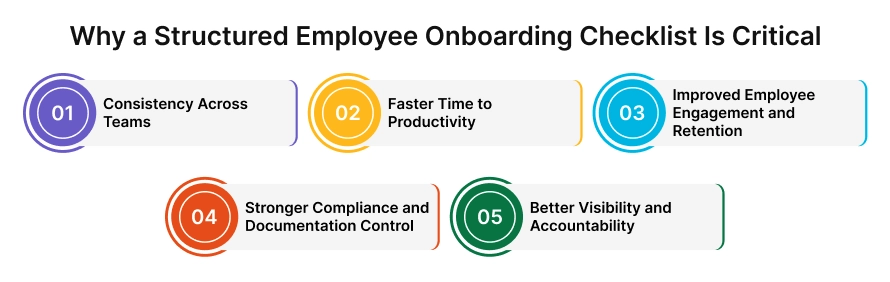
Below are the key reasons why a standardized onboarding checklist for new hires is essential:
1. Consistency Across Teams
A documented staff onboarding checklist ensures that every new employee receives the same level of attention and support. It prevents gaps in communication and reduces variation between departments.
2. Faster Time to Productivity
When tasks, training, and expectations are clearly defined, new hires can focus on learning their role. A well-planned new employee onboarding checklist shortens the ramp-up period and helps employees contribute sooner.
3. Improved Employee Engagement and Retention
Structured onboarding builds trust early. Employees feel supported and valued when the process is organized. This positively impacts retention and long-term engagement.
4. Stronger Compliance and Documentation Control
HR teams handle contracts, policy acknowledgments, tax forms, and regulatory documents. An onboarding checklist for new hires ensures that every required document is completed and recorded properly.
5. Better Visibility and Accountability
Without a checklist, HR teams often rely on emails and spreadsheets. This makes tracking difficult. A structured approach provides clarity on what is completed, pending, or overdue. It also improves collaboration between HR, managers, and IT.
A strong employee onboarding checklist is not just a priority task list. It is a framework that supports both operational efficiency and a positive employee experience.
Who Owns the Onboarding Process?
Employee onboarding is not the responsibility of a single team. It is a shared process that requires coordination between HR, managers, and IT. When ownership is clearly defined, onboarding becomes smoother and more consistent for new hires.
HR Teams
HR teams act as the primary owners of the employee onboarding checklist. They design the onboarding framework, manage documentation, and ensure compliance. HR also coordinates timelines, communicates with new hires, and tracks progress across each onboarding phase.
Managers and Team Leads
Managers play a critical role in helping new hires succeed in their roles. They set expectations, define responsibilities, and guide role-specific training. Managers also provide early feedback and ensure that new employees feel supported within their teams.
IT and Operations Teams
IT teams are responsible for system access, devices, and security setup. A clear IT onboarding checklist ensures that new hires have access to the tools they need on time. Operations teams may also support workspace setup and internal approvals.
When these teams work together using a shared onboarding checklist for new hires, the process becomes more transparent and efficient. Clear ownership reduces delays, improves accountability, and creates a better experience for everyone involved.
The Complete Employee Onboarding Checklist
Employee onboarding is a phased process that begins before a new hire joins and continues through the first few months of employment. Each phase focuses on a specific goal, from preparation to performance alignment. A structured employee onboarding checklist ensures consistency, reduces delays, and improves the overall new hire experience.
Below is a complete onboarding checklist for new hires, organized by each phase of the onboarding timeline.
Pre-Onboarding Checklist for New Hires
Pre-onboarding begins once the candidate accepts the offer. This phase focuses on preparation and communication. When handled well, it helps new hires feel welcomed and reduces first-day confusion.
Pre-Onboarding Checklist:
- Share the offer letter and employment contract
- Collect signed documents and compliance forms
- Complete background verification if required
- Create official employee records
- Set up email, communication tools, and system access
- Assign CRM, HRMS, and internal platform permissions
- Prepare laptop, devices, and workstation
- Schedule the first day’s agenda
- Send a welcome email with joining details and contacts
This phase ensures that HR and IT teams are ready before the employee’s first day.
Day 1 Employee Onboarding Checklist
The first day sets the tone for the employee’s journey. The focus should be on welcoming the new hire and helping them feel comfortable, not overwhelming them with information.
Day 1 Onboarding Checklist:
- Conduct a warm office or virtual welcome
- Introduce the company’s mission, values, and culture
- Explain basic HR policies and guidelines
- Complete any pending documentation
- Provide a walkthrough of key tools and systems
- Introduce the team and reporting manager
- Assign an onboarding buddy or mentor
- Share the onboarding roadmap for the first week
A smooth Day 1 experience builds trust and confidence early.
First Week Staff Onboarding Checklist
The first week focuses on role clarity and gradual learning. Employees start understanding how their work connects to team and company goals.
First Week Onboarding Checklist:
- Explain role responsibilities and expectations
- Share team goals and workflows
- Provide product or service overview
- Begin role-specific training sessions
- Assign initial tasks or shadowing activities
- Set short-term goals for the first month
- Schedule regular check-ins with the manager
- Conduct an HR follow-up to address questions
This phase helps new hires settle into their role without pressure.
First 30–90 Days New Employee Onboarding Checklist
This phase focuses on performance alignment, skill development, and engagement. Continuous feedback is critical during this period.
First 30–90 Days Onboarding Checklist:
- Define performance goals and success metrics
- Track training completion and skill development
- Conduct regular feedback and review meetings
- Address challenges and clarify responsibilities
- Encourage collaboration and team participation
- Reinforce company values and culture
- Confirm role clarity and long-term expectations
A strong new employee onboarding checklist during this phase supports retention and long-term productivity.

IT Onboarding Checklist for New Employees
In modern workplaces, especially IT companies, technical readiness is just as important as HR documentation. Delays in system access or device setup can slow down productivity from day one. That is why a dedicated IT onboarding checklist should run parallel to the employee onboarding checklist.
IT onboarding focuses on secure access, proper permissions, and smooth technical setup. It ensures that new hires can start working without interruptions.
Below is a structured IT onboarding checklist that HR and IT teams can align on.
1. Email and Communication Tools Access
- Create an official company email ID
- Set up access to collaboration tools such as chat and video platforms
- Add the employee to relevant mailing lists and team channels
2. CRM, HRMS, and Internal Platform Access
- Provide access to CRM, HRMS, and project management systems
- An all-in-one business operating system that incorporates all of the above is surely a smart & beneficial decision
- Assign access to internal knowledge bases or documentation portals
3. Device Allocation and Security Setup
- Allocate a laptop or the required devices
- Install necessary software and licensed tools
- Configure antivirus and endpoint protection
- Enable VPN access if required
- Set up multi-factor authentication
4. Data Access Permissions
- Assign role-based system permissions
- Restrict access based on security policies
- Document approval for sensitive data access
5. IT Support Information
- Share IT helpdesk contact details
- Explain the ticketing or support request process
- Provide basic troubleshooting guidelines
A structured IT onboarding checklist prevents access delays and strengthens data security. When HR and IT teams collaborate using a shared workflow, onboarding becomes more predictable and transparent.
Centralized systems, like CollabCRM, will help track approvals, access requests, and completion status without relying on scattered emails or spreadsheets.
Download Employee Onboarding Checklist
Use this ready-to-use employee onboarding checklist to streamline every stage of your onboarding process. The sheet covers pre-onboarding, Day 1, first week, 30 to 90 days, and IT onboarding tasks in a clear, structured format. You can customize it based on role, department, or work model.
Onboarding Remote Employees
Remote onboarding requires more structure and intentional communication than in-office onboarding. When employees are not physically present, it becomes harder to build connections, clarify expectations, and ensure technical readiness. A clear onboarding checklist for new hires is even more important in remote settings.
The goal of remote onboarding is to create clarity, consistency, and engagement without face-to-face interaction. HR, project management office, and IT teams must coordinate closely to avoid delays and miscommunication.
Remote Onboarding Process
Remote onboarding follows the same core phases as traditional onboarding, but with added focus on communication, documentation, and digital access.
Pre-Onboarding for Remote Employees
Preparation is critical. Since equipment and system access cannot be handed over in person, everything must be arranged in advance.
Remote Pre-Onboarding Checklist:
- Ship the laptop and required devices
- Share login credentials securely
- Test system and VPN access
- Send a digital onboarding schedule
- Share the company handbook and policies online
- Confirm internet and workspace readiness
Day 1 Remote Onboarding Checklist
The first day should focus on connection and clarity. Remote employees may feel isolated if engagement is not intentional.
Remote Day 1 Checklist:
- Conduct a virtual welcome session
- Introduce the team via video call
- Review the company’s mission and culture
- Walk through tools and communication platforms
- Explain communication norms and response times
- Assign a remote onboarding buddy
First 30 Days for Remote New Hires
Ongoing communication is the key to successful remote onboarding. Regular check-ins prevent disengagement and confusion.
Remote First 30 Days Checklist:
- Schedule weekly one-on-one meetings
- Provide structured training sessions
- Assign measurable early goals
- Encourage participation in virtual team meetings
- Collect feedback on the onboarding experience
- Clarify performance expectations
Remote onboarding works best when processes are clearly documented and centrally tracked. Many HR teams use digital onboarding workflows within unified platforms such as CollabCRM to maintain visibility across distributed teams. This reduces manual follow-ups and ensures that no onboarding step is missed.
Common Employee Onboarding Mistakes to Avoid
Even well-intentioned onboarding programs can fail if common mistakes are overlooked. These gaps often lead to confusion, disengagement, and slower productivity for new hires. Identifying and avoiding these issues helps HR teams deliver a more consistent and effective onboarding experience.
Overloading New Hires With Information
Sharing too much information at once can overwhelm new employees. Onboarding should be paced and spread across multiple phases to support better understanding and retention.
Lack of Role Clarity
When responsibilities and expectations are unclear, new hires struggle to perform confidently. Clear role definitions and early goal setting are essential.
Poor Coordination Between HR and IT
Delays in system access or device setup often stem from misalignment between teams. A shared onboarding checklist helps prevent these issues.
No Follow-Up After the First Week
Onboarding does not end after Day 1 or Week 1. Without regular check-ins, small issues can turn into bigger problems.
Manual Tracking With Limited Visibility
Relying on emails and spreadsheets makes it difficult to track onboarding progress. Tasks can be missed, and accountability is unclear. Centralized tracking improves transparency and efficiency.
Avoiding these mistakes allows HR teams to build an onboarding process that supports both employee success and business outcomes.
Best Practices for Building a Scalable Onboarding Process
As organizations grow, onboarding must remain consistent without becoming rigid. A scalable onboarding process balances standardization with flexibility. It ensures every new hire has a strong start while allowing room for role-specific needs.
- Standardize core onboarding steps across teams
- Maintain a single employee onboarding checklist
- Customize onboarding by role and department
- Use centralized task and checklist tracking
- Automate reminders and approval workflows
- Ensure easy access to onboarding documents
- Align HR, managers, and IT on timelines
- Schedule regular manager and HR check-ins
- Collect new hire feedback regularly
- Improve and update the onboarding process continuously
This format keeps the section clear, scannable, and action-focused for HR leaders and decision-makers. A scalable onboarding process supports growth without compromising the new hire experience.
How Technology Supports Modern Employee Onboarding
Technology plays a key role in simplifying and scaling employee onboarding. As teams grow and work models become more distributed, manual onboarding processes become harder to manage. Digital tools help HR teams maintain consistency, visibility, and accountability throughout the onboarding journey.
- Centralizes the employee onboarding checklist in one place
- Enables real-time visibility for HR, managers, and IT
- Reduces manual follow-ups and email dependency
- Automates task assignments, reminders, and approvals
- Ensures consistent onboarding for every new hire
- Improves coordination between HR, IT, and team leads
- Stores onboarding documents and policies securely
- Tracks onboarding progress across all phases
- Supports remote and hybrid onboarding workflows
- Enhances the overall new hire experience
Instead of managing onboarding through disconnected spreadsheets and tools, many organizations prefer centralized platforms such as CollabCRM to manage onboarding tasks, access requests, and approvals in a single workflow. This approach helps HR teams focus more on people and less on administrative overhead.
Final Thoughts
A structured employee onboarding checklist helps new hires feel confident and prepared from day one. When onboarding is planned across all phases, starting from recruitment management software, employees reach productivity faster and stay engaged longer. Clear processes, strong coordination, and the right tools make onboarding simpler for HR teams and more effective for the business.
How CollabCRM Simplifies Employee Onboarding Workflows?
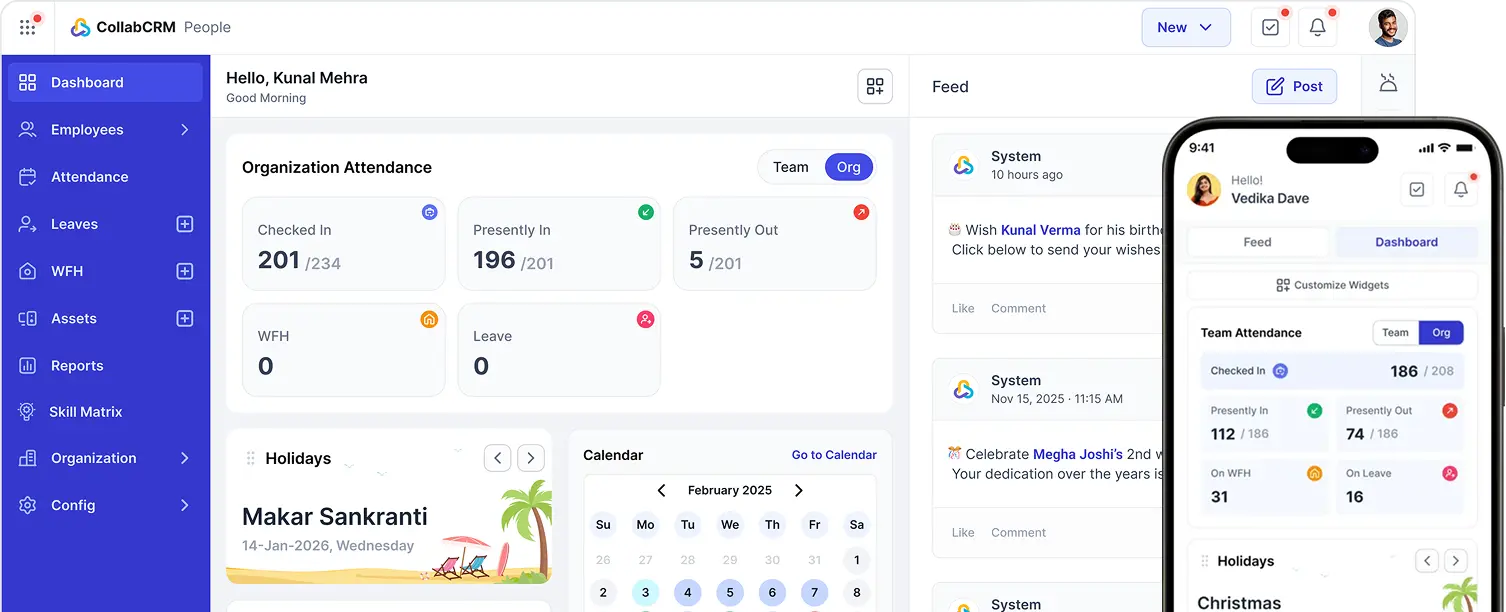
Using a centralized platform like CollabCRM helps HR teams manage the entire employee onboarding checklist in one place. Instead of relying on emails and spreadsheets, onboarding tasks can be tracked, assigned, and monitored in a structured workflow.
It improves coordination between HR, managers, and IT by providing visibility into pending tasks, approvals, and access requests. Automated reminders reduce delays, while centralized documentation ensures compliance and consistency.
By centralizing workflows and data, CollabCRM improves visibility, coordination, and accountability across departments- people management, project management, sales CRM, and reporting. This makes it easier for growing organizations to manage onboarding, ongoing work, and performance from one unified platform.
FAQs
An employee onboarding checklist typically includes pre-onboarding documentation, Day 1 welcome activities, role-specific training, IT setup, compliance tasks, and performance check-ins for the first 30 to 90 days.
Onboarding usually lasts between 30 to 90 days. Some organizations extend it to six months, depending on the complexity of the role and training requirements.
Onboarding is a shared responsibility. HR manages documentation and process flow, managers handle role clarity and training, and IT ensures system access and security setup.
Orientation is a short-term event that introduces company policies and culture. Onboarding is a longer process focused on integration, performance alignment, and engagement.
An IT onboarding checklist ensures timely access to email, CRM, HRMS, and internal systems. It also supports data security and prevents productivity delays.
Structured onboarding helps employees feel supported and confident early in their journey. Clear expectations and regular feedback increase engagement and reduce early attrition.
Remote onboarding requires stronger digital communication, documented workflows, and proactive check-ins. Technical readiness and engagement activities must be planned in advance.
Yes. Many organizations use centralized platforms to automate task assignments, reminders, approvals, and documentation tracking. This improves visibility and reduces manual effort across HR, IT, and managers.





 Priority Onboarding